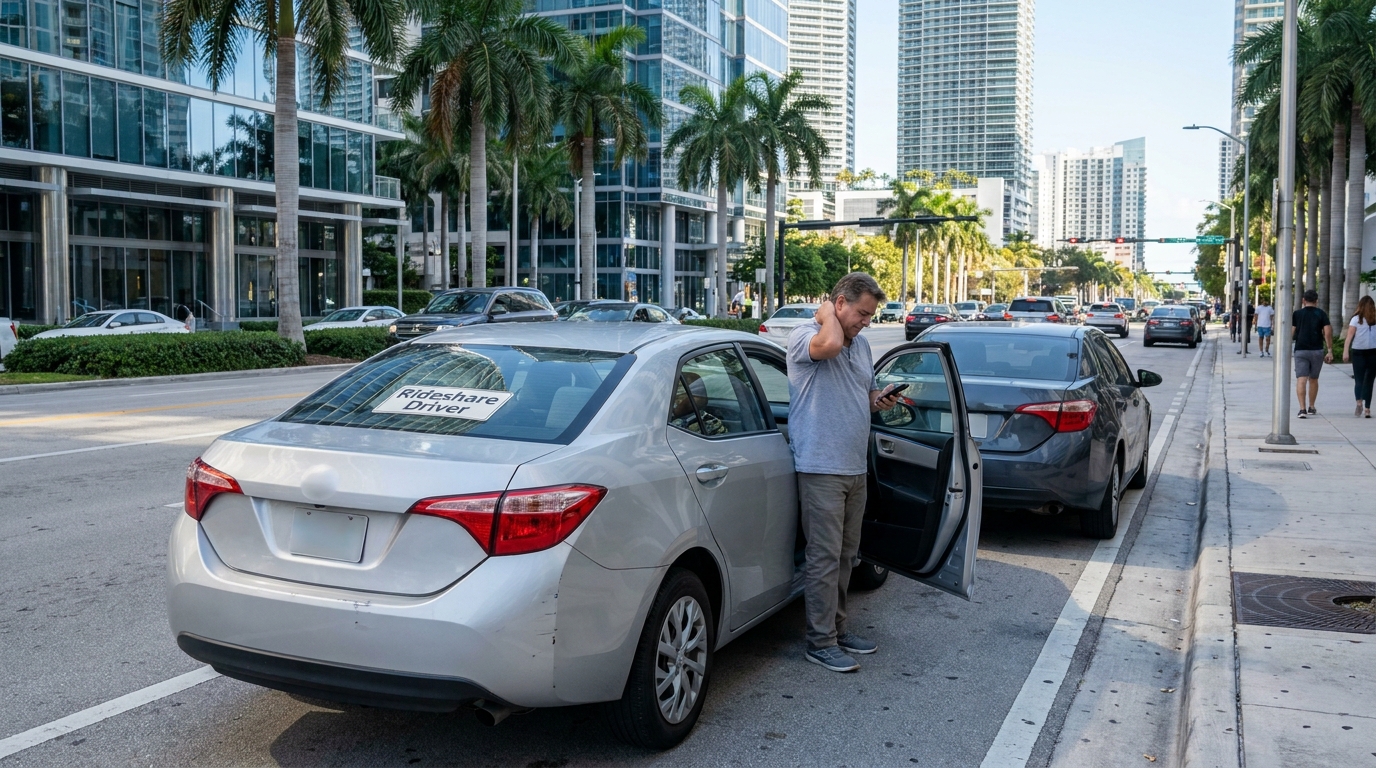
Miami’s rideshare drivers spend hours on the road every day navigating some of the most congested and dangerous corridors in South Florida. From I-95 and the Palmetto Expressway to the narrow streets of Brickell and Miami Beach, the risk of being involved in a serious accident is constant. When a collision happens, rideshare drivers face a set of legal and insurance challenges that other accident victims do not.
As an Uber or Lyft driver, you are classified as an independent contractor. That means no workers’ compensation, no employer-sponsored health insurance, and no guaranteed disability coverage. Your personal auto insurance may deny your claim because you were using your vehicle for commercial purposes. And the rideshare platform’s insurance coverage depends entirely on your status in the app at the moment of the crash.
None of this means you are without options. If another driver’s negligence caused the accident, you have the right to pursue full compensation for your injuries under Florida law. The key is understanding how the insurance system works and taking the right steps to protect your claim from the start.
If you were injured while driving for Uber or Lyft in Miami, call Mausner Group Injury Lawyers at 305-344-4878 for a free case review. We can identify every source of insurance coverage available to you and help you pursue the compensation you deserve.
What Insurance Covers Rideshare Drivers in Florida?
The insurance coverage available to an injured rideshare driver depends on the driver’s status in the Uber or Lyft app at the time of the accident. Florida Statute 627.748 requires rideshare companies to maintain tiered insurance coverage that increases as the driver moves through each phase of a trip.
Phase 1: App On, Waiting for a Ride Request
When you are logged into the Uber or Lyft app but have not yet accepted a ride request, the platform provides limited liability coverage: $50,000 per person for bodily injury, $100,000 per accident, and $25,000 for property damage. This coverage applies if the driver causes injury to a third party, but it does not directly cover the driver’s own injuries. During this phase, your personal auto insurance and PIP coverage are the primary sources of compensation for your own medical bills.
Phase 2: Ride Accepted, En Route to Pick Up
Once you accept a ride request and are driving to pick up the passenger, the platform’s coverage increases to $1 million in third-party liability. The platform also provides uninsured and underinsured motorist (UM/UIM) coverage during this phase. If another driver caused the accident and does not carry enough insurance to cover your injuries, the platform’s UM/UIM policy can fill the gap.
Phase 3: Passenger in the Vehicle
During an active trip with a passenger in the car, the same $1 million in liability coverage and UM/UIM coverage applies. This is the highest level of coverage available under the rideshare insurance system. If another driver causes an accident while you have a passenger, the platform’s UM/UIM coverage provides a critical safety net for your injuries.
Your Personal Auto Insurance
Most personal auto insurance policies contain exclusions for commercial activity. If your insurer determines that you were driving for Uber or Lyft at the time of the accident, they may deny your claim under this exclusion. Some insurers offer rideshare endorsements that bridge the gap between personal and commercial coverage. If you drive for a rideshare platform, it’s essential to confirm whether your personal policy includes this endorsement.
Florida PIP Coverage
Regardless of which phase you were in, Florida’s no-fault Personal Injury Protection (PIP) insurance provides up to $10,000 in initial medical coverage. PIP applies to all motor vehicle accidents in Florida, regardless of fault. However, you must seek medical treatment within 14 days of the accident to preserve your PIP benefits. Missing this deadline allows your PIP insurer to deny the claim entirely.
Why Rideshare Drivers Face Unique Legal Challenges
Rideshare drivers injured in accidents confront obstacles that passengers, pedestrians, and other motorists typically do not face.
No Workers’ Compensation
Uber and Lyft classify their drivers as independent contractors, not employees. Under this classification, drivers are excluded from the Florida workers’ compensation system. That means no automatic medical coverage through an employer, no temporary disability payments, and no vocational rehabilitation benefits. If you are injured and unable to drive, your income stops immediately with no guaranteed safety net.
Insurance Coverage Disputes
When a rideshare driver is injured, multiple insurance companies are involved, and each one looks for reasons to shift responsibility to someone else. Your personal auto insurer may deny the claim because you were engaged in commercial activity. The rideshare platform’s insurer may argue that the accident happened during a phase with limited coverage. The at-fault driver’s insurer may dispute liability altogether. Navigating these overlapping denials requires understanding exactly which policies apply and how to force coverage decisions.
Lost Income Is Immediate and Ongoing
Unlike salaried employees who may receive paid leave or short-term disability, rideshare drivers lose income the moment they cannot drive. If your vehicle is damaged and undrivable, your income loss continues even after your injuries improve. The financial pressure to return to driving before you have fully recovered is real, and insurance companies use that pressure to push low settlement offers early in the process.
Filing a Claim Against the At-Fault Driver
If another driver caused the accident that injured you, you have the right to file a personal injury claim against that driver, regardless of whether you were working for Uber or Lyft at the time. Your status as a rideshare driver does not eliminate or reduce your legal rights as an accident victim.
You can pursue compensation for medical expenses (emergency care, surgery, hospitalization, physical therapy, prescription medications, and projected future treatment), lost income (both the wages you have already lost and the future earning capacity affected by your injuries), pain and suffering (physical pain, emotional distress, anxiety, depression, and reduced quality of life) and property damage to your vehicle.
To recover pain and suffering damages in Florida, your injuries must meet the serious injury threshold under Florida Statute 627.737, which requires significant and permanent loss of a bodily function, permanent injury, significant and permanent scarring or disfigurement, or death.
How Comparative Negligence Affects Your Claim as a Driver
Florida’s modified comparative negligence system under HB 837 directly impacts rideshare driver injury claims. Your compensation is reduced by your percentage of fault in the accident. If you are found 20 percent at fault, your recovery is reduced by 20 percent. If you are found more than 50 percent at fault, you are barred from recovering any damages.
Insurance companies representing the at-fault driver will look for any reason to assign blame to you. They may argue you were distracted by the rideshare app, that you were fatigued from driving too many hours, or that you made a traffic error. Thorough documentation of the accident scene, witness statements, dashcam footage, and a police report are essential to countering these arguments.
The Two-Year Filing Deadline
Under Florida Statute 95.11, you have two years from the date of the accident to file a personal injury lawsuit. This deadline was reduced from four years to two years under HB 837 in March 2023.
For rideshare drivers, the shortened timeline creates additional urgency. You need time to complete medical treatment, determine the full extent of your lost income, obtain trip data and app records from the rideshare platform, and negotiate with multiple insurance companies. Starting the process early gives your attorney time to send preservation demands to Uber or Lyft, lock down the digital evidence that proves your app status at the time of the crash, and build a complete damages file before the deadline arrives.
Steps to Protect Your Claim After an Accident
The actions you take immediately after an accident directly affect the strength and value of your claim.
Call 911 and get medical attention. Even if your injuries seem minor at the scene, get evaluated by a medical professional within 14 days to preserve your PIP benefits. Many serious injuries, including concussions, soft tissue damage, and spinal injuries, do not produce obvious symptoms until days after the collision.
Document everything. Photograph the accident scene, all vehicles involved, your injuries, road conditions, and any relevant traffic signs or signals. Note whether your Uber or Lyft app was active at the time and what phase you were in. Screenshot your trip history and app status if possible.
Report the accident to the rideshare platform. Both Uber and Lyft have in-app accident reporting features. File the report promptly because the platform may begin its own investigation and the report creates a record of the incident tied to your driver account.
Do not accept early settlement offers. Insurance adjusters move quickly to close rideshare driver claims with low offers, especially when they know you are under financial pressure from lost driving income. An early settlement almost always undervalues your claim because it does not account for future medical treatment, long-term lost income, or the full impact of your injuries.
Contact an attorney before giving recorded statements. Any statement you give to an insurance company can be used to minimize or deny your claim. An attorney can handle communications with all insurers, identify every available coverage source, and protect your rights throughout the process.
How Mausner Group Injury Lawyers Helps Injured Rideshare Drivers
At Mausner Group Injury Lawyers, we have handled Uber and Lyft accident claims across Miami, Miami Beach, Brickell, Doral, Palmetto Bay, and throughout South Florida. Attorney Eric Mausner, a former Miami-Dade County prosecutor licensed in Florida, New York, New Jersey, Washington D.C., and Pennsylvania, understands the layered insurance issues that rideshare drivers face and takes immediate action to identify and secure every available source of compensation. Eric has been recognized by Super Lawyers, National Trial Lawyers Top 40 Under 40, Best Lawyers, and Avvo Top Attorney.
We know that injured rideshare drivers face financial pressure that other accident victims do not. When your income depends on being behind the wheel, and you cannot drive, every day matters. We move quickly to file PIP claims, send preservation demands to the rideshare platform, obtain trip data and app records, pursue claims against the at-fault driver, and negotiate aggressively with every insurer involved.
We work on a contingency fee basis, which means you pay nothing unless we recover compensation for you. If you were injured while driving for Uber or Lyft in Miami or anywhere in Florida, contact Mausner Group Injury Lawyers today for a free case review. Call 305-344-4878 to speak with an attorney about your rideshare driver injury claim.
Frequently Asked Questions About Rideshare Driver Injury Claims in Florida
Does Uber or Lyft Pay for My Injuries if I Am the Driver?
Uber and Lyft do not directly pay for your injuries. However, their insurance policies provide uninsured and underinsured motorist coverage during Phase 2 (en route to pick up) and Phase 3 (active trip). If the at-fault driver lacks sufficient coverage, you can file a claim against the platform’s UM/UIM policy. During Phase 1, coverage is more limited, and your personal auto insurance and PIP are the primary sources.
Can I File a Claim if the Accident Was Partly My Fault?
Yes. Under Florida’s modified comparative negligence system, you can recover damages as long as you are not more than 50 percent at fault. Your compensation is reduced by your percentage of fault. If you are found 30 percent responsible for the accident, you recover 70 percent of your total damages.
Will My Personal Auto Insurance Cover an Accident While Driving for Uber or Lyft?
It depends on your policy. Many personal auto insurance policies exclude coverage during commercial activity, including rideshare driving. Some insurers offer a rideshare endorsement that extends coverage to fill the gap. Check your policy or speak with your insurer to confirm whether you have this endorsement. If your personal insurer denies the claim, the rideshare platform’s commercial insurance may apply, depending on your app status.
What if I Was Injured Between Rides and the App Was Off?
If the Uber or Lyft app was not active at the time of the accident, the rideshare platform’s insurance does not apply. Your personal auto insurance and PIP coverage would be the primary sources of compensation. You would pursue a standard personal injury claim against the at-fault driver’s insurance, the same as any other car accident case.
How Long Does a Rideshare Driver Injury Claim Take to Resolve?
Timelines vary depending on the severity of your injuries, the number of insurance companies involved, and whether liability is disputed. Simple claims with clear liability may settle within several months. Complex cases involving multiple insurers, disputed coverage phases or serious injuries requiring extended treatment can take a year or longer. Filing a lawsuit before the two-year statute of limitations expires preserves your rights while negotiations continue.