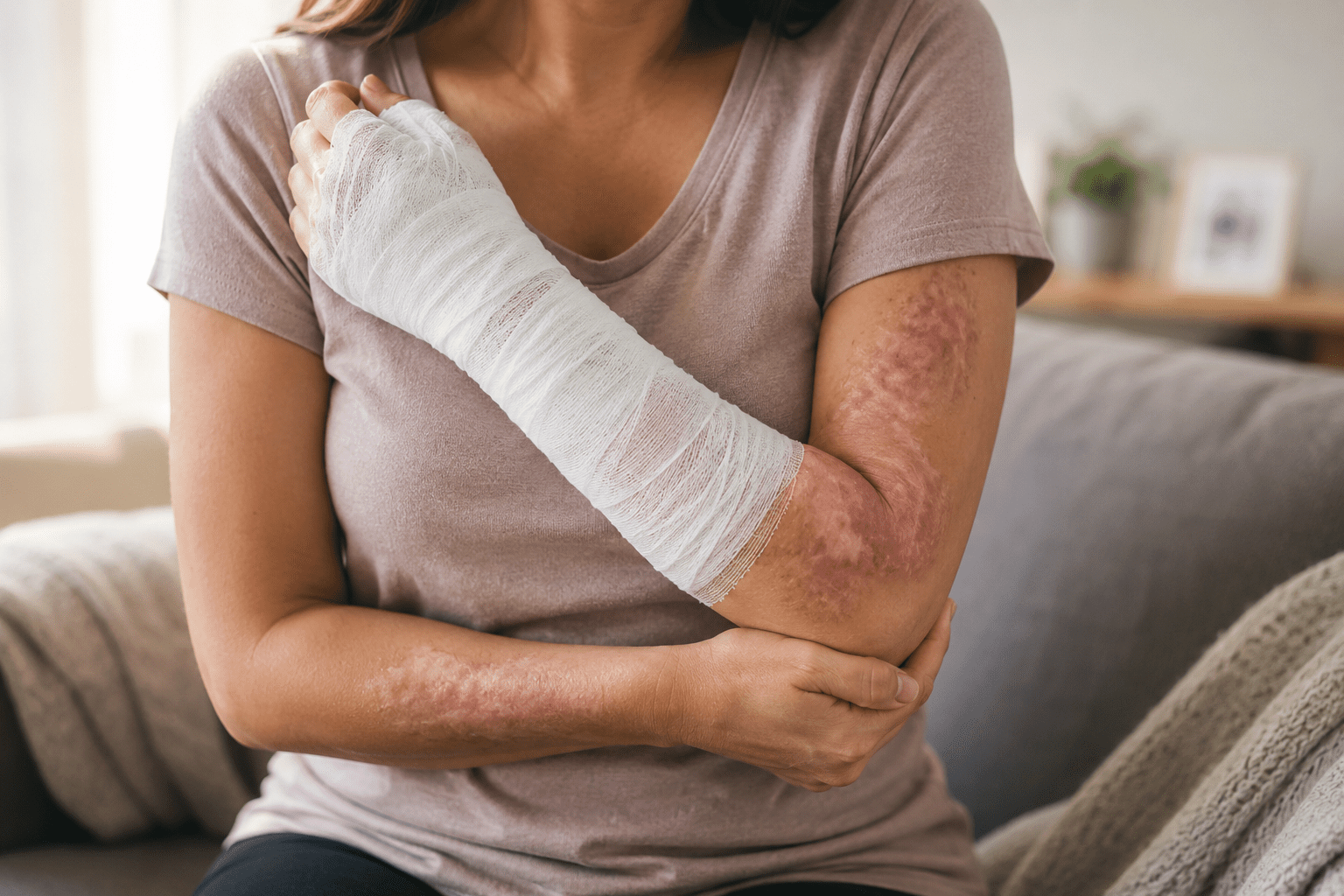
A burn injury changes everything in a matter of seconds. One moment you are driving to work, sitting in a restaurant or walking through a parking lot. The next, you are dealing with pain that does not stop, medical bills that keep coming and scars that may never fully heal.
Burns are among the most painful injuries the human body can experience. They require some of the most expensive medical treatment available. And when they leave permanent scars, the damage extends far beyond the physical. Scarring affects how people see themselves, how others perceive them and how confidently they move through the world. Florida law recognizes all of that. Pain, treatment costs, lost income, disfigurement and the emotional toll of living with visible scars are all compensable damages in a personal injury claim.
If you suffered a burn or scarring injury in a Florida accident, whether it was a car crash, a motorcycle wreck, a slip and fall or an incident at a restaurant or hotel, you may have a legal claim. Contact Mausner Group Injury Lawyers for a free case review.
How Burn Injuries Happen in Florida Accidents
Most people associate burns with house fires or industrial accidents. But burn injuries occur across a wide range of everyday situations, many of which involve someone else's negligence.
Car and Truck Accidents
Vehicle fires are more common than most people realize. The National Fire Protection Association reports that highway vehicle fires account for roughly 174,000 incidents per year in the United States. When a collision ruptures a fuel line, damages the battery system or causes electrical wiring to short-circuit, fire can engulf a vehicle in under 90 seconds. Occupants trapped by jammed doors, deployed airbags or seatbelt malfunctions face catastrophic thermal burns.
Even without a fire, car accidents produce burn injuries. Airbag deployment releases sodium azide gas at temperatures exceeding 300 degrees Fahrenheit, and the nylon fabric of the airbag itself can cause friction burns and chemical burns on the face, arms and chest. Contact with hot engine components after a collision, exposure to leaking radiator fluid and steam burns from ruptured coolant lines are all documented causes of burn injuries in Florida auto accident cases.
Truck accidents carry additional burn risks. Commercial vehicles carrying hazardous materials, fuel tankers and trucks with lithium-ion battery cargo can produce fires and chemical exposures that affect not only the truck driver, but occupants of surrounding vehicles and bystanders.
Motorcycle Accidents
Motorcycle riders face unique burn risks that car occupants do not. Road rash, which occurs when a rider slides across asphalt after being thrown from the bike, is technically a friction burn. At highway speeds, road rash can penetrate through the epidermis and dermis into the subcutaneous tissue, producing injuries that are clinically equivalent to third-degree thermal burns. These injuries require the same debridement, wound care and sometimes skin grafting that traditional burns demand.
Motorcycle exhaust pipes reach temperatures between 500 and 1,200 degrees Fahrenheit. Contact with an exhaust pipe during a crash, or even during a low-speed tip-over, can produce deep second-degree or third-degree burns to the leg or ankle in a fraction of a second. Fuel tank ruptures and electrical fires after a motorcycle collision create additional thermal burn risks.
Premises Liability Incidents
Property owners and businesses in Florida have a legal duty to maintain safe conditions for visitors. Burn injuries on someone else's property can arise from scalding water in hotel bathrooms where water heaters are set above safe temperatures, grease fires or hot plate injuries at restaurants, malfunctioning pool or spa heaters, exposed electrical wiring causing arc flash burns, chemical burns from improperly stored cleaning products and steam burns from defective commercial kitchen equipment.
Florida's premises liability statute requires property owners to correct known dangerous conditions or warn visitors about them. When a property owner knows that a condition on their property poses a burn risk and fails to address it, they can be held liable for the resulting injuries.
Workplace Accidents
Florida does not require all employers to carry workers' compensation insurance, and even when workers' comp applies, it often does not cover the full extent of a severe burn injury. When a third party, meaning someone other than the employer, caused or contributed to a workplace burn, the injured worker may have a separate personal injury claim. Common scenarios include burns from defective equipment manufactured by a third party, chemical burns from products supplied by an outside vendor, construction site fires caused by a subcontractor's negligence and restaurant burns caused by faulty kitchen equipment installed by a contractor.
Electrical Burns
Electrical burns deserve their own category because they behave differently from thermal burns. When electrical current passes through the body, it follows the path of least resistance through nerves, blood vessels and muscle tissue. The visible entry and exit wounds on the skin surface may appear relatively minor while the internal damage is catastrophic. Electrical burns can cause cardiac arrhythmia, compartment syndrome, kidney failure from muscle breakdown (rhabdomyolysis) and nerve damage that produces chronic pain. Electrical burn injuries in Florida often involve downed power lines after storms, defective electrical panels in older residential and commercial buildings, exposed wiring at construction sites and faulty electrical systems in rental properties.
Understanding Burn Severity and How It Affects Your Claim
The severity of a burn directly determines the medical treatment required, the recovery timeline and the value of the legal claim. Burns are classified by depth.
First-degree burns damage only the outer layer of skin. They cause redness, pain and minor swelling. Most heal within a week without medical treatment. While painful, first-degree burns rarely support significant personal injury claims on their own.
Second-degree burns penetrate the epidermis into the dermis. They produce blistering, intense pain and swelling. Superficial second-degree burns typically heal in two to three weeks with proper wound care. Deep second-degree burns may require skin grafting and can produce permanent scarring. The distinction between superficial and deep second-degree burns significantly affects both treatment and compensation.
Third-degree burns destroy the full thickness of the skin. The burned area may appear white, leathery, brown or charred. Because nerve endings in the dermis are destroyed, the burned area may not produce pain, but surrounding tissue is often excruciating. Third-degree burns do not heal on their own. They require surgical intervention including debridement and skin grafting.
Fourth-degree burns extend through the skin into the underlying fat, muscle, tendon or bone. They most commonly result from prolonged fire exposure, high-voltage electrical injuries and industrial accidents. Treatment often involves multiple surgeries, fasciotomies, possible amputation and years of reconstructive procedures.
The total body surface area (TBSA) affected by the burn is equally important. Burns covering more than 10% of TBSA in adults are considered major burn injuries and typically require treatment at a specialized burn center. The combination of burn depth and TBSA drives the medical costs, the recovery timeline and the damages calculation in a personal injury claim.
The Cost of Burn Injury Treatment in Florida
Burn injuries generate some of the highest medical bills in personal injury cases. The American Burn Association reports that the average hospital stay for a burn injury costs more than $24,000. For burns requiring skin grafts, which applies to roughly 29% of cases, add at least $17,000 per grafting procedure. Graft failure occurs in approximately 32% of cases, generating additional treatment costs between $37,000 and $110,000.
Beyond the initial hospitalization, burn survivors face ongoing costs that can persist for years or decades. Reconstructive surgeries to improve function and appearance of scarred tissue often require multiple procedures over several years. Physical and occupational therapy to restore range of motion in areas where scar tissue has contracted is often needed for months. Compression garments and silicone sheeting for scar management cost between $200 and $1,500 per garment and must be replaced regularly. Psychological treatment for PTSD, depression and anxiety affects up to 45% of burn survivors. Pain management including medications, nerve blocks and other interventions adds ongoing costs.
For severe burns, lifetime treatment costs can exceed $1 million. Every one of those costs is a recoverable damage when the burn was caused by someone else's negligence.
Scarring and Disfigurement: The Damage That Does Not End
A burn injury can heal, but the scar it leaves behind is permanent. Florida law treats scarring and disfigurement as a separate category of damages because the impact extends beyond physical pain into how a person lives their life.
Types of Burn Scars
Hypertrophic scars are raised, red and thick. They remain within the boundaries of the original wound, but can be painful, itchy and restrict movement. They are the most common type of scar following second-degree and third-degree burns.
Keloid scars grow beyond the boundaries of the original wound. They can continue to expand over time, cause pain and itching and are particularly difficult to treat. Keloid formation is more common in certain skin types and can be disfiguring when they occur on visible areas like the face, neck and hands.
Contracture scars form when scar tissue tightens during healing, pulling the surrounding skin and underlying tissue together. Contractures can restrict joint movement, limit range of motion and cause functional disability. Burn contractures across joints like the elbow, knee, wrist or fingers often require surgical release followed by physical therapy to restore mobility.
Skin graft scars result from the grafting procedure itself. Even successful grafts produce visible differences in skin color, texture and thickness at both the graft site and the donor site where skin was harvested.
How Florida Law Values Scarring and Disfigurement
In Florida personal injury cases, scarring and disfigurement damages fall under non-economic damages. The value depends on several factors: the visibility and location of the scarring (facial and hand scars carry higher value because they are constantly visible), the permanence of the scarring, the age of the victim (younger victims live longer with the disfigurement), the psychological impact documented through treatment records and the effect on the victim's career, relationships and daily activities.
There is no formula for calculating disfigurement damages in Florida. Juries consider the totality of how the scarring has changed the victim's life. An experienced personal injury attorney will document the impact through medical records, psychological evaluations, before-and-after photographs and testimony from the victim, their family and treating physicians.
Florida's Comparative Fault Rule and Burn Injury Claims
Under HB 837, Florida's modified comparative negligence rule bars recovery if you are found 51% or more at fault for the accident. In burn injury cases, defense attorneys will often argue that the victim contributed to the injury by failing to escape the vehicle quickly enough, not wearing protective gear (in motorcycle cases), ignoring posted warnings on a premises or misusing a product.
Comparative fault does not eliminate your claim. It reduces your recovery proportionally. If a jury finds you 20% at fault and the defendant 80% at fault on a $500,000 verdict, your recovery is reduced to $400,000. The critical question in most burn cases is not whether you bear some responsibility for the underlying accident, but whether the defendant's negligence caused the severity of the burn. A car accident may be partially your fault, but the vehicle manufacturer's failure to install a fire-suppression system or the property owner's failure to maintain a fire extinguisher may be what turned a survivable crash into a catastrophic burn injury.
Building a Burn Injury Case in Florida
Burn injury cases require specific evidence to connect the defendant's negligence to both the accident and the severity of the burn.
Medical documentation. Burn depth classification, total body surface area affected, treatment records, surgical notes from grafting and reconstructive procedures, physical therapy records and psychological treatment records. A burn surgeon or plastic surgeon who can testify about the injury severity, causation and long-term prognosis is critical.
Scar documentation. Professional medical photography documenting the scarring over time. Before-and-after photographs. Measurements of scar dimensions. Documentation of scar-related functional limitations.
Accident reconstruction. In vehicle fire cases, an expert who can establish what caused the fire, whether the fire was preventable and whether the vehicle's safety systems functioned as designed. In premises cases, evidence of the property condition, maintenance records, prior complaints and code violations.
Financial documentation. Medical bills, out-of-pocket costs for scar management products, lost wages, evidence of reduced earning capacity and a life care plan prepared by a medical economist projecting future treatment costs.
Impact testimony. Statements from the victim, family members, coworkers and friends describing how the burn and scarring have changed the victim's daily life, relationships, career and emotional wellbeing.
Time is critical. Florida's statute of limitations for personal injury claims is two years for claims arising after March 2023 under HB 837 (four years for claims arising before that date). Physical evidence from the accident scene degrades. Vehicle components can be scrapped. Property conditions can be repaired. The sooner you contact an attorney, the more evidence is available to build your case.
Damages Available in Florida Burn and Scarring Cases
Economic damages: Past and future medical expenses, lost wages and lost earning capacity, cost of future reconstructive surgeries, physical therapy, scar management, psychological treatment and home modification costs for severe burn disabilities.
Non-economic damages: Pain and suffering (burn injuries are among the most painful injuries possible), permanent scarring and disfigurement, emotional distress, loss of enjoyment of life, loss of consortium for the victim's spouse and the psychological impact of living with visible disfigurement.
Punitive damages: When the defendant's conduct was grossly negligent, reckless or intentional, Florida Statute 768.72 allows punitive damages. These are designed to punish the defendant and deter similar conduct. In burn cases, punitive damages may apply when a property owner knew about a fire hazard and ignored it, a manufacturer knew a product was prone to causing fires and failed to recall it, or a trucking company knowingly transported hazardous materials in violation of federal safety regulations.
Contact a Florida Burn Injury Attorney
Burn injuries are life-changing. The medical treatment is grueling and expensive. The scars are permanent. And the insurance companies on the other side of your claim know exactly how to minimize what they pay you. They will argue your burns are not as severe as you claim, that you contributed to the accident, that your scarring will improve over time. They rely on injured people accepting lowball offers because they need money now.
Mausner Group Injury Lawyers represents burn and scarring injury victims across Miami-Dade, Broward and Palm Beach counties. We investigate the cause of the accident, document the full extent of your injuries and fight for compensation that reflects what you have actually been through, not what an insurance adjuster says your case is worth.
Contact Mausner Group Injury Lawyers today for a free case review. There is no fee unless we recover compensation for you.
This page is for general informational purposes only and does not constitute legal advice. Florida law referenced includes HB 837 (modified comparative negligence), Florida Statute 768.72 (punitive damages) and Florida Statute 95.11 (statute of limitations). Laws change; consult a licensed Florida attorney for advice specific to your situation.
