

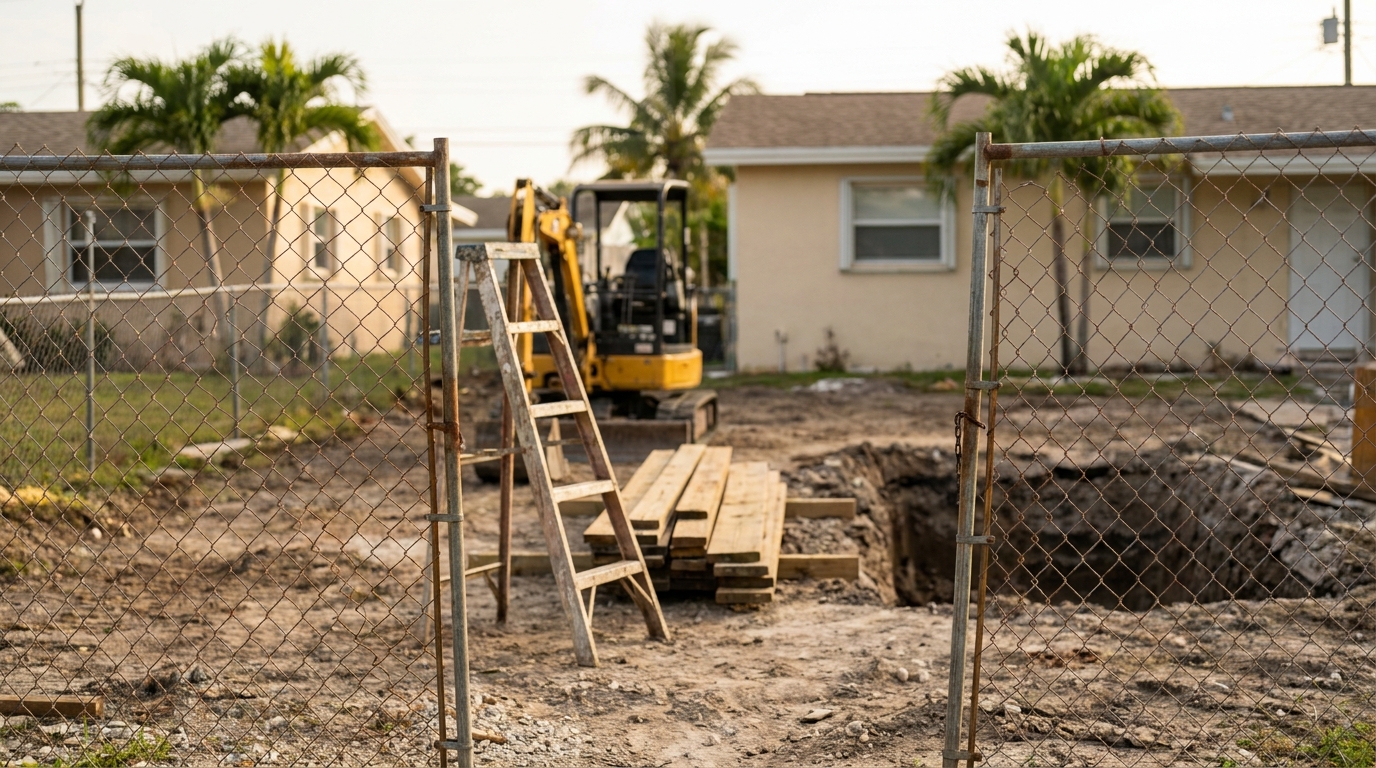
The general rule of Florida property law is blunt: Owners owe very little to trespassers. The attractive nuisance doctrine exists because children are not ordinary trespassers. A five-year-old who wanders toward a glittering pool does not weigh property boundaries against drowning risk, and the law refuses to let a property owner pretend otherwise.
Under the doctrine, an owner who keeps something on their land that is both dangerous and enticing to young children, a pool, a trampoline, construction equipment, an abandoned refrigerator, must take reasonable steps to protect the children it will predictably draw in. When the owner does nothing and a child is hurt or killed, the child's family has a claim, even though the child entered without permission.
In South Florida, where nearly every block has a pool, a canal, or a retention pond, this doctrine sits underneath most of the child injury cases we handle. This article explains how it works, what it covers, its one surprising limit involving water, and what a family's claim actually looks like. If your child was hurt on someone else's property, the abogados de responsabilidad de locales en Miami en Mausner Group Injury Lawyers ofrecemos consultas gratuitas y confidenciales en 305-344-4878.
What the Doctrine Requires
Florida follows the framework from Section 339 of the Restatement (Second) of Torts. A property owner is liable for injury to a trespassing child when, in essence, five things line up:
- The owner knows, or should know, children are likely to trespass where the hazard sits
- The condition poses an unreasonable risk of death or serious injury to children
- The child, because of age, does not appreciate the danger
- The burden of fixing or guarding the hazard is small compared to the risk it creates
- The owner fails to use reasonable care to eliminate the danger or protect the children
Notice what carries the analysis: foreseeability and proportion. A homeowner near a school who leaves a pool gate broken faces a very different legal picture than a rural owner whose land no child passes. And the fix the law demands is almost always cheap relative to a child's life: a working latch, a fence panel, a locked cabinet, a drained container.
There is no fixed age cutoff in Florida. Courts evaluate whether this particular child, given age, maturity, and experience, could appreciate the specific danger. The doctrine is applied most readily to young children and becomes harder to invoke as a child approaches the teenage years, though it is not foreclosed simply because a child was old enough to walk to the hazard alone.
What Counts as an Attractive Nuisance
The classic South Florida examples:
- Swimming pools without compliant barriers, the leading example by far, and the reason the Residential Swimming Pool Safety Act exists, as we covered in our Chapter 515 guide.
- Trampolines, treehouses, and play structures visible from the street
- Construction sites with accessible ladders, scaffolds, machinery, and open excavations
- Abandoned appliances, cars, and equipment a child can climb into or under
- Wells, cisterns, and drainage structures
The common thread is an artificial condition the owner created or maintains. The doctrine asks whether a reasonable adult would recognize that this thing, in this place, will pull children toward serious harm.
Florida law names one of these categories outright. Under Florida Statute 823.08, it is unlawful to discard an abandoned refrigerator, freezer, icebox, or clothes dryer without first removing the door, and the statute treats such an appliance as an attractive nuisance. When a statute declares a hazard an attractive nuisance, the argument about whether children are drawn to it is effectively over.
Pool Barriers: What Florida Actually Requires
Because pools dominate these cases, the specifics are worth stating. Florida's Residential Swimming Pool Safety Act, Chapter 515, applies to residential pools, spas, and hot tubs built on or after October 1, 2000, and requires at least one safety feature:
- A barrier meeting the requirements of Florida Statute 515.29, which must be at least four feet high on the outside, with no gaps, openings, indentations, or protrusions a young child could crawl under, squeeze through, or climb over
- An approved safety pool cover
- Exit alarms on all doors and windows providing direct access from the home to the pool
- Self-closing, self-latching devices on all doors providing direct access from the home to the pool, with the release mechanism placed no lower than 54 inches above the floor
Gates in a pool barrier must be self-closing and self-latching and must open outward, away from the pool.
Two points matter for families. First, the statute is a floor, not a ceiling. Compliance with Chapter 515 does not automatically defeat an attractive nuisance claim if the circumstances demanded more. Second, violation of these requirements is powerful evidence of negligence, and in these cases the failure is rarely exotic. It is a latch that was broken for months, a gate propped open for a landscaper, a screen panel nobody replaced.
The Water Exception, and Why It Is Not the End of the Case
Here is the wrinkle that surprises families: Florida courts have generally declined to treat open water itself, lakes, canals, and ponds, as an attractive nuisance. The reasoning is that water's danger is considered obvious, even to children, in a state defined by it.
But that is the beginning of the analysis, not the end, and it is why our artículo sobre estanque de retención matters as a companion to this one. Liability for water deaths still arises when something more than the water itself created the danger: a steep, unstable, or eroded bank that functions as a trap, a submerged hazard invisible from the surface, the absence of barriers required by code or by a water management district's design criteria, or a location placed feet from where children live and play without any protective measure. The doctrine also applies with full force to artificial features around water: pumps, drains, culverts, and equipment.
In practice, child drowning cases in South Florida are built on the specific negligent choices of the owner, developer, or association, whether the legal label is attractive nuisance or ordinary premises liability. The label matters less than the proof.
Who the Doctrine Reaches
The defendant is whoever controlled the hazard: homeowners and their insurers, landlords and property managers, homeowners associations responsible for common areas and community ponds, builders and contractors on construction sites, and businesses whose equipment or storage drew a child in. Where a child drowned at a home daycare or an unlicensed babysitting arrangement, the analysis shifts to the supervision duties we covered in our daycare and summer camp drowning guide.
Identifying every responsible party early matters more here than in most cases, because the insurance often sits in different places than the fault. A homeowner's policy, an association's general liability policy, a property manager's coverage, and a contractor's policy may all be in play for the same drowning, and each carrier has an incentive to point at the others.
One more point families should hear directly: Florida law does not blame young children for their own injuries. Florida courts treat children under six as incapable of comparative negligence, and older children are judged by what is reasonable for a child of their age, experience, and intelligence, not by adult standards. Defense arguments that the child should not have been there are answered by the doctrine itself, which exists precisely because children go where they should not.
That said, Florida's 2023 tort reform, which amended Florida Statute 768.81 to bar recovery by anyone more than 50 percent at fault for their own harm, has changed how defendants approach these cases. Where the injured child cannot be assigned fault, defense teams turn to the supervising adult and to other property owners, arguing the fault belongs anywhere but with their client. Anticipating that argument is part of building the case.
What These Claims Can Recover
When a child survives a near-drowning or a serious fall, the damages are almost always long-horizon: emergency and hospital care, rehabilitation, and in anoxic brain injury cases, the cost of lifetime attendant care, therapy, adaptive equipment, and lost future earning capacity. Those future costs are proven through life care planning and economic testimony, not through the medical bills already received, and they typically dwarf the treatment to date.
When a child does not survive, the claim proceeds under Florida's Wrongful Death Act, Florida Statutes 768.16 through 768.26. The personal representative of the child's estate brings the action, and Florida law permits both parents to recover for mental pain and suffering from the date of injury, along with medical and funeral expenses and lost support and services. These are among the most difficult cases in this practice area, and they are handled accordingly.
What a Family Should Do
These cases are proven with the property as it existed that day: the gap in the fence, the propped gate, the ladder left against the trampoline. Photograph everything immediately, before repairs erase the evidence. Identify who owned and who maintained the property, which are often different parties. Preserve any surveillance footage from neighboring homes, community entrances, or nearby businesses, which in gated South Florida communities frequently exists and is overwritten within days.
And get legal help early, because Florida's two-year deadline under Florida Statute 95.11(4)(a), explained in our statute of limitations guide, runs faster than grief allows anyone to move. Wrongful death claims carry their own two-year period running from the date of death. Our página de práctica de responsabilidad de los locales describes how we investigate these cases, and how we carry them so families do not have to.
Frequently Asked Questions About Attractive Nuisance in Florida
¿Qué es la doctrina de la atracción irresistible?
It is the rule that property owners must protect young children from dangerous conditions on their land that are likely to attract them, such as pools, trampolines, and construction equipment. It applies even when the child entered the property without permission, because the law does not treat young children as ordinary trespassers.
Is a swimming pool an attractive nuisance in Florida?
Yes, pools are the leading example. Florida reinforces the doctrine with the Residential Swimming Pool Safety Act, Chapter 515, which requires a four-foot barrier, an approved safety cover, exit alarms, or self-closing and self-latching doors on residential pools built on or after October 1, 2000. A pool accessible to a wandering child through a broken gate or missing fence is the classic attractive nuisance case.
What age does the attractive nuisance doctrine protect?
Florida sets no fixed cutoff. Courts ask whether this particular child, given age, maturity, and experience, could appreciate the specific danger involved. The doctrine applies most readily to young children and becomes harder to establish as a child approaches the teenage years, but there is no automatic age at which it stops applying.
Can I sue if my child was injured while trespassing?
Potentially, yes. When the five attractive nuisance factors are met, the owner's duty to protect trespassing children overrides the usual trespasser rules. Florida courts treat children under six as incapable of negligence, so a young child's presence on the property does not defeat the claim.
Does the doctrine apply to lakes, canals, and retention ponds?
Not to the water itself in most cases, because Florida courts treat open water as an obvious danger. Liability still arises from hazards beyond the water: trap-like banks, missing required barriers, submerged dangers, and negligent design or placement. Child drownings in ponds are pursued through those theories.
Who can be held liable under the attractive nuisance doctrine?
Whoever controlled the hazard: homeowners, landlords, property managers, homeowners associations, builders, and contractors. On construction sites and community property, more than one party often shares responsibility, along with their insurers.
What can a family recover if a child drowns on someone else's property?
Under Florida's Wrongful Death Act, Florida Statutes 768.16 through 768.26, the personal representative of the child's estate brings the claim. Both parents may recover for mental pain and suffering from the date of the injury, and the estate may recover medical and funeral expenses. When a child survives with a brain injury, the claim also covers lifetime care, therapy, adaptive equipment, and lost future earning capacity.
What should we do first after a child is injured on someone's property?
Photograph the property immediately, especially the access point and the hazard, before anything is repaired or removed. Preserve any nearby surveillance footage, then get medical documentation and legal advice quickly. Florida allows two years to file suit, but the physical evidence that proves these cases can vanish in days.
Hable con un abogado de responsabilidad de locales en Miami
A child cannot recognize danger. The law says the property owner must do it for them. If your child was hurt or worse on someone else's property, Mausner Group Injury Lawyers will find out what should have been fixed, and hold the right people accountable. Eric J. Mausner treats children's cases as a personal priority.
Llamar 305-344-4878 para una consulta gratuita y confidencial, disponible las 24 horas del día. No hay ningún costo a menos que recuperemos una compensación para su familia.
This article is for general informational purposes only and does not constitute legal advice. Authority referenced includes Restatement (Second) of Torts s. 339 as applied by Florida courts, Fla. Stat. Chapter 515, Fla. Stat. 823.08, Fla. Stat. 768.81, Fla. Stat. 768.16 through 768.26, and Fla. Stat. 95.11(4)(a). Laws change; consult a licensed Florida attorney for advice specific to your situation.