

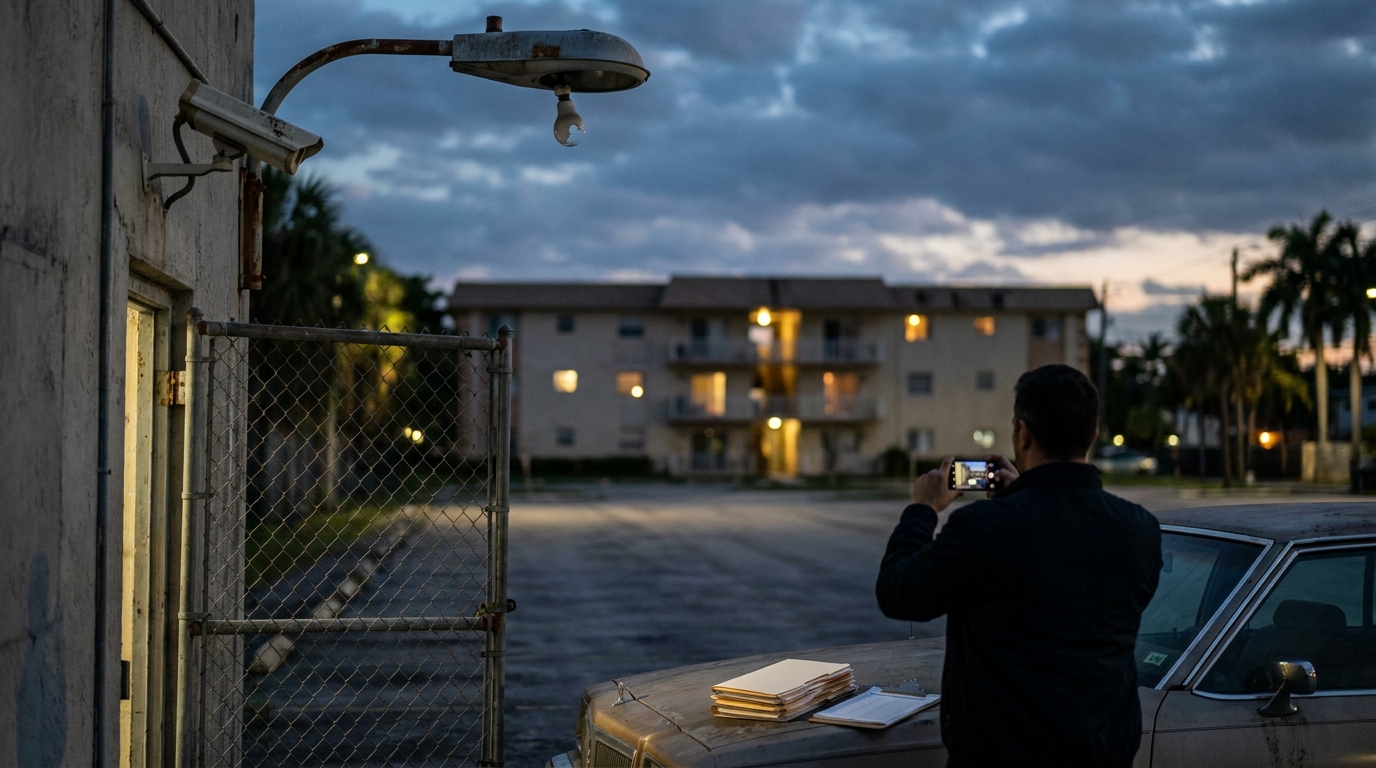
A property owner is not automatically responsible when a crime happens on their land. They become responsible when the crime was foreseeable and they failed to guard against it. That single word, foreseeability, decides almost every negligent security case in Florida, and it is proven with evidence most victims never think to look for: the crimes that happened before theirs.
Robberies in the same parking lot. Police calls to the same complex. Assaults at the gas station next door. Florida law lets a victim use that history to show the owner knew, or should have known, that customers and residents were at risk, and chose not to spend money on lighting, cameras, gates, or guards. In a county where crime concentrates block by block, that evidence usually exists. The question is whether anyone goes and gets it.
This article explains how foreseeability works, what evidence proves it, and how a 2023 law, HB 837, changed the playing field for apartment complex cases. If you or a loved one was attacked at a business, apartment complex, or parking lot anywhere in South Florida, the Miami negligent security lawyers at Mausner Group Injury Lawyers offer free, confidential consultations at 305-344-4878.
The Duty Behind Every Negligent Security Case
Florida businesses and landlords owe the people they invite onto their property reasonable protection from foreseeable harm, and that includes foreseeable criminal harm. A convenience store in a high-crime corridor, an apartment complex with a broken entry gate, a mall parking garage with burned-out lights: Each owes its customers and residents security measures that match the risk.
The owner's favorite defense is that crime is unpredictable, committed by a third party the owner does not control. Foreseeability is how the law answers that defense. If the risk was visible in advance, the owner's duty was, too.
How Florida Courts Measure Foreseeability
Florida courts look at foreseeability through two overlapping lenses, and a strong case usually satisfies both.
Prior Similar Incidents
The most direct proof is crime that already happened on the property or in its immediate area. Courts weigh how similar the prior crimes were, how close in place and time, and how frequently they occurred. A shooting at a complex that logged three armed robberies in the prior 18 months was not a bolt from the blue. It was the next data point in a pattern the owner was watching.
The prior crimes do not need to be identical. Florida courts have recognized that a property drawing repeated violent or property crime signals a general risk of criminal activity, and an owner cannot claim surprise merely because the latest crime was worse than the ones before it.
Totality of the Circumstances
Courts also look at everything an owner knew or should have known: the character of the neighborhood, the nature of the business, complaints from tenants and customers, warnings from employees, and industry knowledge about the risks a business type attracts. Late-night cash businesses, bars, gas stations, and large apartment complexes all carry documented risk profiles, and owners in those categories are expected to act like it.
The Evidence That Proves It
Foreseeability cases are built from records, and Miami-Dade generates detailed ones:
- Calls for service. Police dispatch records showing every 911 call to the address, often numbering in the hundreds for a troubled complex
- Crime grid data. Incident-level crime mapping for the surrounding blocks, which shows what the owner's neighborhood actually looked like, not what their leasing brochure claimed
- Prior incident reports. The property's own internal security logs, incident reports, and tenant complaints
- Prior lawsuits and claims. Earlier victims at the same property leave a paper trail
- Security company records. What the owner was told by its own consultants and contractors, and what recommendations it declined to pay for
That last category is often the case. An owner who received a security assessment recommending cameras and gate repairs, and shelved it, has written the closing argument against itself.
What HB 837 Changed for Apartment Cases
Florida's 2023 tort reform law created a special presumption for owners of multifamily residential properties. Under Section 768.0706, Florida Statutes, an apartment or condo owner earns a presumption against liability in negligent security cases if it substantially implements a defined checklist of measures, including security cameras at entry and exit points, adequate lighting in parking lots and common areas, deadbolts and locking devices on unit doors and windows, gated pool fences, and a crime prevention assessment of the property.
Two things matter about that presumption. First, it only protects owners who actually did the work, and in our experience most troubled properties have not. The statute's checklist becomes a measuring stick, and every item the owner skipped is now a numbered statutory standard they failed. Second, the presumption applies to multifamily housing, not to the stores, bars, gas stations, garages, and hotels where a large share of negligent security cases arise.
HB 837 also changed how fault can be divided in these cases, allowing juries to assign a share of responsibility to the criminal attacker. That change makes case selection and trial strategy matter more, not less, because the victim's lawyers must keep the focus where it belongs: on the owner who left the door open.
What These Cases Look Like in Miami
The fact patterns repeat across the county: a shooting in the parking lot of a complex with a gate that has been broken for months, an armed robbery outside a late-night business with no cameras and no lighting, an assault in a garage stairwell no guard ever patrols, violence outside a club that skimped on trained security – a subject we will take on directly in our upcoming piece on bar and nightclub liability. In each, the crime made the news and the foreseeability evidence sat in public records, waiting.
Victims of crime can recover for their medical care, trauma and counseling, lost income, and the lasting harm of the attack, and families can bring wrongful death claims when the worst happens. Florida's two-year deadline, covered in our statute of limitations guide, applies, and the calls-for-service records that prove these cases are easiest to obtain while the incident is recent. Our negligent security practice page explains how we investigate these properties.
Frequently Asked Questions About Negligent Security and Foreseeability
Can I sue a property owner if I was attacked on their property?
Potentially, yes. Florida law holds businesses and landlords responsible for violent crime on their property when the crime was foreseeable and reasonable security would have prevented it. Prior crime at and around the property is the core evidence of foreseeability.
What makes a crime foreseeable in Florida?
Courts look at prior similar incidents on or near the property and at the totality of the circumstances, including the neighborhood's crime levels, the type of business, and complaints or warnings the owner received. A documented pattern of crime at the location is the strongest proof.
How do lawyers prove the owner knew about prior crime?
Through police calls-for-service records for the address, incident-level crime grid data for the surrounding area, the property's own security logs and tenant complaints, and records from security consultants. These records are obtainable, and they frequently show hundreds of police responses to a single property.
What is the HB 837 presumption for apartment complexes?
Section 768.0706, Florida Statutes, gives multifamily property owners a presumption against liability if they substantially implement specific measures, including entry cameras, parking lot lighting, deadbolts, and a crime prevention assessment. Owners who skipped those measures get no presumption, and the statutory checklist becomes evidence of what they failed to do.
Does it matter that the criminal, not the property owner, attacked me?
No. Negligent security law exists precisely for crimes committed by third parties. The owner's liability rests on its own failure to provide reasonable protection against a foreseeable risk, though under current Florida law a jury may also assign a share of fault to the attacker.
How long do I have to bring a negligent security claim?
Two years in most cases under Florida's statute of limitations. Acting quickly matters beyond the deadline, because surveillance footage is overwritten fast and the records proving prior crime are easiest to assemble while the incident is fresh.
Speak With a Miami Negligent Security Lawyer
You were attacked at a place that promised, by opening its doors, to keep you reasonably safe. Founding partner Eric J. Mausner spent years as a prosecutor proving what criminals did. Now he proves what property owners failed to do.
Llamar 305-344-4878 for a free, confidential consultation, available 24/7. You pay nothing unless we win.
This article is for general informational purposes only and does not constitute legal advice. Florida law referenced includes Fla. Stat. 768.0706 and 95.11, as amended by HB 837 (2023), and Florida premises liability case law. Laws change; consult a licensed Florida attorney for advice specific to your situation.