
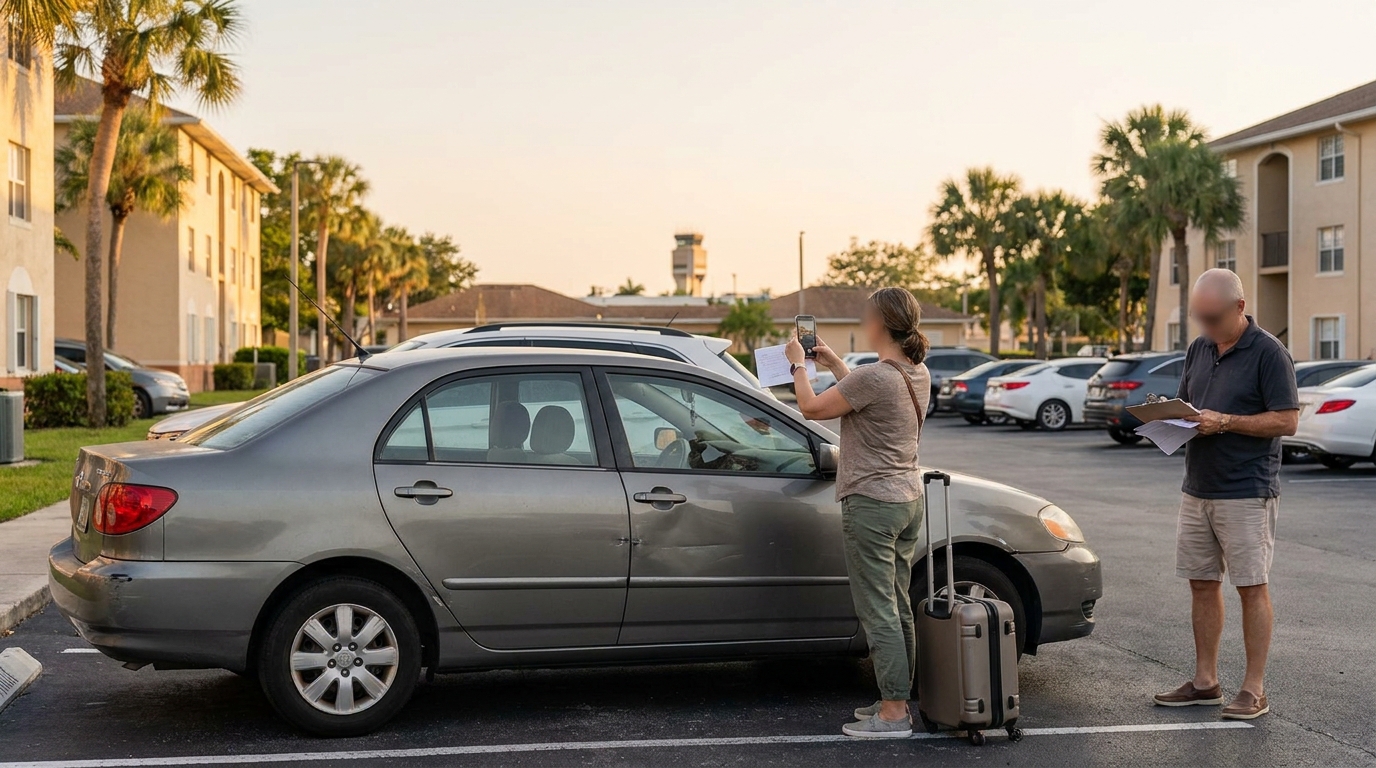
Miami is one of the busiest Turo markets in the country. Visitors land at MIA and skip the rental counter for someone's personal Lamborghini, Tesla, or Corolla, and thousands of locals rent their own cars out as a side business. Then, a crash happens, and everyone involved discovers that a peer-to-peer rental sits in an insurance gray zone that ordinary rentals never touch.
The car belongs to a private owner. The driver picked an insurance tier from an app, or thinks they did. The driver's personal auto policy probably excludes car-sharing. A federal law written for Hertz and Enterprise may shield the owner from the liability Florida law would normally put on them. And a Florida statute most people have never heard of quietly sets a floor underneath the whole arrangement. Sorting out who pays, and in what order, is the whole case.
This article explains how Turo's protection plans work, what Florida Statute 627.7483 requires, what the Graves Amendment means for these claims, and what injured drivers, passengers, and third parties should do after a peer-to-peer rental crash. If you were hurt in a Turo crash anywhere in South Florida, Mausner Group Injury Lawyers offers free consultations at 305-344-4878.
How Turo Is Different From a Rental Company
Turo does not own cars. It is a marketplace where private owners, called hosts, rent their personal vehicles to guests. That structure changes the legal picture in two directions at once.
Under Florida's dangerous instrumentality doctrine, a long-standing rule of Florida common law, the owner of a car is normally responsible when someone they lend it to hurts people with it. That rule would make every Turo host liable for their guests' crashes. But a federal law, the Graves Amendment, 49 U.S.C. 30106, blocks vicarious liability for owners engaged in the business of renting vehicles, and courts have applied it to peer-to-peer platforms. Whether a particular host qualifies as being in the rental business, or was negligent in their own right, is one of the genuinely contested questions in these cases.
The practical consequence: Recovery in a Turo case usually flows through the insurance stack rather than through suing the owner personally, and the stack depends on both Florida law and the choices made in the app before the trip.
Florida Statute 627.7483: The Rule Most People Miss
Florida did not leave peer-to-peer rentals to the platforms' terms of service. Florida Statute 627.7483, the state's peer-to-peer car sharing insurance law, sets requirements that apply to every car-sharing period in the state. Three provisions matter most to an injured person.
The platform must ensure coverage exists. During each car-sharing period, the program must ensure the shared vehicle owner and the shared vehicle driver are insured under a motor vehicle policy providing property damage liability under Florida Statute 324.022, bodily injury liability at the limits in Florida Statute 324.021(7), personal injury protection benefits meeting Florida Statute 627.736, and uninsured and underinsured motorist coverage under Florida Statute 627.727. That coverage can be satisfied by the owner, the driver, the program, or a combination of them.
That coverage is primary. The statute makes the policy satisfying those requirements primary during the car-sharing period. That ordering matters enormously when multiple carriers are arguing about who responds first.
The program assumes the owner's liability. During the car-sharing period, the peer-to-peer car-sharing program assumes the liability of the shared vehicle owner for bodily injury and property damage to third parties, and for uninsured motorist and PIP losses, in the amount stated in the program agreement and not less than the statutory minimums. That assumption does not apply where the owner made an intentional or fraudulent material misrepresentation or omission to the program before the car-sharing period.
Here is the practical translation, and it corrects a widespread assumption. A guest who declined optional protection in the app is not automatically uninsured. Florida law requires that statutory minimum coverage exist during the car-sharing period. What that guest has declined is coverage above the floor, and the floor is low: Florida's minimums are $10,000 in property damage liability and $10,000 per person and $20,000 per crash in bodily injury liability, plus $10,000 in PIP.
Against a serious injury, $10,000 in bodily injury liability is close to meaningless. That gap between the statutory floor and the actual cost of a catastrophic injury is the central problem in most Turo cases, and it is why identifying every other available layer is not optional.
The Turo Insurance Stack
Coverage in a Turo crash comes from several layers, and which ones apply depends on who you are and what was selected:
- The guest's protection plan. Turo offers guests tiered plans, and the liability coverage supplied through Turo's commercial insurer is what responds when the guest injures someone. Higher tiers carry meaningfully higher liability limits than the statutory floor.
- The host's protection plan. Hosts choose their own plan tiers, which mainly govern damage to the car, but interact with liability coverage.
- Personal auto policies, with a catch. Most personal policies contain car-sharing exclusions in both directions: The guest's insurer says the rental was commercial use, and the host's insurer says the car was being rented for profit. Assumptions here are dangerous, and reading the actual policies is step one.
- PIP. Florida's no-fault benefits, which we covered in our PIP guide, still apply to occupants, subject to the 14-day treatment rule under Florida Statute 627.736.
- Uninsured and underinsured motorist coverage. Required to be available during the car-sharing period under 627.7483, and frequently the most important layer when the at-fault driver's limits are exhausted by a serious injury.
- The at-fault driver's coverage, when the Turo guest was the victim rather than the cause. If another motorist caused the crash, the claim proceeds like any Miami crash, and uninsured motorist coverage questions follow the usual rules.
Which layer pays first, and how much sits in each, is exactly the kind of dispute insurers drag out. In serious injury cases, pinning down every layer early is most of the battle.
Common Miami Turo Crash Scenarios
The claims we see follow the market. Tourists unfamiliar with Miami traffic crash rented performance cars, and the speed of the car makes the injuries worse. Guests hand the car to friends who are not approved drivers, which can void protection plans and turn coverage into a fight. Hosts list cars with bald tires or overdue brake work, which opens the door to a negligence claim against the host directly, Graves Amendment or not, because that law does not protect an owner's own carelessness, including negligent maintenance or renting to an obviously unfit driver.
There is a second reason host conduct matters. Under Florida Statute 627.7483, the program's assumption of the owner's liability falls away when the owner made an intentional or fraudulent material misrepresentation or omission to the program before the trip. A host who misrepresented the vehicle's condition, insurance status, or eligibility may find themselves personally exposed in a way the statute would otherwise have prevented.
Third parties, the Miami drivers, cyclists, and pedestrians hit by a Turo guest, have claims against the guest and the protection plan's liability coverage, and their cases turn on locking down what plan was in force before anyone's story changes.
What to Do After a Turo Crash
The checklist looks like an ordinary crash plus the app:
- Get medical care immediately, protecting both your health and your PIP benefits
- Screenshot everything in the app: the trip, the protection plan selected, the host listing, and all messages
- Photograph the vehicles, scene, and any maintenance issues with the car itself
- Note the exact trip start and end times, since Florida's coverage rules turn on the car-sharing period
- Report the crash to Turo through the app so the claim record exists
- Do not give a recorded statement to any insurer before understanding which policies apply
- Do not accept any insurer's first coverage position, because in these cases the first position is often wrong
Florida's two-year lawsuit deadline under Florida Statute 95.11(4)(a), covered in our statute of limitations guide, applies. Listings and app records are far more perishable, and hosts can edit or delete listings that showed a car's condition.
What These Claims Are Worth
The honest answer is that value in a Turo case is often capped by coverage rather than by injury. A catastrophic injury caused by a guest on a minimum-limits arrangement can exceed every available policy combined, which makes two things decisive.
First, finding every layer. Guest plan, host plan, program-assumed liability, any personal policy without an applicable exclusion, PIP, and the injured person's own uninsured motorist coverage. Cases are frequently resolved by a layer nobody looked for in the first thirty days.
Second, comparative fault. Under Florida Statute 768.81(6), amended effective March 24, 2023, an injured person found more than 50 percent at fault recovers nothing, and recovery at 50 percent or less is reduced by that percentage. Insurers in platform cases lean hard on this, particularly against tourists unfamiliar with local roads. Scene evidence and app data are what answer it.
A Rising Case Type With Few Experienced Hands
Peer-to-peer rental claims are new enough that many insurers, and many lawyers, handle them like ordinary crashes and leave coverage on the table. They sit closest to the rideshare cases we handle every week, with the same app-data fights and layered-coverage structure. Our Uber and Lyft accident practice page explains how we approach platform cases, and the same discipline applies to Turo: Preserve the data, identify every layer, and make the stack pay what the injury actually costs.
Frequently Asked Questions About Turo Accidents
Who pays if I crash a Turo rental in Florida?
Coverage comes first from whatever policy satisfies Florida Statute 627.7483 during the car-sharing period, which the statute makes primary. In practice that is usually the liability coverage supplied through Turo's commercial insurer, at limits determined by the protection plan selected. Injured third parties claim against that same coverage, and guests who declined optional protection are generally left at Florida's statutory minimum limits rather than with no coverage at all.
Does Florida have a law specifically about Turo?
Yes. Florida Statute 627.7483 governs peer-to-peer car sharing. It requires the program to ensure that property damage liability, bodily injury liability, PIP, and uninsured motorist coverage are in place during each car-sharing period, makes that coverage primary, and requires the program to assume the vehicle owner's liability to third parties, subject to an exception where the owner made a fraudulent or intentional material misrepresentation to the program.
Can I sue the owner of the Turo car?
Usually not just for owning it. The federal Graves Amendment generally blocks vicarious liability claims against owners in the rental business, and courts have applied it to peer-to-peer platforms. Owners remain liable for their own negligence, such as renting out a poorly maintained car or handing keys to an obviously unfit driver, and an owner who misrepresented the vehicle to the platform can lose the statutory protection that would otherwise shift liability to the program.
Does my own car insurance cover me when I drive a Turo?
Often not. Most personal auto policies exclude peer-to-peer rental use, treating it as commercial activity. Some policies and credit card benefits differ, so the actual policy language controls, and it should be reviewed before assuming coverage exists in either direction.
Does PIP apply to Turo crashes in Florida?
Yes. Florida's no-fault PIP benefits apply to vehicle occupants in Turo crashes the same way they do in other crashes, including the 14-day treatment deadline under Florida Statute 627.736, and Florida Statute 627.7483 requires PIP to be in place during the car-sharing period. PIP is a floor, not the whole claim, and serious injuries proceed against liability coverage beyond it.
What if a Turo driver hit me?
You have a claim against that driver, backed by the liability coverage in force during the car-sharing period, plus the liability the car-sharing program assumes under Florida Statute 627.7483. Identifying the trip status and plan quickly matters, which is why these cases benefit from early legal help and preservation demands to the platform.
What if the Turo coverage is not enough for my injuries?
This is common in serious cases, because Florida's minimum bodily injury limits are $10,000 per person and $20,000 per crash. The next steps are identifying any higher-tier protection plan in force, any personal policy without an applicable exclusion, any independent negligence by the host, and your own uninsured or underinsured motorist coverage, which often becomes the largest single source of recovery.
How long do I have to file a claim after a Turo accident?
Two years under Florida Statute 95.11(4)(a) for negligence claims. App records, listings, and vehicle condition evidence disappear much sooner, so the practical timeline for building the case is measured in weeks.
Talk to a Miami Car Accident Lawyer Who Knows Platform Cases
A Turo crash drops you into a coverage maze built by a platform, an insurer, and two private parties who all prefer someone else pays. Mausner Group Injury Lawyers untangles platform accident cases across Miami-Dade and South Florida.
Call 305-344-4878 for a free consultation, available 24/7. You pay nothing unless we win.
This article is for general informational purposes only and does not constitute legal advice. Law referenced includes the Graves Amendment, 49 U.S.C. 30106, and Fla. Stat. 627.7483, 627.736, 627.727, 324.021, 324.022, 768.81, and 95.11(4)(a). Insurance minimums and platform policies change; consult a licensed Florida attorney for advice specific to your situation.