Florida law reduces your car accident compensation by your percentage of fault, and eliminates it entirely if that percentage goes over 50. A driver found 30 percent at fault recovers 70 percent of their damages. A driver found 51 percent at fault recovers nothing. That cliff, created when HB 837 rewrote Florida Statute 768.81 in 2023, is now the single most important number in most Florida injury claims.
Before 2023, Florida used pure comparative negligence: Even a driver 80 percent at fault could recover 20 percent of their damages. The switch to a modified system with a 51 percent bar changed the strategy of every contested claim in the state, because insurers no longer need to prove you caused the crash. They only need to push your share past the halfway mark, and your claim is worth zero.
This article explains how the rule works, the math that decides real cases, and how fault percentages actually get assigned and fought. If you were hurt in a crash anywhere in South Florida and fault is being disputed, the Miami car accident lawyers at Mausner Group Injury Lawyers offer free consultations at 305-344-4878.
The Rule in One Table
Under Section 768.81, Florida Statutes, a jury assigns each party a percentage of fault, and the math follows mechanically. On $100,000 in damages:
- 0 percent at fault: recover the full $100,000
- 20 percent at fault: recover $80,000
- 49 percent at fault: recover $51,000
- 50 percent at fault: recover $50,000, because the bar applies only to fault greater than 50 percent
- 51 percent at fault: recover nothing
The 50/51 line is the whole fight. One percentage point separates a $50,000 recovery from zero, and in a disputed crash, that point is argued with everything both sides have. Medical malpractice claims are exempt from the bar and still follow the old pure comparative rule, but for car, truck, motorcycle, and premises cases, the cliff is the law.
How Fault Percentages Actually Get Assigned
No formula produces these numbers. Fault percentages come from negotiation and, if the case tries, from a jury weighing the evidence. That makes the inputs everything:
- The crash report, though a police officer's fault opinion is a starting point, not a verdict
- Physical evidence: vehicle damage patterns, skid marks, debris fields, and event data recorder downloads
- Video, from intersection cameras, dashcams, and nearby businesses, which settles more fault fights than any other evidence
- Witness accounts, whose value decays by the week
- Reconstruction experts in serious cases
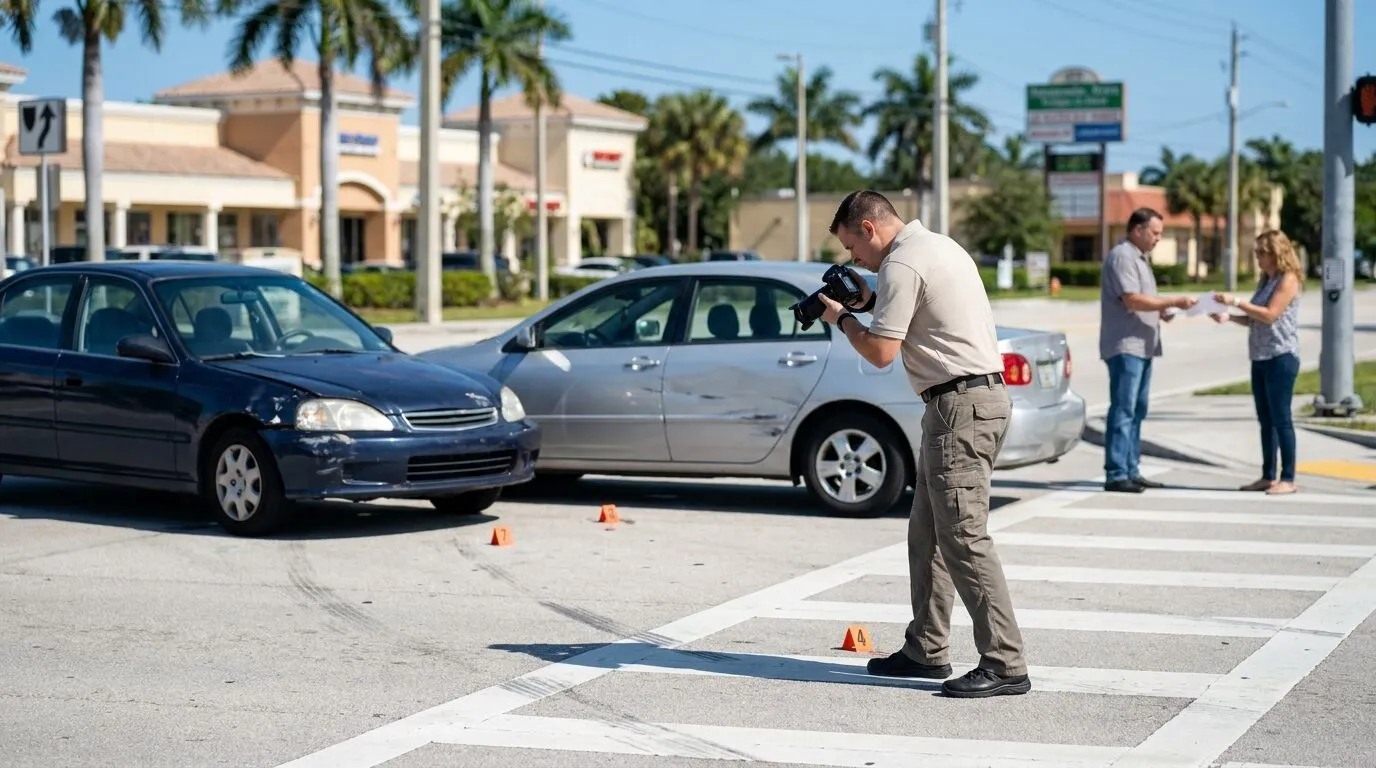
Common Miami scenarios show how the percentages move. A left-turn crash starts heavily against the turning driver, but speeding by the oncoming car shifts points back. A rear-end crash presumes the trailing driver's fault, but a sudden lane change in front of them reopens it. An intersection crash with both drivers claiming the green becomes a pure evidence race. We covered who is at fault in common crash types in our earlier guide; this article is about what those percentages do to the money.
How Insurers Use the 51% Bar
The bar handed insurers a tool, and adjusters use it in predictable ways. They take recorded statements hunting for admissions: "I looked down for a second" becomes 20 points of fault. They seize on apologies at the scene. They argue speed, following distance, or a missed defensive maneuver to stack percentage points, not because any single argument wins, but because the pile only needs to reach 51.
Two implications follow. First, never accept an insurer's fault assessment as a fact. It is an opening position from a party with a financial stake in the number. Second, the evidence that pushes your percentage down is time-sensitive, which is why the days after a crash matter more under the new rule than they ever did under the old one.
Fault fights also interact with the rest of the claim. Your own PIP benefits, explained in our Florida PIP guide, pay regardless of fault. The two-year filing deadline from our statute of limitations guide runs no matter how long the fault negotiation drags. And comparative fault applies to every defendant and every case type, which is why it appears in our premises and rider articles too.
What This Means for Your Case
If you were partly at fault, or an insurer says you were, three things are true. You can still recover if your share is 50 percent or less, and the recovery can be substantial. The percentage is negotiable and evidence-driven, not fixed by the adjuster's letter. And the difference between a lawyer who contests fault properly and an unrepresented claimant absorbing the insurer's number is frequently the difference between a real recovery and none.
Our Miami car accident practice page explains how we build fault cases, from scene evidence through reconstruction.
Frequently Asked Questions About Florida Comparative Negligence
Can I still recover damages if the accident was partly my fault?
Yes, as long as your share of fault is 50 percent or less. Your recovery is reduced by your percentage: a driver 25 percent at fault with $100,000 in damages recovers $75,000. Above 50 percent, Florida's modified comparative negligence rule bars recovery entirely.
What is the 51% bar rule in Florida?
Under Florida Statute 768.81 as amended by HB 837 in 2023, a plaintiff found more than 50 percent at fault for their own harm recovers nothing. At exactly 50 percent, recovery is still allowed, reduced by half, which makes the single point between 50 and 51 the most contested number in Florida injury law.
Who decides what percentage of fault I carry?
Ultimately a jury, if the case goes to trial. Before that, the percentage is negotiated between your lawyer and the insurers based on the crash report, physical evidence, video, witnesses, and expert reconstruction. An adjuster's fault assessment is an opening negotiating position, not a ruling.
Does the 51% bar apply to all Florida injury cases?
It applies to most negligence cases, including car, truck, motorcycle, pedestrian, and premises liability claims. Medical malpractice claims are the notable exception and remain under pure comparative negligence, where recovery is reduced by fault, but never barred.
The insurance company says I was mostly at fault. Is my case over?
No. Insurers have every incentive to push your percentage past 50, and their assessment is not binding. Fault percentages move with evidence, and crash cases are regularly won after an insurer's initial mostly-at-fault position collapses under video, physical evidence, or reconstruction.
Did HB 837 change how much time I have to file?
Yes, separately from the fault rule. The same 2023 law cut the statute of limitations for negligence claims from four years to two. The fault fight and the filing deadline run on independent clocks, and waiting on one burns the other.
Fault Is Being Disputed? Do Not Absorb the Insurer's Number
Under the 51% bar, every percentage point is money, and the insurer is counting points from your first phone call. Mausner Group Injury Lawyers contests fault with evidence across Miami-Dade and South Florida.
Call 305-344-4878 for a free consultation, available 24/7. You pay nothing unless we win.
This article is for general informational purposes only and does not constitute legal advice. Florida law referenced includes Fla. Stat. 768.81 and 95.11, as amended by HB 837 (2023). Laws change; consult a licensed Florida attorney for advice specific to your situation.
