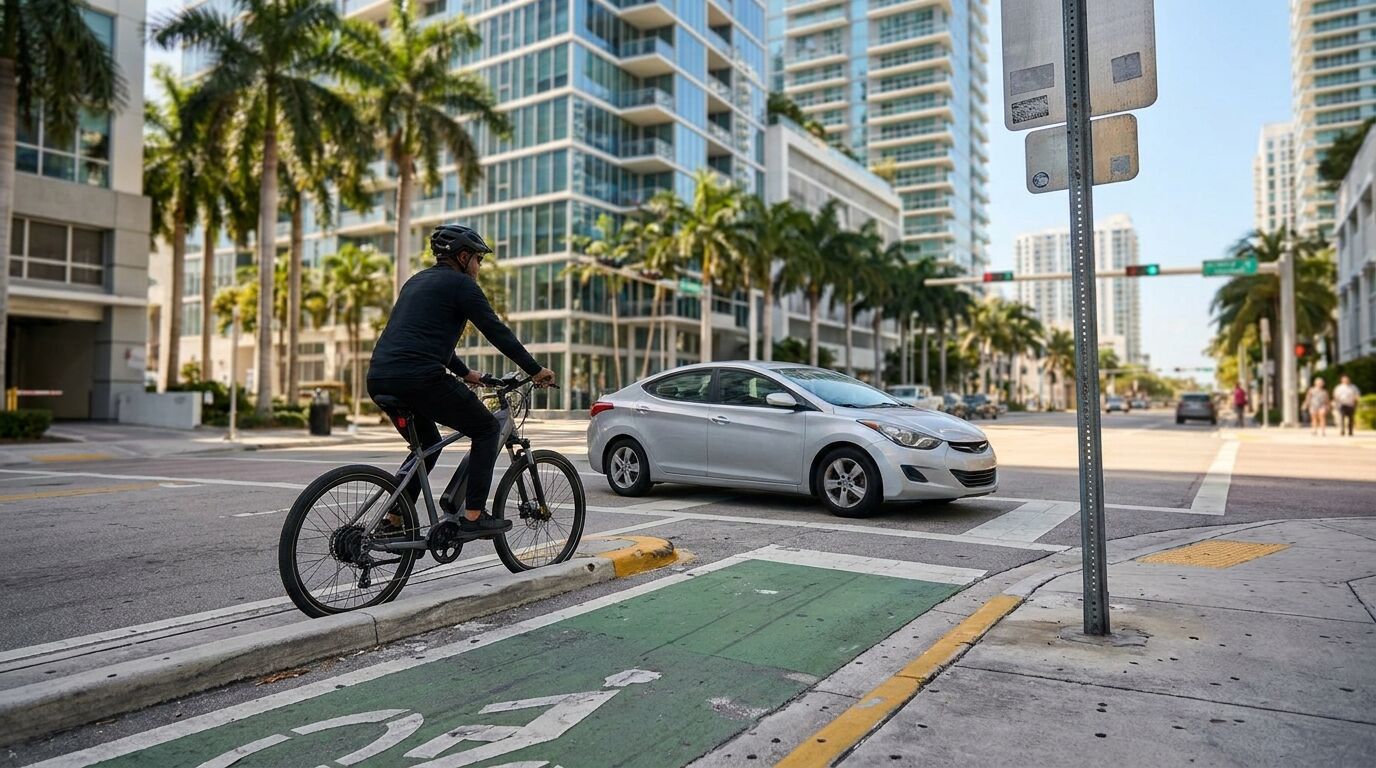
Florida treats e-bikes like regular bicycles. Riders need no license, no registration, and no insurance, helmets are only required under age 16, and an electric motor under 750 watts can legally push a rider to 28 mph. The state then leaves the hard questions to each city, which is why the rules change every time a rider crosses a municipal line in Miami-Dade.
The injuries are not waiting for the law to catch up. As the Miami Herald reported in August 2026, Nicklaus Children's Hospital logged 6 severe e-bike and e-scooter injuries in its trauma registry in 2021 and 37 in 2025, an increase of more than 500 percent, with 46 more in just the first five months of this year. Memorial Healthcare System in South Broward saw micromobility injuries jump 178 percent from 2024 to 2025. Trauma teams describe head injuries, facial injuries, broken bones, and internal organ damage that look less like bicycle falls and more like motorcycle crashes.
This guide covers what Florida law actually says about e-bikes, the city-by-city rules across Miami-Dade, and the question that matters most after a crash: who pays. If you or your child has been hurt on or by an e-bike anywhere in South Florida, Mausner Group Injury Lawyers offers free consultations at 305-344-4878.
What Florida Law Says About E-Bikes
Under Florida law, an e-bike is a bicycle or tricycle with fully operable pedals, a seat, and an electric motor under 750 watts. Depending on class, e-bikes reach assisted speeds of 20 to 28 mph. Legally, they are not motor vehicles, which produces a short list of statewide rules:
- No driver's license, registration, or insurance is required to ride
- Riders and passengers under 16 must wear helmets
- Only one person may ride an e-bike designed for a single rider
- Lights are required for night riding, front and rear
- E-bikes follow the same road rules as pedal bicycles
Everything else, including where e-bikes can be ridden and how old a rider must be, is left to local governments. A Miami Beach police officer put it plainly in the Herald's reporting: What is totally prohibited in one city may be perfectly legal in the next, and then comes the confusion.
Why the Injuries Are So Much Worse
Speed is the whole story. Commuters travel 4 to 10 mph faster on an e-bike than a pedal bike, and a heavier frame at higher speed means every crash carries more force. The National Highway Traffic Safety Administration adds a second problem: Drivers misjudge how fast an approaching e-bike is moving, which is exactly how left-turn and pull-out collisions happen.
Two patterns make South Florida's numbers worse. First, kids are riding devices built for adults, often two to a bike. Nicklaus trauma staff describe two children arriving together with injuries that look like a collision between them, when in fact both were on the same scooter or e-bike. Second, these crashes are undercounted. NHTSA acknowledges e-bike crashes are often recorded as ordinary bicycle crashes and e-scooter crashes as pedestrian incidents, so the true injury numbers are higher than any official count.
E-Bike Rules by City in Miami-Dade
There is no county-wide rule book. Here is where the major municipalities stand as of late 2026:
Sunny Isles Beach
Riders must be 16 or older with a government-issued ID, and e-bikes are banned on city sidewalks. Fines run $250 for a first offense and $500 after that, with citations that began August 16, 2026.
Aventura
E-bikes are allowed on streets, bike lanes, sidewalks, and shared pathways, but sidewalk riding is capped at 10 mph with motors disengaged around pedestrians. E-bikes are prohibited on Biscayne Boulevard, with a $100 fine.
Pinecrest
Shared pathways, including Kendall Linear Park, carry a 15 mph limit, sidewalks 10 mph. Riders under 16 on a class two e-bike must complete a free safety training first. Fines are $250, then $500.
Doral
Riders 15 and older may operate with a valid ID or learner's permit. E-bikes are allowed on streets, sidewalks, and bike paths, with a 16 mph sidewalk speed limit.
Bal Harbour
E-bikes are prohibited on the Beach Path, the Jetty and Cut Walk, and the 102nd Street Beach Access Path south of Oceana. Violations carry a $50 fine.
Key Biscayne
The strictest in the county: Micromobility devices are prohibited on streets, sidewalks, paths, trails, beaches, and dunes unless authorized, with fines of $250, then $500 plus impoundment. Class one e-bikes are permitted in the Crandon Boulevard bike lanes.
Miami Beach
E-bikes, e-scooters, and e-skateboards are banned on the Beachwalk, sidewalks, Collins Park, the Promenade, South Pointe Park, the Baywalk, and Lincoln Road. Green bike lanes are open to e-bikes at safe speeds of roughly 8 mph.
The University of Miami went further than any city and banned all micromobility devices from campus starting in August 2026, citing pedestrian safety and lithium-ion battery risks.
Who Is Liable When an E-Bike Rider Is Hurt
Most serious e-bike injuries in Miami involve a car, and the analysis looks like any other crash between a driver and a cyclist. A driver who turns across an e-bike's path, drifts into a bike lane, or pulls out of a driveway without looking is negligent, and the rider's injuries are that driver's responsibility.
Two insurance points surprise almost everyone:
- Because Florida classifies e-bikes as bicycles rather than motor vehicles, an e-bike rider struck by a car is generally covered by PIP, the no-fault benefits we explained in our Florida PIP guide. That is the opposite of the rule for motorcyclists, who are excluded entirely.
- Uninsured motorist coverage on the rider's own auto policy usually applies when the at-fault driver flees or carries no coverage. Hit-and-run e-bike crashes are common in Miami, and UM coverage is frequently what actually pays.
Other defendants appear in these cases, too. A rider thrown by a pothole, broken pavement, or a dangerous road design may have a claim against the responsible government entity, with the special notice deadlines those claims carry. A battery fire, brake failure, or throttle defect points at the manufacturer. And when an e-bike rider strikes a pedestrian, the injured pedestrian may have claims against the rider, and in some cases a parent who put a fast machine in the hands of an unsupervised child.
When the Rider Is a Child
Parents buy e-bikes as transportation and kids treat them as toys, and Florida's comparative negligence rules meet that reality carefully. Very young children cannot legally be at fault, and even teenagers are judged by what is reasonable for a child of their age, not by adult standards. A driver who says a kid came out of nowhere still had a duty to watch for exactly that.
The harder conversations are preventive. Florida requires helmets under 16, but trauma coordinators report most injured riders are not wearing one. The Florida Bicycle Association's advice to parents is worth repeating: Before a child commutes by e-bike, ride the route yourself at the same time of day and ask whether the child is ready for the route and the route is ready for the child.
The Deadline and the Evidence
E-bike injury claims follow Florida's two-year statute of limitations, the same deadline we covered in our car accident statute of limitations guide, and claims against cities or the county require formal pre-suit notice on top of it. The practical deadline is shorter. Intersection cameras and doorbell footage get overwritten in days, and in a hit-and-run, the first week often decides whether the driver is ever identified.
Our earlier article on scooter accidents covers the shared-scooter side of this problem, and our bicycle accident practice page explains how we investigate rider cases across Miami-Dade.
Frequently Asked Questions About Florida E-Bike Laws and Accidents
Are e-bikes legal in Florida?
Yes. Florida treats e-bikes with operable pedals and motors under 750 watts like bicycles. No license, registration, or insurance is required, and riders may use roads and bike lanes statewide. Cities may restrict where e-bikes can be ridden, and many in Miami-Dade have.
Do you need a license to ride an e-bike in Florida?
No state license or registration is required. However, several Miami-Dade cities impose their own age and ID rules, such as Sunny Isles Beach requiring riders to be 16 or older with government-issued ID and Doral requiring riders 15 and up to carry a valid ID or learner's permit.
Does a helmet law apply to e-bike riders?
Florida requires riders and passengers under 16 to wear helmets on e-bikes, the same rule as pedal bicycles. Hospitals report that most injured riders were not wearing one, and standard bicycle helmets are not rated for the 20 to 28 mph speeds e-bikes reach.
Does PIP insurance cover e-bike accidents?
Generally, yes. Because Florida classifies e-bikes as bicycles rather than motor vehicles, a rider struck by a car is treated like a bicyclist and can access PIP benefits, unlike a motorcyclist. The 14-day treatment deadline still applies, so prompt medical care matters.
Who is liable if a car hits someone on an e-bike?
The driver, when the crash resulted from failing to yield, turning across the rider's path, or drifting into a bike lane. If the driver flees or is uninsured, the rider's own uninsured motorist coverage often applies. Road defects and product failures can add government or manufacturer defendants.
Can my child be blamed for their own e-bike accident?
Florida law does not hold very young children to adult standards of care, and teenagers are judged by what is reasonable for their age. Insurers still argue rider fault aggressively in e-bike cases, which is why witness accounts and video evidence should be preserved quickly.
Hurt in an E-Bike Crash? Talk to a Miami Injury Lawyer
E-bike cases sit in a gap the law has not caught up to, and insurers use that confusion to underpay riders and pedestrians alike. Mausner Group Injury Lawyers handles e-bike, bicycle, and scooter injury cases across Miami-Dade and South Florida.
Call 305-344-4878 for a free consultation, available 24/7. You pay nothing unless we win.
This article is for general informational purposes only and does not constitute legal advice. Florida law referenced includes Fla. Stat. 316.20655 and 316.2065, and municipal ordinances current as of August 2026; injury data reported by the Miami Herald. Local ordinances change frequently; consult a licensed Florida attorney for advice specific to your situation.
