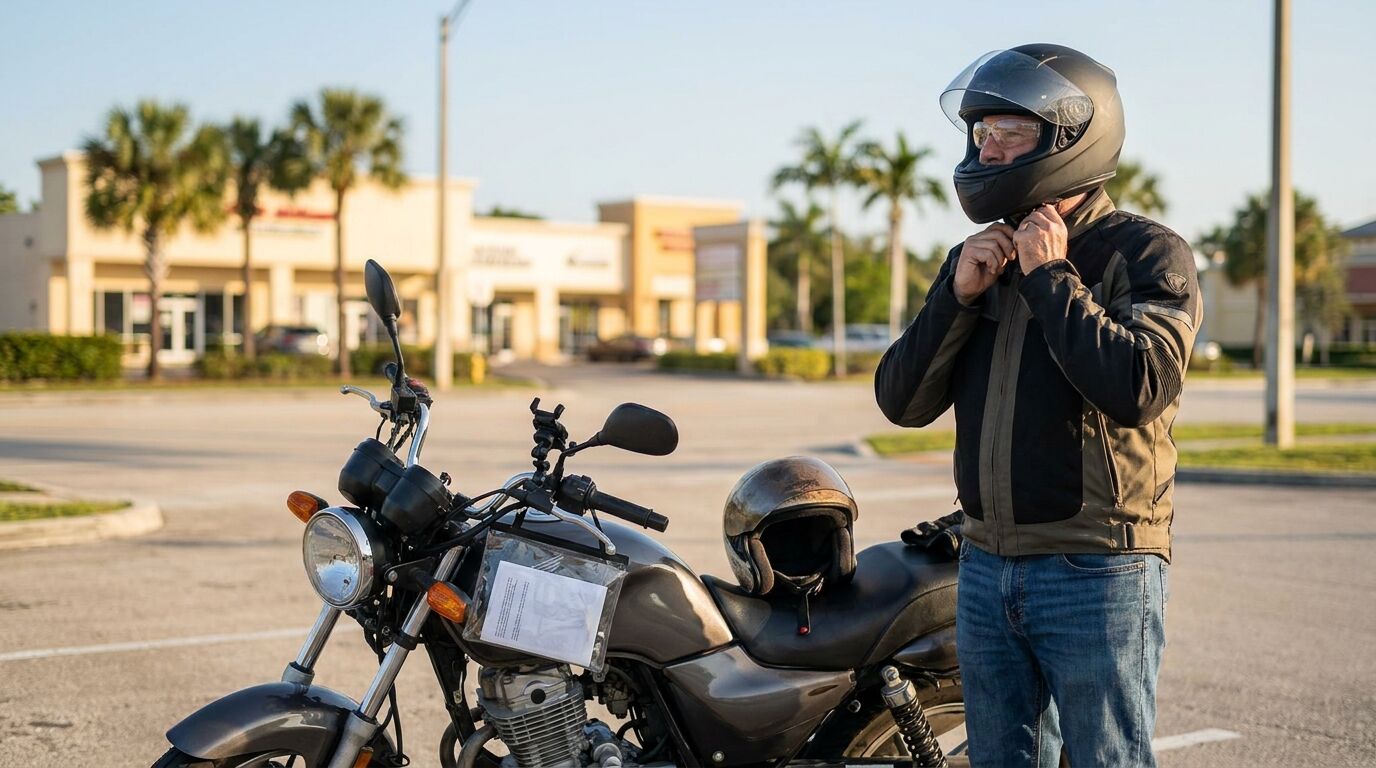
Florida riders 21 and older may legally ride without a helmet if they carry an insurance policy providing at least $10,000 in medical benefits for motorcycle crash injuries. Riders under 21 must wear a helmet that complies with federal safety standards, no exceptions, and every rider regardless of age must wear eye protection. That is the whole law, found in Florida Statute 316.211, and it has been the rule since Florida repealed its universal helmet requirement in 2000.
What the statute does not answer is the question that actually reaches our office: What happens to your injury claim if you were hurt while riding without a helmet? Insurers want riders to believe that no helmet means no case. That is false, but the truth has real nuance, and understanding it can be worth a great deal to an injured rider.
This article explains the helmet law precisely, how the so-called helmet defense works in Florida injury cases, and how riders can protect both their heads and their claims. If you were hurt riding anywhere in South Florida, the motorcycle accident lawyers at Mausner Group Injury Lawyers offer free consultations at 305-344-4878.
What Florida Statute 316.211 Actually Requires
The rules break down cleanly by age:
- Under 21: A helmet meeting Federal Motor Vehicle Safety Standard 218 is mandatory. There is no insurance workaround for young riders.
- 21 and older: Helmet-optional, but only for riders covered by an insurance policy providing at least $10,000 in medical benefits for injuries from a motorcycle crash. Riding helmetless without that coverage violates the statute.
- Everyone: Eye protection is required at all times, helmet or not.
Two misunderstandings come up constantly. First, the $10,000 medical coverage is not PIP. As we explained in our motorcycle accident causes guide, Florida's PIP system excludes motorcyclists entirely, so the qualifying coverage must come from a policy that actually pays medical benefits for motorcycle injuries. Riders who assume their auto PIP satisfies the helmet exemption are riding in violation without knowing it. Second, the $10,000 is a legal threshold, not a suggestion of adequacy. A single night in a trauma center exhausts it.
Riding Without a Helmet Does Not Bar Your Claim
Start with the rule that matters most: A rider legally riding without a helmet has broken no law, and even a rider in violation of the helmet statute does not lose the right to compensation. Florida negligence law asks who caused the crash. A driver who turned left across your path is liable for that choice whether you wore a helmet or not.
What helmet choice can affect is the amount of recovery, through what lawyers call the helmet defense.
How the Helmet Defense Works
Florida applies comparative negligence, meaning a jury can reduce a victim's recovery by their own share of fault. Defense lawyers argue that riding helmetless was itself negligent and that it worsened the rider's injuries. But the defense has to prove two things, and both are harder than insurers pretend:
- Causation, injury by injury. The helmet defense applies only to injuries a helmet would have prevented or reduced, which in practice means head and certain facial injuries. A helmetless rider with a shattered leg, a spinal injury, or internal injuries loses nothing to the defense on those injuries, because no helmet prevents them.
- Expert proof. The defense needs biomechanical and medical expert testimony connecting the absence of a helmet to the specific head injury claimed. Vague common-sense arguments are subject to challenge, and courts require real proof, not assumption.
There is also a fairness argument juries understand: The Legislature made helmetless riding a lawful choice for adult riders. Punishing a rider for exercising a legal right sits poorly, and good trial lawyers make sure juries see the tension.
That said, the defense is real, and under Florida's modified comparative negligence rule from HB 837, a victim found more than 50 percent at fault recovers nothing. In a serious head injury case, the helmet fight can be the whole case, which is why these claims need lawyers who build the medical causation record early rather than conceding it.
The Practical Advice, Legal and Otherwise
As lawyers who see the aftermath, our advice is unambiguous: Wear a DOT-compliant helmet every ride. Roughly half the riders killed in Florida each year were not wearing one, and Florida leads the nation in rider deaths, as we covered in our guide to Miami motorcycle accident causes. A helmet cannot prevent every death, but head injury is the one risk riders can meaningfully buy down for a hundred dollars.
For the claim side, three steps protect riders before any crash:
- Carry the $10,000 medical benefits coverage if you ever ride helmetless, both for legality and because it pays bills PIP will not
- Buy as much uninsured motorist coverage as you can afford, the single most important policy decision a Florida rider makes
- Keep proof of your coverage and your helmet's DOT certification, small facts that shut down insurer arguments later
After a crash, the standard rules apply with extra force for riders: medical care immediately, no recorded statements, preserve the bike and the gear, including the helmet itself, which is physical evidence of impact forces.
Frequently Asked Questions About Florida's Helmet Law
Do you have to wear a motorcycle helmet in Florida?
Not if you are 21 or older and covered by an insurance policy providing at least $10,000 in medical benefits for motorcycle crash injuries, under Florida Statute 316.211. Riders under 21 must always wear a federally compliant helmet, and all riders must wear eye protection.
Can I still recover compensation if I was not wearing a helmet?
Yes. Helmet choice does not decide who caused the crash, and an at-fault driver remains liable. The defense can argue your head injuries would have been less severe with a helmet, but that argument requires expert proof and applies only to injuries a helmet could have prevented.
What is the helmet defense?
It is a comparative negligence argument that a rider's decision not to wear a helmet contributed to their head injuries, reducing the recovery for those specific injuries. It does not apply to leg, spine, internal, or other non-head injuries, and it must be supported by biomechanical and medical expert testimony.
Does PIP satisfy the $10,000 requirement to ride without a helmet?
No. Florida PIP excludes motorcyclists, so the qualifying coverage must be a policy that actually provides medical benefits for motorcycle crash injuries. Riders relying on their car's PIP policy do not meet the exemption.
Does riding without a helmet violate the law if I lack the insurance?
Yes. A rider 21 or older without the $10,000 in medical benefits coverage is required to wear a helmet, and riding without one is a violation. In an injury case, that violation can strengthen the defense's comparative fault arguments, which makes the coverage doubly important.
My child under 21 was hurt riding without a helmet. Is the case over?
No. The under-21 helmet requirement makes the comparative fault argument easier for the defense, but the at-fault driver's liability for causing the crash remains, and all non-head injuries fall outside the helmet issue entirely. These cases need careful handling, not abandonment.
Talk to a Florida Motorcycle Accident Lawyer
Insurers use the word helmet to shrink rider claims that the law fully supports. Mausner Group Injury Lawyers builds the medical and expert record that keeps your claim about what actually caused the crash.
Call 305-344-4878 for a free consultation, available 24/7. You pay nothing unless we win.
This article is for general informational purposes only and does not constitute legal advice. Florida law referenced includes Fla. Stat. 316.211 and 627.736, and HB 837 (2023); fatality data from FLHSMV and NHTSA. Laws change; consult a licensed Florida attorney for advice specific to your situation.
