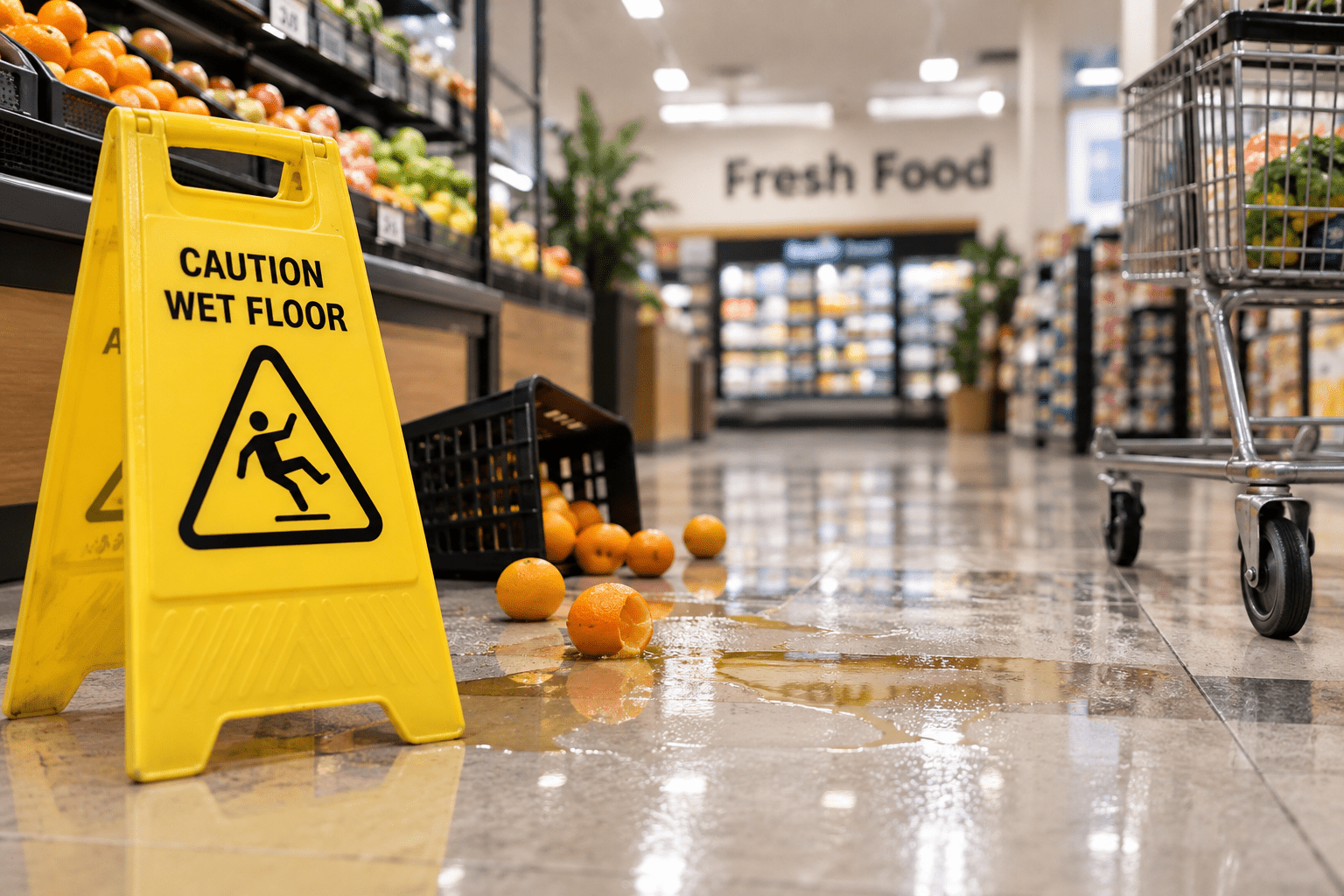
Slip and fall claims against grocery stores are the most common premises cases in Florida, and the most commonly misunderstood. Shoppers assume that falling on a wet supermarket floor means the store pays. Florida law says something narrower: The store pays if it knew, or should have known, about the spill and failed to clean it up. That single issue, called notice, decides nearly every one of these cases.
The Legislature wrote the rule into Florida Statute 768.0755, and every major chain operating in South Florida, from Publix to Sedano's, Winn-Dixie, and Presidente, defends fall cases with it daily. These companies have professional claims departments, store surveillance systems, and inspection procedures built with this statute in mind. An injured shopper walking into that machinery alone is outmatched from the first phone call.
This article explains what the law requires, how notice actually gets proven, how Florida's 2023 tort reform changed the defense playbook, and the steps in the minutes and days after a fall that make or break the claim. If you were hurt in a fall at a store anywhere in South Florida, the Florida slip and fall lawyers at Mausner Group Injury Lawyers offer free consultations at 305-344-4878.
The Rule: Florida Statute 768.0755
Florida Statute 768.0755 governs falls caused by a transitory foreign substance in a business establishment. A transitory foreign substance is anything temporary that does not belong on the floor: spilled liquid, a dropped grape, tracked-in rainwater, a broken jar, produce misting runoff. The statute requires the injured person to prove the business had knowledge of that condition. It allows two kinds.
- Actual knowledge. An employee saw the spill, caused it, or was told about it before the fall.
- Constructive knowledge. The dangerous condition existed long enough that the store should have discovered it through reasonable care, or it happened with such regularity that it was foreseeable.
That second category is where these cases are won and lost. Nobody hands over a confession that an employee saw the spill. Constructive knowledge is built from circumstantial evidence, and the statute invites exactly that proof.
It is worth being precise about what 768.0755 did. Before it, Florida law placed a heavier burden on the store to explain how a hazard got there. The statute shifted that burden onto the injured shopper. That is why these cases are evidence contests rather than fairness arguments, and why the work starts immediately rather than after the medical treatment is finished.
How Notice Actually Gets Proven
The evidence that establishes how long a hazard sat on the floor is specific and, in a modern supermarket, usually exists:
- Surveillance video. The single most important item. Store cameras often capture the spill happening, every employee who walked past it, and the fall itself. Video also disappears on retention cycles measured in days, which is why an immediate preservation letter is standard practice in our cases.
- The condition of the substance. Melted ice cream, a puddle with cart tracks and footprints through it, a browning piece of produce: the state of the spill testifies to its age.
- Sweep logs and inspection records. Chains maintain scheduled floor inspection procedures. A log showing no inspection for two hours before the fall proves the store's own system would have found the hazard in time, and was not followed.
- Employee proximity. Video or testimony placing staff feet from the spill supports the inference they should have seen it.
- Regularity. A freezer case that leaks every afternoon, a soda fountain that drips, rainwater at the same entrance every storm: Recurring conditions put the store on notice as a matter of pattern, and prior incident reports at the same spot are gold.
This is why the same fall can be a losing case handled late and a strong case handled early. The proof exists at first. It evaporates.
Where Falls Happen in South Florida Stores
The fact patterns repeat across every chain in Miami-Dade: produce sections where misters and dropped fruit meet polished tile, freezer aisles with condensation and defrost leaks, deli and cafeteria areas in stores with hot food service, entrances during the summer rainy season when every customer tracks in water, and checkout lanes where dropped items sit in the busiest foot traffic in the store.
Rain cases deserve a note. Florida stores are not liable for the weather, but they are responsible for reasonable measures, mats, warning cones, mopping cycles, at entrances they know flood with tracked-in water every afternoon from June through September. A store in South Florida cannot credibly claim surprise that its entrance was wet during a July storm.
How Florida's 2023 Tort Reform Changed These Cases
This is the part most shoppers have never heard, and it changed the economics of every fall claim in the state.
Effective March 24, 2023, House Bill 837 amended Florida Statute 768.81 to replace pure comparative negligence with a modified system. Under 768.81(6), a party found more than 50 percent at fault for their own harm recovers nothing at all. At exactly 50 percent or less, the claim survives but the award is reduced by that percentage.
Before that change, a shopper found 60 percent at fault still recovered 40 percent of their damages. Now that same shopper recovers zero. The practical result is that store defense teams no longer argue comparative fault to shave a settlement. They argue it to erase the claim entirely, and they start building that argument the moment the incident report is written.
Expect these arguments in a grocery store fall case:
- You were looking at your phone, a shopping list, or the shelves rather than the floor.
- You were wearing sandals, flip-flops, or worn shoes.
- The hazard was open and obvious, meaning a reasonable person would have seen and avoided it.
- You walked past a warning cone or an area that was visibly being cleaned.
- You had a prior injury, a mobility issue, or a medication that contributed to the fall.
The open and obvious argument deserves a direct answer. Under Florida law, a condition being open and obvious can reduce or defeat the store's duty to warn, but it does not eliminate the store's separate duty to maintain the premises in a reasonably safe condition. A clear puddle in the middle of an aisle may be visible, and the store may still be responsible for leaving it there.
None of this makes these cases unwinnable. It makes early, disciplined evidence work the difference between a recovery and nothing, because the same video and sweep logs that prove the store's notice also tend to show what the shopper was actually doing.
The Injuries Are Not Minor
Falls on commercial tile produce hip fractures, wrist and shoulder injuries, knee damage requiring surgery, and head strikes that become the traumatic brain injuries we discuss on our catastrophic injury page. Older shoppers are hurt worst, and a broken hip at 70 is a life-altering event, not a nuisance claim. Store insurers price falls as nuisance claims anyway, which is exactly the gap good lawyering closes.
What a Grocery Store Fall Claim Is Worth
There is no chart. Florida does not assign values by injury type, and any lawyer who quotes a number before reviewing the medical records is guessing. What a claim is actually worth is driven by a short list of factors:
- The medical picture. Past treatment, future care, and whether surgery is required or recommended.
- Lost income. Time missed, and whether the injury limits future earning capacity.
- Permanence. A documented permanent impairment rating opens the door to non-economic damages in a way a full recovery does not.
- Liability strength. A case with clear video and a gapped sweep log is worth more than the identical injury with no notice evidence, because settlement value tracks the risk the store faces at trial.
- Comparative fault exposure. After HB 837, every percentage point of shopper fault matters, and the risk of crossing 51 percent is priced into every offer.
Non-economic damages, pain and suffering, loss of enjoyment of life, are real and recoverable in Florida premises cases. They are also the first thing an insurer discounts, which is why documentation of how the injury changed daily life matters as much as the billing records.
What to Do After a Store Fall
The first hour matters more in these cases than in almost any other injury claim:
- Report the fall to the manager before leaving and insist an incident report is created
- Ask for a copy of the incident report, or photograph it before you leave
- Photograph the substance, the surrounding area, and any absence of warning cones, plus your own clothing and shoes
- Get names of employees and any customers who saw the fall or the spill
- Seek medical care the same day, both for your health and your credibility
- Do not give a recorded statement to the store's insurer or claims team
- Do not post about the fall or your activities on social media, which defense teams review as a matter of routine
- Get a preservation letter sent for the video immediately, which is one of the first things we do in every store fall case
Florida Statute 95.11(4)(a) gives you two years from the date of the fall to file suit, a deadline shortened from four years by the same 2023 reform discussed above and explained further in our statute of limitations guide. The video that wins the case may be gone in a week. Our premises liability page covers how we handle these claims statewide.
Frequently Asked Questions About Grocery Store Falls
Can I sue a grocery store if I slipped and fell in Florida?
Yes, if the store had actual or constructive knowledge of the hazard and failed to address it, as required by Florida Statute 768.0755. The strength of the case depends on proving how long the condition existed, which is done through video, inspection logs, and the condition of the substance itself.
What is constructive knowledge in a slip and fall case?
It means the store should have known about the hazard: either the condition existed long enough that reasonable inspections would have found it, or it recurred so regularly that it was foreseeable. A puddle with cart tracks through it and a sweep log showing no inspection for hours are classic constructive knowledge proof.
Can I still recover if I was partly at fault for my fall?
Yes, as long as you were not more than 50 percent at fault. Under Florida Statute 768.81(6), amended effective March 24, 2023, a person found greater than 50 percent responsible for their own harm recovers nothing, and anyone at 50 percent or less recovers damages reduced by their share. This is why stores now argue shopper carelessness so aggressively.
Do I have a case if I fell on rainwater at the store entrance?
Possibly. Stores are not responsible for rain itself, but South Florida stores know their entrances flood with tracked-in water every rainy afternoon, and they must respond reasonably with mats, cones, and mopping. A bare, wet entrance during a storm the store did nothing about can support a claim.
What if the spill was obvious and I just did not see it?
An open and obvious hazard can reduce or eliminate the store's duty to warn you about it, but it does not automatically end the case. Florida stores have a separate duty to maintain the property in a reasonably safe condition, which means leaving a known spill on the floor can still be negligence even if the spill was visible.
How much is a grocery store fall case worth in Florida?
There is no standard figure. Value depends on the medical treatment required, whether surgery is needed, lost income and future earning capacity, whether a permanent impairment is documented, how strong the notice evidence is, and how much comparative fault the store can credibly argue. Cases with clear video and a gapped inspection log settle for materially more than identical injuries with no notice proof.
What should I do immediately after falling in a store?
Report it to a manager and make sure an incident report exists, photograph the hazard and the area, collect witness names, and get medical care the same day. Then, have a lawyer send a video preservation letter fast, because store surveillance is routinely overwritten within days.
Will the store's insurance offer me a fair settlement?
Rarely at first. Major chains and their insurers evaluate fall claims aggressively and price them as nuisance cases, especially before litigation. Offers change when the notice evidence, video, logs, and prior incidents, is actually assembled and the store's exposure becomes concrete.
How long do I have to file a slip and fall lawsuit in Florida?
Two years from the date of the fall under Florida Statute 95.11(4)(a). That period was shortened from four years to two for causes of action accruing on or after March 24, 2023. The evidence timeline is far shorter, since surveillance footage and inspection records can disappear within days without a preservation demand.
Talk to a Florida Slip and Fall Lawyer
The store had cameras, logs, and a claims department working from the moment you hit the floor. You are entitled to bring the same preparation. Mausner Group Injury Lawyers handles store fall cases across Miami-Dade and all of Florida, and we move on the evidence before it disappears.
Call 305-344-4878 for a free consultation, available 24/7. You pay nothing unless we win.
This article is for general informational purposes only and does not constitute legal advice. Florida law referenced includes Fla. Stat. 768.0755, 768.81, and 95.11(4)(a). Business names are referenced as examples of common fall locations, not as statements about any company's practices. Laws change; consult a licensed Florida attorney for advice specific to your situation.
