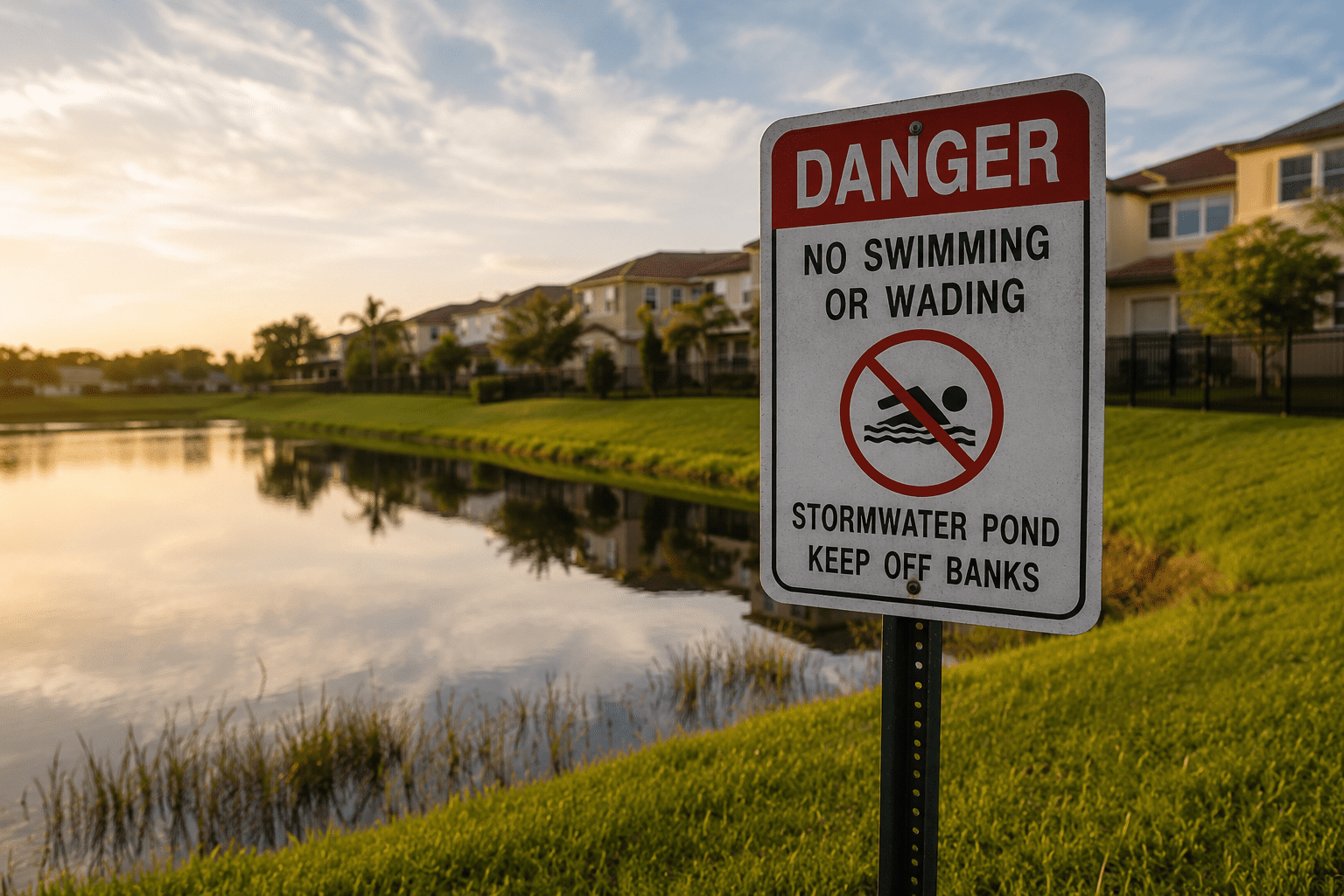
Retention ponds are among the most dangerous bodies of water in Florida, and no state law requires them to be fenced. When a child drowns in one, liability usually falls on the property owner, developer, homeowners association, or management company that controlled the pond, based on how it was designed, built, and maintained.
Drive through any subdivision in West Kendall, Doral, or Homestead and you will pass them without a second look. They sit beside playgrounds, bus stops, apartment parking lots, and backyard fences. Florida's development rules require stormwater management, so nearly every community built in the last several decades has at least one pond. Almost none of them have barriers.
Florida loses more young children to drowning than any other state, according to the Florida Department of Health, and retention ponds are a recurring site of those tragedies. This article explains why these ponds are so deadly, what design standards apply to them, and the legal theories that hold owners accountable. If your family has been affected, the Miami premises liability lawyers at Mausner Group Injury Lawyers can help you understand your options in a free, confidential consultation.
What Retention Ponds Are and Why They Are Everywhere
A retention pond is an engineered basin that collects stormwater runoff from streets, roofs, and parking lots. South Florida's flat terrain and heavy rains make them a requirement of development. Water management district permitting rules effectively guarantee that new subdivisions, shopping centers, schools, and apartment complexes include them.
That means the entity responsible for a pond is almost never "nobody." Someone designed it, someone built it, and someone holds the permit and the maintenance obligation today. That chain of responsibility is exactly where a drowning investigation starts.
Why Retention Ponds Are More Dangerous Than They Look
A retention pond looks like a calm neighborhood lake. Its construction is what makes it deadly:
- Side slopes can be steep, and erosion makes them steeper over time, so a child who slips in cannot simply walk back out
- The bottom is typically soft muck and sediment that gives no footing and can trap a struggling swimmer
- Depth changes suddenly, with drop-offs a few feet from the bank
- Algae and wet grass make the banks slick
- Water is often murky, so a child who goes under cannot be seen from shore
Unlike a backyard pool, there is usually no fence, no alarm, and no adult nearby. A toddler who wanders fifty yards from a front door can reach the water's edge in under a minute.
No Fence Required: The Gap in Florida Law
Florida's Residential Swimming Pool Safety Act, Chapter 515 of the Florida Statutes, requires barriers, alarms, or covers for residential pools. It does not apply to retention ponds. There is no statewide statute requiring a fence around a stormwater pond, even one sitting beside a playground.
That legislative gap does not mean owners are off the hook. It means the case is built on premises liability and negligence principles instead of a barrier statute, and on the engineering standards the pond was permitted under.
The Design Standards That Decide These Cases
Retention ponds in South Florida are permitted through the environmental resource permit program administered under Chapter 62-330 of the Florida Administrative Code and the water management districts' applicants' handbooks. Those design criteria address side slope grading, with gentler slopes near the waterline so that a person who enters the water can regain footing, along with berms, littoral shelves, and maintenance obligations.
This is where these cases are won. When a pond's as-built condition deviates from its permitted design, that deviation becomes powerful evidence of negligence. Common examples include:
- Slopes graded steeper than the permit allowed, or allowed to erode into an underwater cliff
- Soil types and compaction that differ from the approved plans, creating unstable banks
- Missing littoral shelves or safety benches that the design required
- Maintenance failures, such as washouts and bank collapse, left unrepaired for years
An engineering inspection comparing the pond to its permit file can show a jury precisely how the owner's choices turned a stormwater feature into a hazard.
Who Can Be Held Liable
Depending on the facts, responsible parties can include:
- The property owner, including institutional owners and single-family rental operators who hold large portfolios of homes and common areas in South Florida
- The homeowners or condominium association that controls the common areas where the pond sits
- The property management company hired to maintain the grounds
- The developer or engineering firm, when the pond was negligently designed or built
- A contractor whose grading or maintenance work created the hazard
Florida premises liability law ties duty to control. Whoever had the ability to fence, grade, warn, or repair, and did not, is the party the law looks to.
The Attractive Nuisance Doctrine Protects Children
Property owners often argue that a drowned child was trespassing. Florida law anticipated that argument decades ago. Under the attractive nuisance doctrine, drawn from Section 339 of the Restatement (Second) of Torts and adopted by Florida courts, an owner can be liable for injuries to child trespassers when an artificial condition on the land is likely to attract children who cannot appreciate its danger.
A man-made pond in the middle of a residential neighborhood is close to the textbook example. Young children are drawn to water, and Florida courts recognize that a toddler cannot weigh the risk of a steep bank and a muck bottom. Very young children are also legally incapable of negligence in Florida, so blaming the child is not a defense the law entertains.
The doctrine asks a practical question: The owner knew children live, walk, and play near this water, so what did the owner do about it? Where the answer is nothing, liability follows. Our guide to swimming pool drowning liability in Florida covers how these principles apply when the water is a pool instead of a pond.
What Families Should Know About Bringing a Claim
A retention pond drowning case is typically brought as a wrongful death claim under the Florida Wrongful Death Act, filed by the estate's personal representative within two years. The investigation moves on two tracks at once: securing the permit file, design plans, and maintenance records before they disappear, and having an engineer document the pond's current condition before the owner regrades it.
These cases carry a weight beyond one family's loss. Verdicts and settlements are what push associations, developers, and management companies to fence ponds, fix slopes, and post warnings. Learn more about how our premises liability practice approaches cases involving dangerous property conditions.
Frequently Asked Questions About Retention Pond Drownings
Are retention ponds required to be fenced in Florida?
No. Florida's pool barrier law, Chapter 515, applies to residential swimming pools, not stormwater ponds. No statewide statute requires retention pond fencing, which is why liability in a drowning case is established through premises liability and negligence principles rather than a barrier statute.
Who is responsible when a child drowns in a retention pond?
The party that owned or controlled the pond, which is usually a homeowners association, developer, property owner, or management company. Engineers and contractors can also be liable when the pond was designed or built in violation of its permit.
What is the attractive nuisance doctrine?
It is a legal rule that holds property owners responsible when an artificial condition likely to attract children, such as a man-made pond, injures a child who could not appreciate the danger. Florida courts apply it based on Section 339 of the Restatement (Second) of Torts, and it defeats the argument that a drowned child was merely trespassing.
Can the property owner blame my child for the drowning?
Florida law treats very young children as legally incapable of negligence, and the attractive nuisance doctrine exists precisely because young children cannot assess dangers like deep water. Fault arguments aimed at a small child carry little weight.
How do you prove a retention pond was negligently maintained?
By comparing the pond's actual condition to its permitted design. Steeper-than-approved slopes, erosion, missing safety shelves, and unstable soil are documented through an engineering inspection and the permit file from the water management district. Deviations from the approved design are strong evidence of negligence.
How long do we have to file a claim?
A wrongful death claim must generally be filed within two years of the death under Florida Statute 95.11. Evidence like the pond's condition can change much faster, so early investigation matters more than the legal deadline suggests.
Speak With a Miami Premises Liability Lawyer
If you have lost a child or family member in a retention pond drowning, you deserve answers about how it happened and who allowed it to happen. Mausner Group Injury Lawyers investigates drowning cases throughout Miami-Dade and South Florida, and we handle every case with the care these losses demand.
Call 305-344-4878 for a free, confidential consultation. We are available 24 hours a day, and there is no fee unless we recover for your family.
This article is for general informational purposes only and does not constitute legal advice. Florida law cited includes Fla. Stat. Chapter 515, Fla. Stat. 95.11, the Florida Wrongful Death Act, and Chapter 62-330, Florida Administrative Code. Laws change; consult a licensed Florida attorney for advice specific to your situation.
