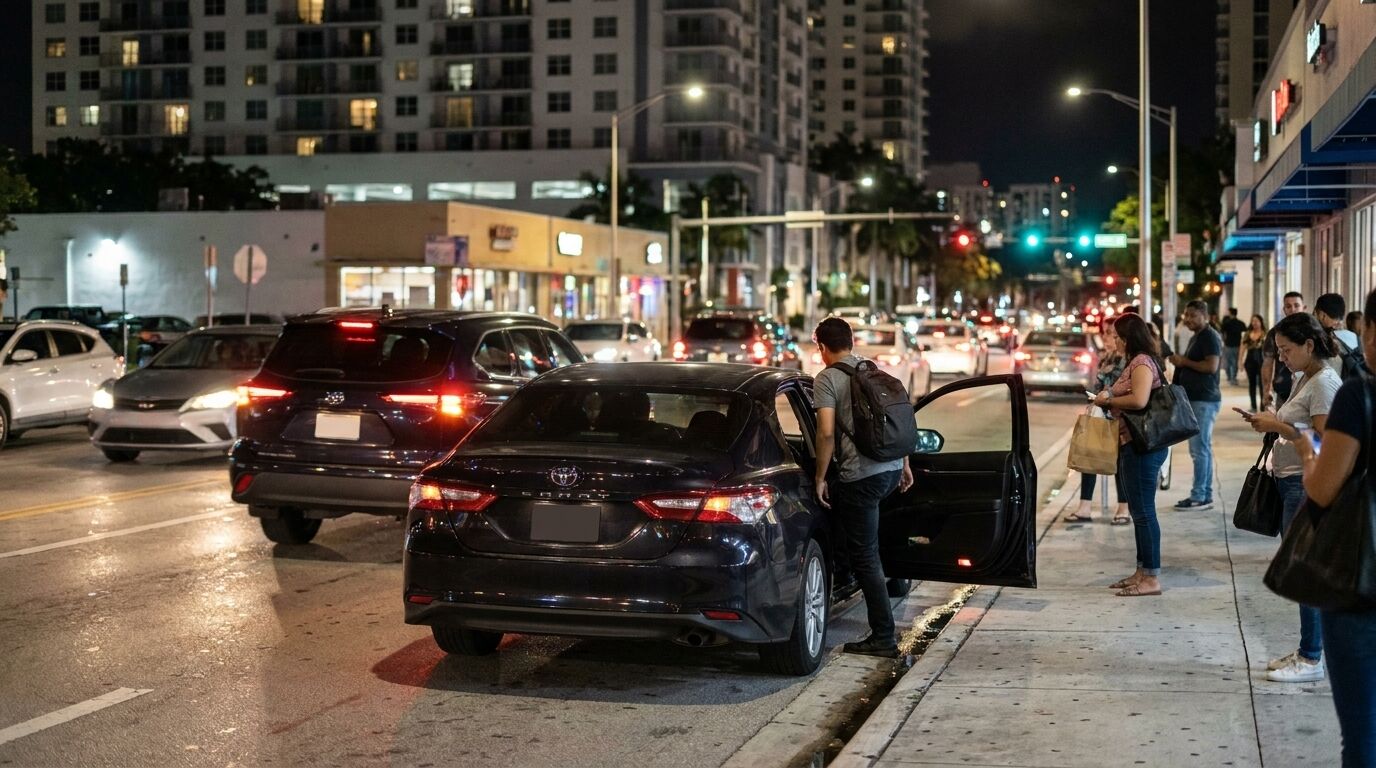
Every weekend night, Miami's nightlife districts run one of the largest rideshare operations in the country. Thousands of Ubers and Lyfts cycle through Brickell's high-rise valet lanes, the gallery blocks of Wynwood, and the hotel loading zones off Collins Avenue and Ocean Drive, and they do it in the hours when crash risk peaks: after midnight, in heavy pedestrian traffic, surrounded by drivers who have been drinking even when the rideshare driver has not.
The result is a crash pattern specific to these neighborhoods. Double-parked pickups on Brickell Avenue force passengers to board in live traffic lanes. Drivers watching the app instead of the crosswalk drift through Wynwood's crowds on NW 2nd Avenue. Impatient traffic swings around stopped rideshares on narrow South Beach streets. When it goes wrong, the injured include passengers, pedestrians, cyclists, and the occupants of other cars.
The good news for anyone hurt in one of these crashes is that rideshare collisions during a trip carry up to $1 million in insurance coverage, far more than the typical Miami driver's policy. This article covers why nightlife-district crashes happen, who is liable, and how the coverage works. The Miami Uber and Lyft accident lawyers at Mausner Group Injury Lawyers offer free consultations at 305-344-4878.
Why Late-Night Rideshare Crashes Cluster Here
Miami-Dade's crash data tells a consistent story: Serious crashes concentrate in the late-night and early-morning hours, and they concentrate where drinking, density, and traffic meet. The nightlife districts combine every risk factor at once.
- The pickup chaos problem. Brickell towers, Wynwood venues, and South Beach hotels generate hundreds of simultaneous pickups with almost nowhere legal to stop. Drivers halt in travel lanes, passengers step between parked cars, and following traffic makes sudden moves around both.
- Impaired drivers everywhere else. Rideshare exists so people do not drive drunk, which means the cars around a 2 a.m. Uber are disproportionately driven by people who made the other choice. A sober rideshare driver hit by a drunk driver is a common Miami case with a clear liability picture.
- App distraction. Rideshare driving is phone driving. Accepting trips, following navigation, and locating passengers all pull eyes off streets full of pedestrians.
- Fatigue. Peak nightlife earnings happen at the end of a long day. Many drivers run the late shift after other work, and drowsy driving past 2 a.m. performs like impaired driving.
- Pedestrians in the roadway. From scooter riders on Ocean Drive to crowds spilling off Wynwood sidewalks during art walks, these districts put people on foot inches from pickup lanes all night.
Who Can Be Hurt, and Who Pays
The nightlife crash pattern produces four kinds of victims, and the same insurance framework covers all of them.
Passengers have the cleanest claims. A passenger injured mid-trip is covered by the $1 million policy Florida law requires rideshare companies to provide during rides, no matter which driver caused the crash.
Pedestrians and cyclists struck by a rideshare driver during a trip or en route to a pickup can claim against the same $1 million tier. Given how many nightlife victims are on foot, this is one of the most important and least known features of Florida rideshare law.
Other drivers hit by a rideshare vehicle use the coverage tier that matches the driver's app status at the moment of the crash, from the driver's personal policy when the app is off, to at least $50,000 per person while the driver waits for a request, to the full $1 million during trips.
Rideshare drivers themselves, when hit by a drunk or reckless driver, typically claim against that driver and may have uninsured motorist coverage through the rideshare policy or their own, which matters in a county with one of the worst uninsured driver rates in the country.
The dividing lines are minutes on a trip log, and the companies' insurers fight over them. Preserving the trip data, the receipt, and the app screenshots on the night of the crash removes the argument before it starts.
The Drunk Driver Wrinkle
Many nightlife-district cases involve an impaired driver who is not the rideshare driver, and those cases can reach beyond the drunk driver. Florida's dram shop law is narrow, but liability can extend to a bar or club that served alcohol to a minor or to someone habitually addicted to alcohol. In serious cases arising from South Beach and Wynwood venues, that question is always worth investigating alongside the crash itself, and it previews the venue liability issues we will cover in our upcoming work on nightclub security cases.
Punitive damages are also on the table against drunk drivers in Florida, one of the few crash scenarios where they routinely are.
What to Do After a Nightlife Rideshare Crash
The late-night setting complicates evidence in predictable ways: Witnesses scatter, everyone involved may have been drinking except the drivers, and surveillance footage from bars and building lobbies gets overwritten within days. The checklist matters more here than in a daytime crash:
- Get medical attention immediately, both for your health and because Florida's 14-day PIP rule punishes delay, as we explained in our PIP guide
- Screenshot the trip in the app before it disappears from view: driver, route, timestamps
- Photograph the scene, the vehicles, and the pickup location
- Get names and numbers from witnesses before the crowd moves on
- Report the crash through the app so the companies open a record
- Do not give recorded statements to any insurer before speaking with a lawyer
The two-year filing deadline from our statute of limitations guide applies, but nearby camera footage lasts days, not years.
The Neighborhood Knowledge That Wins These Cases
These cases turn on local specifics: which Brickell buildings funnel pickups into live lanes, where Wynwood's pedestrian crowds cross mid-block, how the causeway approaches to South Beach concentrate speed at 3 a.m. Mausner Group Injury Lawyers handles rideshare cases across these exact corridors, and our Uber and Lyft accident practice page explains how we investigate them, from trip data subpoenas to venue camera preservation.
Frequently Asked Questions About Miami Nightlife Rideshare Accidents
What should I do if my Uber crashes in Brickell or South Beach?
Get medical care immediately, screenshot the trip details in the app, photograph the scene, and collect witness contacts before leaving. Report the crash through the app so a record exists, and avoid recorded statements to insurers until you have spoken with a lawyer.
Am I covered if I was a passenger in an Uber or Lyft crash?
Yes. Florida law requires rideshare companies to provide $1 million in coverage during trips, and it protects passengers regardless of which driver caused the crash. Passenger claims are typically the strongest rideshare cases.
What if a drunk driver hit my rideshare?
Your claim runs against the drunk driver and their insurer, with the rideshare policy's uninsured motorist coverage potentially applying if they carry too little insurance. Punitive damages are available against drunk drivers in Florida, and in some cases a bar that overserved them can share responsibility.
Does rideshare insurance cover pedestrians hit by an Uber driver?
Yes. The coverage tiers protect anyone the driver injures during a covered period, including pedestrians, scooter riders, and cyclists. A pedestrian struck during an active trip or pickup run can claim against the $1 million policy.
Why does it matter whether the driver's app was on?
The app status at the moment of the crash sets the insurance tier: personal coverage only when the app is off, at least $50,000 per person while waiting for a request, and $1 million during pickups and trips. Trip data resolves disputes, which is why preserving it immediately matters.
How long do I have to file a rideshare accident claim in Florida?
Two years from the crash under Florida's statute of limitations. The practical window is far shorter, because venue and building surveillance footage in nightlife districts is commonly overwritten within days.
Talk to a Miami Rideshare Accident Lawyer
A crash at 2 a.m. on Brickell Avenue is not the same case as a fender bender in a parking lot, and it should not be handled like one. Mausner Group Injury Lawyers knows these streets, these venues, and the insurance rules that decide these claims.
Call 305-344-4878 for a free consultation, available 24/7. You pay nothing unless we win.
This article is for general informational purposes only and does not constitute legal advice. Florida law referenced includes Fla. Stat. 627.748, 627.736, 768.125, and 95.11. Laws change; consult a licensed Florida attorney for advice specific to your situation.
