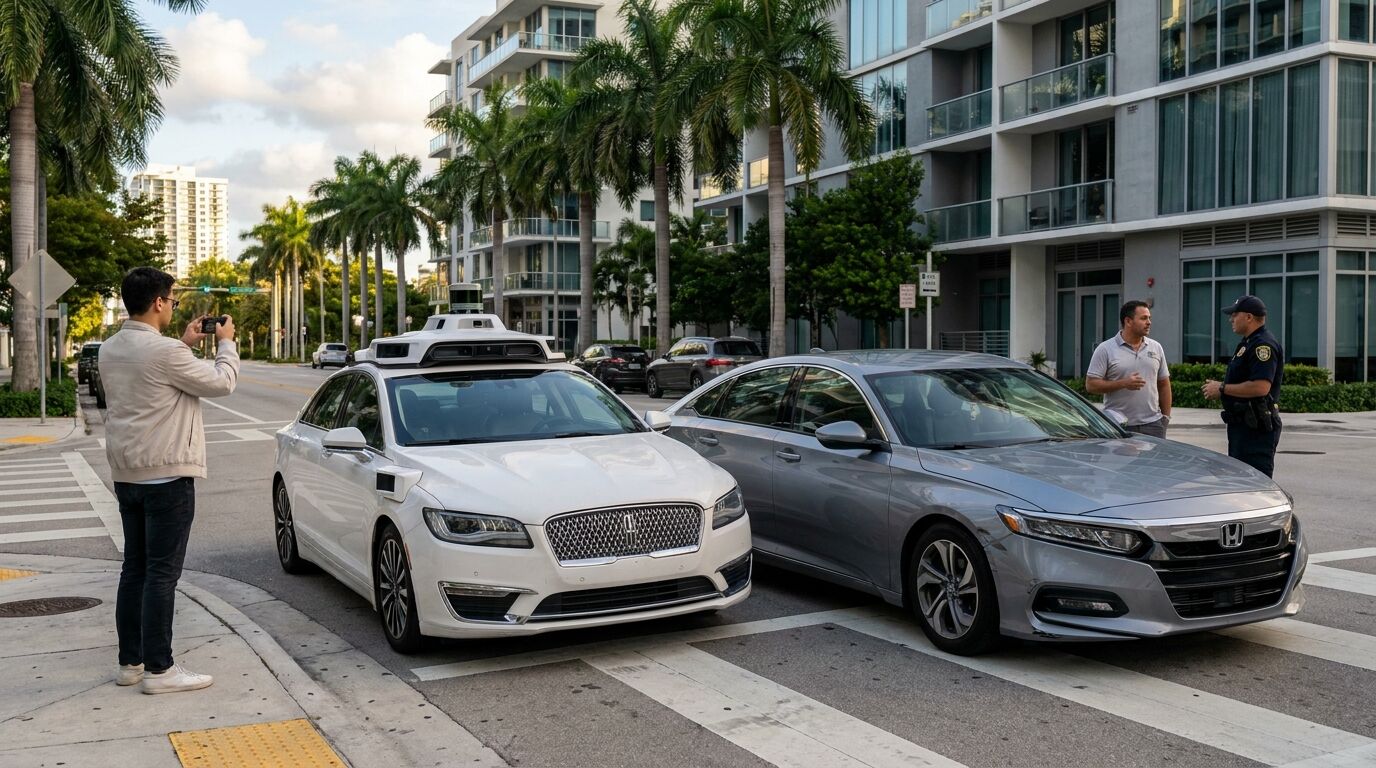
When a driverless car crashes in Florida, liability shifts from a human driver to the company behind the vehicle. Florida law treats the automated driving system as the legal operator when it is engaged, which means a crash involving a Waymo robotaxi is, from the first moment, a claim against a corporation and its technology rather than a negligence case against a person. That changes the defendants, the evidence, and the money, and it is no longer a hypothetical in Miami.
Waymo opened its Miami robotaxi service to the public in January 2026 and has been expanding since, with airport service in testing. Thousands of fully driverless rides now happen across Miami-Dade every week, sharing Biscayne Boulevard, Brickell, and Wynwood with the human drivers, riders, cyclists, and pedestrians we represent. Nationally, the technology's record is genuinely strong in some respects and genuinely unsettled in others, and federal regulators have had the company's driving behavior under review even as it expands.
This article explains how Florida law handles autonomous vehicle crashes, who can be held responsible, and what injured riders, drivers, and pedestrians should do, because the playbook differs from that of any ordinary crash. If you were hurt in a collision involving a driverless vehicle anywhere in South Florida, Mausner Group Injury Lawyers offers free consultations at 305-344-4878.
Florida's Driverless Car Law in Plain Language
Florida has been one of the most permissive states in the country for autonomous vehicles since 2019, when the Legislature authorized fully driverless operation with no human behind the wheel. The framework, built mainly in Section 316.85, Florida Statutes, does three things that matter after a crash:
- It makes the automated driving system the legal operator of the vehicle while engaged, so traffic law compliance, and violation, belongs to the system and the company behind it
- It requires on-demand autonomous vehicle networks, the robotaxi services, to carry substantial liability coverage, at least $1 million, well above what ordinary Florida drivers carry
- It exempts fully autonomous vehicles from rules that assume a human driver, which is why a Waymo with an empty driver seat is lawful on Miami streets
The practical consequences cut both ways. There is no driver to cross-examine, no distracted human to blame, and a sophisticated corporate defendant on the other side. But there is also real insurance, deep pockets, and a defendant that recorded everything.
Who Can Be Held Responsible
The AV Company
When the automated system causes a crash, running a light, misjudging a pedestrian, stopping where it should not, the operator company is the primary defendant, through negligence and product liability theories: the system performed below what a reasonable driver, or a reasonably designed system, would have done. The federal scrutiny of robotaxi driving behavior matters here, because the standards regulators probe are the same ones a civil case measures.
The Human Driver Who Hit the Robotaxi
Here is the underappreciated reality: in a large share of robotaxi crashes reported nationally, the human driver was at fault, rear-ending a cautious AV, turning across its path, or drifting into it. A Waymo passenger injured by a human driver has an ordinary claim against that driver, backed by the robotaxi network's coverage layers, a structure similar to the rideshare tiers we explained in our Uber and Lyft insurance guide, with the critical difference that there is no driver between the passenger and the company.
Everyone Else in the Chain
Depending on the crash, the vehicle manufacturer, component and sensor makers, the fleet maintenance operation, and in hybrid cases, a safety operator or remote assistance decision. AV cases borrow their defendant-mapping discipline from the trucking cases we handle, where the chain of responsible companies is the case.
PIP, UM, and the Insurance Questions Nobody Has Asked Yet
Florida's ordinary insurance rules still apply around the new technology. An injured Waymo passenger's own PIP coverage applies to them as a vehicle occupant, with the same 14-day treatment rule from our PIP guide. A pedestrian or cyclist struck by an AV claims against the network's liability coverage, and their own PIP and UM coverage remain in the background. A driver whose car is hit by an AV pursues the network's coverage the way they would any at-fault party, with the difference that fault will be fought with data rather than testimony.
What has no settled answer yet is how aggressively AV companies will contest fault, and early signs nationally suggest they defend their systems hard. The company's position will arrive with charts. The answer is matching its data with your own: scene evidence, witness accounts, and independent reconstruction.
The Evidence Is Spectacular, and It Is Theirs
A Waymo records more about its crashes than any vehicle in history: lidar, radar, and camera streams, the system's own decision logs, speed and braking data, everything. That evidence can prove your case beyond argument. It can also sit entirely in the company's hands, be interpreted by the company's engineers, and be summarized to the public in the company's framing.
The legal response is the same discipline trucking taught us, moved up a technology generation: immediate preservation demands for the complete sensor and decision data, not the summary; independent experts who can read it; and scene evidence gathered before it fades, because the company's data should be checked against the world, not accepted as the world. Riders should also preserve everything on their side: the trip record in the app, photos, and their own account written down while fresh.
What to Do After a Driverless Car Crash
The familiar steps apply, with AV-specific additions: get medical care immediately and within the PIP window; report the crash to police so an official record exists independent of the company's; photograph the vehicle, its sensors, and the scene; capture the trip details in the app if you were a passenger; get witness contacts; and do not give statements to the company's representatives, who may be on scene faster than anyone, before getting advice. Then move quickly on preservation, because the two-year deadline from our statute of limitations guide is generous compared to the data retention questions nobody can yet answer.
Serious AV crashes produce the same injuries as any serious crash, and the catastrophic cases follow the lifetime-valuation path our catastrophic injury page describes. The technology is new. The harm is not.
Frequently Asked Questions About Driverless Car Accidents
Who is liable if a Waymo crashes in Florida?
When the automated system caused the crash, the company operating the vehicle is the primary defendant, since Florida law treats the automated driving system as the legal operator. When a human driver caused it, that driver is liable, with the robotaxi network's substantial insurance coverage protecting its own injured passengers.
Can I sue if I was a passenger in a driverless taxi that crashed?
Yes. Injured robotaxi passengers have claims regardless of which vehicle caused the crash: against the human driver who hit the AV, or against the AV company when its system failed. Florida requires autonomous ride networks to carry at least $1 million in liability coverage.
What if a driverless car hit me as a pedestrian or cyclist?
You have a claim against the AV network's liability coverage, and the vehicle's own sensors likely recorded the entire event. Preserving that data through immediate legal demands is the single most important step, alongside prompt medical care and a police report.
Does PIP apply to autonomous vehicle accidents?
Yes. Florida's no-fault rules operate normally: occupants and struck pedestrians access PIP benefits through the usual channels, with the same 14-day treatment deadline. The AV's corporate liability coverage sits above PIP for serious injuries, just as a negligent driver's coverage would.
Are driverless cars actually safer?
The data is genuinely mixed in its implications: AVs avoid impairment, distraction, and fatigue, and a large share of their crashes are caused by human drivers around them. But federal regulators have scrutinized robotaxi driving behavior, and individual system failures do happen. Safety statistics about a fleet say nothing about liability in your specific crash.
Do I need a lawyer for a driverless car accident claim?
More than in an ordinary crash. The defendant is a corporation holding all of the crash data, defending its technology's reputation, and experienced at presenting its version. Matching that requires preservation demands, independent experts, and counsel comfortable litigating against engineering evidence. Consultations are free.
Hit by, or Hurt in, a Driverless Car? The Company Has the Data. Get Your Own Team.
Autonomous vehicle claims are corporate litigation wearing a car accident costume, and the first weeks decide whether the full sensor record is preserved or summarized. Mausner Group Injury Lawyers handles driverless vehicle cases across Miami-Dade and South Florida.
Call 305-344-4878 for a free consultation, available 24/7, in English or Spanish. You pay nothing unless we win.
This article is for general informational purposes only and does not constitute legal advice. Florida law referenced includes Fla. Stat. 316.85 and related autonomous vehicle provisions, 627.736, 627.727, and 95.11. Autonomous vehicle law and service availability change rapidly; facts current as of October 2026. Consult a licensed Florida attorney for advice specific to your situation.
