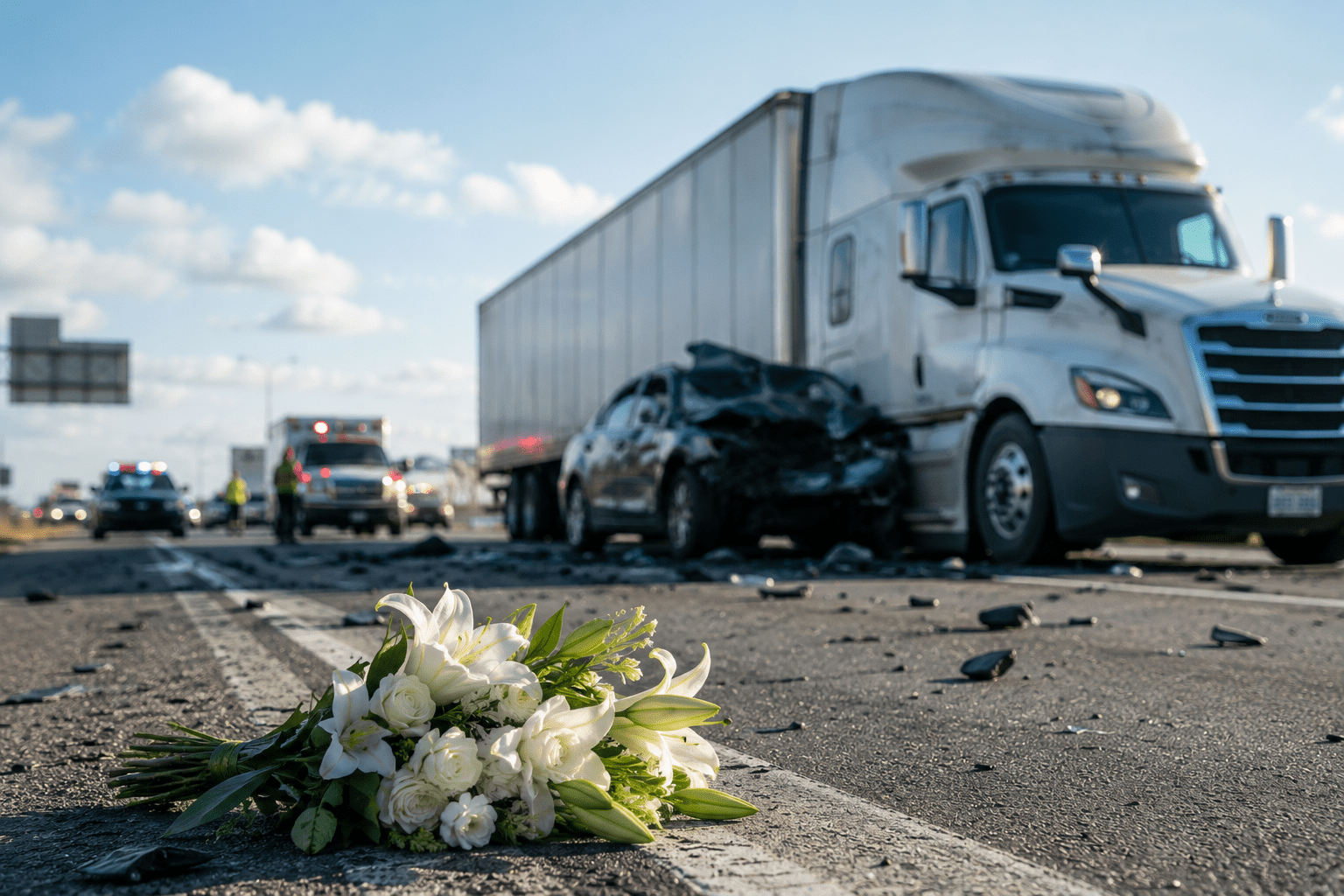
When a truck accident takes a life in Florida, the victim's family can pursue a wrongful death claim under the Florida Wrongful Death Act, Florida Statutes 768.16 through 768.26. The claim is filed by the personal representative of the estate, and it must be filed within two years of the death.
That is the legal answer. The human reality is harder. A fatal crash on I-95 or the Palmetto Expressway leaves a family grieving while a trucking company's insurance carrier and rapid-response team are already working the case, sometimes within hours of the collision.
This article explains how wrongful death claims work when the crash involves a commercial truck, who is allowed to file, what compensation Florida law makes available, and why these cases move differently than a fatal car accident claim. If you have lost a family member in a truck crash, the Miami truck accident lawyers at Mausner Group Injury Lawyers offer free consultations, and there is no fee unless we recover for you. Call 305-344-4878.
What Counts as Wrongful Death Under Florida Law
Florida Statute 768.19 defines a wrongful death as one caused by another party's wrongful act, negligence, default, or breach of contract. In plain terms, if the person would have had a valid personal injury claim had they survived, their survivors have a wrongful death claim after their passing.
In a trucking case, that negligence can take many forms. A driver who exceeded federal hours-of-service limits and fell asleep. A carrier that put an unqualified driver behind the wheel of an 80,000-pound vehicle. A maintenance shop that signed off on worn brakes. Each of those failures can support a claim under the Act.
The purpose of the statute is spelled out in Section 768.17: Shift the losses caused by a death from the survivors to the wrongdoer. Florida courts read the Act broadly for exactly that reason.
Who Is Allowed to File the Claim
Only the personal representative of the deceased person's estate can file a Florida wrongful death lawsuit. That rule comes from Florida Statute 768.20. The personal representative is named in the will or, if there is no will, appointed by the court.
The lawsuit is filed on behalf of the survivors, which Section 768.18 defines to include:
- The surviving spouse
- Children of the deceased, including adult children in many circumstances
- Parents of the deceased, particularly when the victim was a minor child
- Blood relatives and adoptive siblings who were partly or wholly dependent on the deceased for support or services
Every survivor's recovery flows through this single lawsuit. Families do not file separate competing claims, which is one reason it matters to get the estate opened and the personal representative appointed quickly.
Fatal Truck Crashes Are a Persistent Problem in South Florida
More than 5,000 people are killed in crashes involving large trucks in the United States each year, according to the Federal Motor Carrier Safety Administration's Large Truck and Bus Crash Facts. The overwhelming majority of those killed are not the truck's occupants. They are people in passenger vehicles, pedestrians, and riders.
Florida consistently ranks among the states with the most fatal large truck crashes, and Miami-Dade County carries some of the heaviest commercial traffic in the state. Freight moves through the Port of Miami and Miami International Airport, in and out of the Doral warehouse district, and along I-95, the Palmetto Expressway, the Homestead Extension of Florida's Turnpike, and Okeechobee Road every day. Heavy truck volume mixed with dense commuter traffic is the environment where fatal underride, override, jackknife, and rollover crashes happen. We covered how those specific crash types occur in our guide to jackknife and rollover truck accidents in Florida.
Why a Fatal Truck Case Has More Defendants Than a Fatal Car Case
In a fatal two-car crash, there is usually one at-fault driver and one insurance policy. Fatal trucking cases rarely look like that. The commercial trucking industry is built on layers of companies, and several of them may share legal responsibility:
- The truck driver, for negligent operation, fatigue, distraction, or impairment
- The motor carrier, for negligent hiring, training, supervision, and for the driver's conduct within the scope of employment
- The freight broker or shipper, in cases involving negligent carrier selection or dangerous loading
- The cargo loader, when shifting or overweight cargo caused the loss of control
- A maintenance contractor, when brake, tire, or coupling failures contributed to the crash
Identifying every responsible party is not academic. Interstate carriers are required by federal regulation to carry at least $750,000 in liability coverage, and many carry policies of $1 million or more. When catastrophic losses exceed one policy, recovery for the family often depends on building the case against every negligent party, not just the driver.

The Evidence Window Closes Fast
Federal regulations require carriers to keep certain records, but only for a limited time. Some driver logs can be lawfully destroyed after six months. Electronic logging device data, engine control module data, dashcam footage, dispatch records, and the driver qualification file are all held by the very companies whose exposure they establish.
An experienced wrongful death attorney sends a spoliation letter immediately, demanding preservation of the truck itself, its electronic data, and the carrier's records. In fatal crash cases, we also move quickly to inspect the vehicle before it is repaired, sold, or salvaged. The FMCSA's regulations, including the hours-of-service rules in 49 CFR Part 395, often provide the standard of care that the evidence is measured against.
What Compensation the Act Provides
Florida Statute 768.21 sets out damages by survivor, and they differ depending on the survivor's relationship to the deceased:
- A surviving spouse may recover for loss of companionship and protection and for mental pain and suffering from the date of injury
- Minor children, and in many cases adult children, may recover for lost parental companionship, instruction, and guidance, along with mental pain and suffering
- Parents of a deceased minor child may recover for their own mental pain and suffering
- Each survivor may recover the value of lost support and services the deceased provided
The estate itself can also recover lost earnings, the loss of prospective net accumulations the deceased would likely have saved over a normal life, and medical and funeral expenses paid by the estate.
No settlement replaces a person. What these damages do is keep a family financially whole after the household's income, services, and stability are taken away by someone else's negligence.
The Two-Year Deadline
Florida law gives the personal representative two years from the date of death to file a wrongful death lawsuit under Florida Statute 95.11. Limited exceptions exist, but families should never plan around them.
Two years sounds like time. In a trucking case it is not. Estate administration, accident reconstruction, records subpoenas, and negotiation all have to happen inside that window, and the strongest cases are the ones where the investigation started in the first weeks after the crash. Our overview of who is liable in a Florida trucking accident explains how that early investigation shapes everything that follows.
Frequently Asked Questions About Truck Accident Wrongful Death Claims
Who can file a wrongful death claim after a truck accident in Florida?
Only the personal representative of the deceased person's estate can file the claim under Florida Statute 768.20. The lawsuit is brought on behalf of all eligible survivors, including the surviving spouse, children, parents, and dependent relatives defined in Section 768.18.
How long do we have to file a wrongful death lawsuit in Florida?
Two years from the date of death, under Florida Statute 95.11. Because trucking evidence like driver logs and electronic data can be destroyed much sooner, the practical deadline to start investigating is far shorter than the legal one.
What is the difference between a wrongful death claim and a survival action?
A wrongful death claim compensates the survivors for their own losses, such as lost support and companionship. A survival action continues the claims the deceased person could have brought, such as their pre-death pain and suffering. Florida handles these through related, but distinct legal mechanisms, and some cases involve both.
Can we sue the trucking company, or only the driver?
In most cases the motor carrier is a defendant alongside the driver. Carriers are legally responsible for their drivers' on-the-job negligence and can be independently liable for negligent hiring, training, supervision, or maintenance. Brokers, shippers, and cargo loaders can also share liability depending on the facts.
How much insurance coverage do trucking companies carry?
Federal regulations require most interstate carriers to maintain at least $750,000 in liability coverage, and many policies are $1 million or higher. That is far more than a typical Florida auto policy, which is one reason these cases are litigated so aggressively by insurers.
What does it cost to hire a wrongful death lawyer?
Mausner Group Injury Lawyers handles wrongful death cases on a contingency fee. The consultation is free, and the firm only collects a fee if it recovers compensation for your family.
Talk to a Miami Truck Accident Wrongful Death Lawyer
Losing a family member in a preventable crash is a weight no one should carry alone, and the legal process should not add to it. Mausner Group Injury Lawyers investigates fatal truck crashes across Miami-Dade, Broward, and all of Florida, and founding partner Eric J. Mausner brings a former prosecutor's approach to building these cases.
Call 305-344-4878 for a free, no-obligation consultation. We are available 24 hours a day, and you pay nothing unless we win.
This article is for general informational purposes only and does not constitute legal advice. Florida law cited includes the Florida Wrongful Death Act, Fla. Stat. 768.16-768.26, and Fla. Stat. 95.11. Laws change; consult a licensed Florida attorney for advice specific to your situation.
