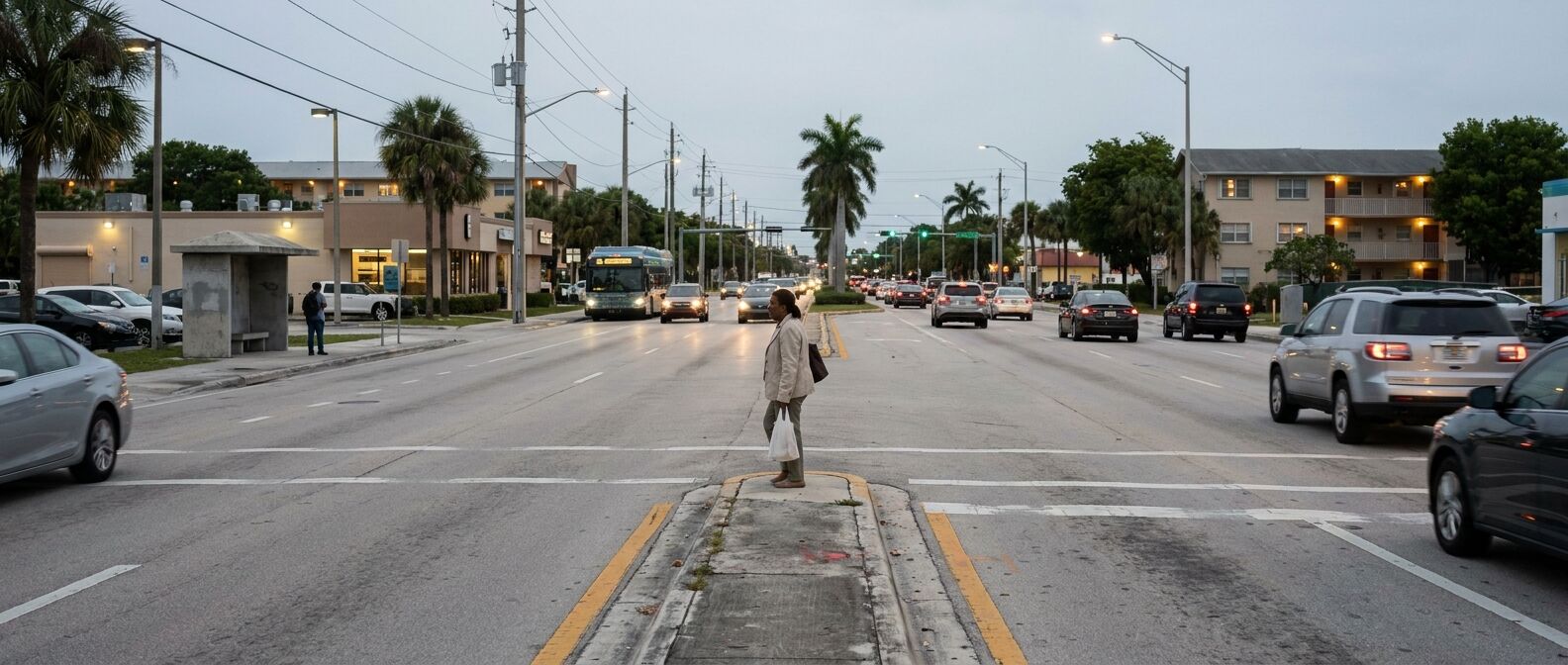
Pedestrian deaths in Miami are not scattered randomly across the map. They concentrate on a handful of corridors every local can name: US-1, Biscayne Boulevard, NW 7th Avenue, Flagler Street, Okeechobee Road, and the wide arterials that stitch the county together. The Smart Growth America "Dangerous by Design" reports have ranked Florida metros among the deadliest places to walk in America year after year, and the Miami pattern inside that statistic is specific enough to draw on a map.
The reason is the roads themselves. Miami's killer corridors share a design: six or more lanes, speeds posted at 40 and driven at 55, crosswalks a half mile apart, transit stops that strand riders across from their destinations, and lighting built for drivers rather than the people crossing in front of them. Traffic engineers call them arterials. The crash data calls them something else.
This article maps where Miami pedestrians actually get hit, explains why those corridors keep killing, and lays out the legal rights of the people struck on them, which are stronger than the victims usually believe. If you or a family member was hit by a vehicle anywhere in South Florida, Mausner Group Injury Lawyers offers free consultations at 305-344-4878.
The Corridors
US-1 (South Dixie Highway)
The county's long diagonal, running from downtown through Coral Gables, South Miami, and toward the Keys. High speeds, long gaps between signals, and a corridor lined with the stores, transit stops, and apartments that put people on foot beside it all day. The stretch through South Miami-Dade appears in fatal crash data with grim regularity.
Biscayne Boulevard (US-1 North)
The signal-dense stretch from downtown through the Upper East Side mixes nightlife crowds, transit riders, and wide crossings. Late-night crashes cluster here, and they overlap with the impaired-driving and hit-and-run patterns we described in our Brickell nightlife rideshare article. The intersection problem is compounded by long blocks that invite mid-block crossing, exactly the scenario where Florida's crosswalk rules, covered in our crosswalk law guide, get argued after the fact.
NW 7th Avenue and NW 27th Avenue
The north-south arterials through Liberty City, Little Haiti, and Opa-locka carry some of the county's highest pedestrian crash densities. These are working neighborhoods where people walk to transit by necessity, across roads built to move commuter traffic fast. Lighting and crosswalk spacing lag the corridors' actual use, and the crash data shows it after dark.
Flagler Street and SW 8th Street (Calle Ocho)
The east-west spines of the urban core. Dense retail, bus routes, and older residents walking daily errands meet turning traffic at hundreds of driveways and intersections. Calle Ocho's role as both a neighborhood main street and a commuter route is the exact conflict that produces left-turn and driveway strikes.
Okeechobee Road and the Palmetto's Surface Crossings
The industrial northwest, where truck corridors meet the county's most transit-dependent workforce. Crossing distances are enormous, and the vehicles are the heaviest on the road. The highway version of this geography is its own story, which Eric tells in our Palmetto Expressway piece; the surface streets around it are the pedestrian version.
Why These Roads Keep Killing
The pattern across every corridor is the same four failures. Speed, because a pedestrian hit at 40 mph dies in most cases while one hit at 25 usually survives, and these corridors are engineered for the higher number. Crossing distance, because six to eight lanes cannot be crossed in one signal cycle by an older adult, and refuge islands are rare. Crosswalk spacing, because when the nearest marked crossing is a half mile round trip, mid-block crossing is not recklessness, it is arithmetic. And lighting, because Florida's pedestrian deaths happen disproportionately after dark, on roads lit to make drivers comfortable at speed rather than to make people visible.
None of this excuses drivers, who owe every pedestrian due care under Florida law. But it has a legal consequence most victims never hear: Road design can make the government a defendant. Where a corridor's crossing spacing, signal timing, or lighting fell below engineering standards and contributed to a death, a claim against the responsible agency, with its special notice requirements, belongs in the case alongside the driver.
The Legal Rights of a Struck Pedestrian
Three points from our crosswalk law guide bear repeating because insurers count on victims not knowing them. Unmarked crosswalks legally exist at most intersections, so "they weren't in a crosswalk" is often simply false. Drivers owe due care to every pedestrian, in or out of a crosswalk, so even a mid-block crossing does not end the claim. And Florida's comparative fault system means a pedestrian assigned a share of blame still recovers, reduced by that share, as long as it stays at or below 50 percent.
The insurance picture is equally misunderstood. The driver's bodily injury coverage leads, but the pedestrian's own auto policy follows them onto the sidewalk: PIP pays initial medical bills, and uninsured motorist coverage answers for the uninsured and hit-and-run drivers these corridors produce in volume, the coverage we broke down in our UM claims guide. Pedestrians hit by rideshare drivers on active trips reach the $1 million rideshare tier. And because pedestrian injuries skew catastrophic, brain injuries, spinal damage, and deaths that become Wrongful Death Act claims, the lifetime damages work our catastrophic injury page describes is standard in these cases, not exceptional.
What the Evidence Race Looks Like
Pedestrian cases on these corridors are won in the first two weeks. Transit bus cameras, which ride every one of these routes, capture a huge share of crashes and are overwritten on short cycles. Business and doorbell cameras line the commercial stretches. Signal timing records fix who had the walk phase. Vehicle data fixes speed. The injured person is usually in no condition to gather any of it, which is the whole argument for getting counsel involved while the footage still exists.
For families and victims, the practical list is short: medical care immediately, preserve the clothing and shoes, report the crash, write down everything remembered about the vehicle while it is fresh, and get preservation letters out to the transit agency and corridor businesses fast. The two-year deadline from our statute of limitations guide governs the lawsuit. The cameras govern the case.
The Honest Conclusion
Miami's pedestrian deaths are concentrated, predictable, and documented, which means they are also preventable, by engineering, by enforcement, and by drivers who treat the corridors like the neighborhoods they run through. Until that happens, the people hit on these roads have strong legal rights and short evidence windows. Mausner Group Injury Lawyers handles pedestrian cases on every corridor named in this article, and our car accident practice page describes how we build them.
Frequently Asked Questions About Miami Pedestrian Accidents
What are the most dangerous roads for pedestrians in Miami?
The county's pedestrian crashes concentrate on its wide arterials: US-1/South Dixie Highway, Biscayne Boulevard, NW 7th and NW 27th Avenues, Flagler Street, SW 8th Street, and Okeechobee Road. High speeds, long crossing distances, sparse crosswalks, and poor lighting are the shared ingredients.
Why is Florida so dangerous for pedestrians?
National "Dangerous by Design" analyses consistently rank Florida metros among the worst in the country, a product of road networks built for vehicle speed through areas where people live, walk, and ride transit. Most deaths occur on exactly the kind of multi-lane arterials Miami is built around.
Can I recover compensation if I was hit outside a crosswalk?
Often, yes. Drivers owe due care to every pedestrian regardless of where they cross, unmarked crosswalks legally exist at most intersections, and comparative fault reduces rather than eliminates recovery as long as your share stays at or below 50 percent.
Can the city or state be liable for a pedestrian death?
Potentially. Where crossing spacing, signal timing, lighting, or road design fell below engineering standards and contributed to the crash, the responsible government agency can be a defendant alongside the driver. These claims carry strict pre-suit notice requirements, which is a reason to evaluate them early.
Whose insurance pays when a pedestrian is hit?
The driver's bodily injury coverage is the lead claim, but the pedestrian's own auto policy applies too: PIP covers initial medical bills even on foot, and uninsured motorist coverage answers for uninsured and hit-and-run drivers. Rideshare and commercial policies add layers when those vehicles are involved.
What should families do after a serious pedestrian crash?
Focus on medical care, and get the evidence race started: Transit bus and business camera footage on these corridors is overwritten within days, and it decides fault disputes the victim often cannot testify about. Preservation letters in the first week protect everything that follows.
Hit by a Driver on One of These Roads? You Have More Rights Than They Will Tell You
The corridor was built wrong, the driver was moving fast, and the insurer's first move will be blaming the person on foot. Our first move is the cameras. Mausner Group Injury Lawyers handles pedestrian cases across Miami-Dade and South Florida.
Call 305-344-4878 for a free consultation, available 24/7, in English or Spanish. You pay nothing unless we win.
This article is for general informational purposes only and does not constitute legal advice. Sources referenced include Smart Growth America's Dangerous by Design reports and FDOT crash data; Florida law referenced includes Fla. Stat. 316.130, 768.81, 768.28, 627.727, 627.736, and 95.11. Laws change; consult a licensed Florida attorney for advice specific to your situation.
