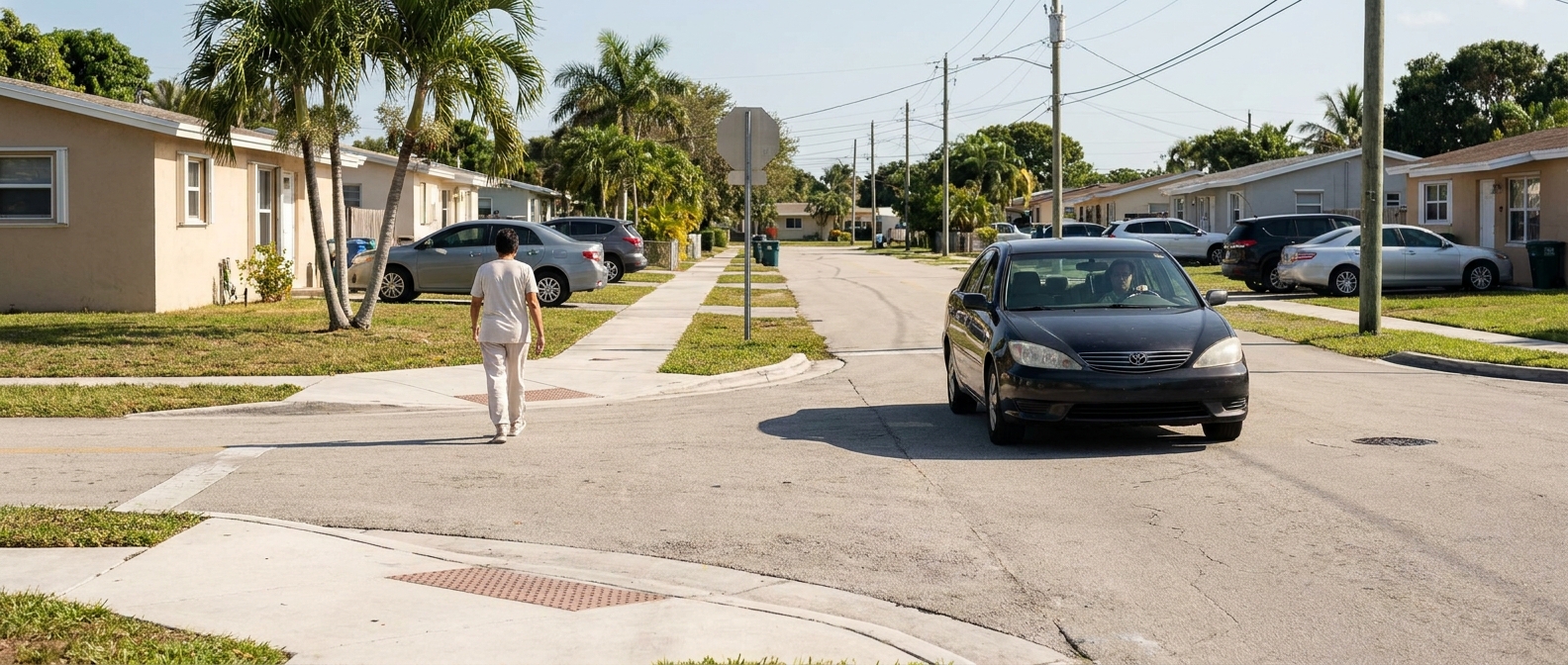
Florida's crosswalk law is misunderstood by almost everyone on both sides of the windshield. Drivers believe pedestrians outside a painted crosswalk have no rights. Pedestrians believe a crosswalk is a force field. Both are wrong, and the gap between what people believe and what Section 316.130, Florida Statutes, actually says decides injury cases every week in a state that perennially ranks among the deadliest in America for people on foot.
The real rules are more balanced and more interesting. Pedestrians have the right of way in crosswalks, including unmarked ones most drivers do not know exist. Pedestrians crossing elsewhere must yield, but drivers still owe them a duty the statute spells out in plain words: Every driver must exercise due care to avoid colliding with any pedestrian, regardless of who had the right of way. That sentence, the one nobody quotes, is often the one that wins the case.
This article walks through Florida's crosswalk and right of way rules, the unmarked crosswalk doctrine, what "jaywalking" actually means legally, and how all of it plays out after a pedestrian is hit. If you or a family member was struck by a vehicle anywhere in South Florida, Mausner Group Injury Lawyers offers free consultations. Contact us today.
The Rules, Driver Side and Walker Side
Section 316.130 lays out a two-way framework:
- Drivers must stop (not merely slow) for pedestrians in a crosswalk at signalized intersections when the pedestrian has the signal, and must yield to pedestrians in crosswalks generally, including when turning across them on a green light, the single most common Miami pedestrian crash we see
- Drivers must exercise due care to avoid hitting any pedestrian anywhere, sound the horn when necessary, and use proper caution around children and obviously confused or incapacitated people
- Pedestrians must obey pedestrian signals, use sidewalks where provided, walk facing traffic where there are none, and yield to vehicles when crossing outside a crosswalk
- Where an intersection has traffic signals, pedestrians between adjacent signalized intersections may cross only in a marked crosswalk
The design of the statute matters for injury cases: Almost no pedestrian crash involves a party with zero duties. The legal question is nearly always how the duties interact, which under Florida's comparative negligence rules becomes a percentage fight, and after HB 837, a fight with a cliff at 51 percent, as we explained in our comparative negligence guide.
The Unmarked Crosswalk Most Drivers Have Never Heard Of
Here is the rule that surprises drivers: A crosswalk legally exists at most intersections whether or not anyone painted one. Florida defines a crosswalk to include the extension of the sidewalk lines across the road at an intersection. A pedestrian crossing there, at an ordinary unpainted residential intersection, is in a crosswalk and generally holds the right of way.
This matters enormously in Miami's residential grid, where painted crossings are rare and insurers routinely tell struck pedestrians they were "jaywalking" at intersections where the law says the opposite. Whether an unmarked crosswalk existed at the crash location is a mapping and statutory question, not the adjuster's call, and getting it right has flipped liability in case after case.
What Jaywalking Actually Means in Florida
Florida has no offense called jaywalking. What exists is a set of crossing rules: yield when crossing mid-block, use the crosswalk between signalized intersections, obey the signals. Violating them can mean a pedestrian shares fault. It has never meant a driver is free to hit them.
Two legal principles protect even an imperfect pedestrian. First, the driver's statutory due care duty applies to every pedestrian, in or out of a crosswalk. A driver who had time and room to see and avoid someone, and did not, carries fault regardless of where the person crossed. Second, comparative negligence means a pedestrian found partially at fault still recovers, reduced by their share, as long as that share stays at 50 percent or below. A seriously injured pedestrian assigned 30 percent for crossing mid-block still has 70 percent of a claim that, in a catastrophic case, remains a substantial recovery.
Children get further protection. The statute specifically commands extra caution around children, and Florida law does not judge young children by adult standards at all, a principle we covered in our attractive nuisance guide.
Why Pedestrian Cases Are Evidence Cases
Pedestrian crashes generate a predictable factual fight: The driver says the person came out of nowhere, and the pedestrian, often unconscious or gone, cannot answer. The case is then won with reconstruction:
- Where the pedestrian was in the roadway at impact, established by the vehicle damage, the final rest positions, and injury patterns
- Sight lines and lighting, which answer whether "came out of nowhere" is physics or excuse
- Vehicle speed, recovered from event data recorders and crush analysis
- Signal timing records, which fix who had the walk signal at the moment of impact
- Camera footage, from intersections, buses, doorbells, and storefronts, which in Miami exists far more often than insurers hope
The driver's insurer starts building its comparative fault story immediately. The pedestrian's side has to match that speed, because the camera footage that proves the walk signal gets overwritten in days.
The Insurance Surprise in Pedestrian Cases
Struck pedestrians are often shocked to learn which policies cover them. The driver's bodily injury coverage is the main claim, but your own auto policy follows you onto the sidewalk: your PIP pays your initial medical bills even though you were on foot, as we explained in our PIP guide, and your uninsured motorist coverage applies if the driver who hit you carried nothing or fled, the exact scenario our UM guide covers. In a county with Florida's worst uninsured rates and a brutal hit and run problem, a pedestrian's own UM coverage is frequently the claim that matters. Pedestrians hit by rideshare drivers on an active trip can reach the $1 million rideshare tier we covered in our Brickell nightlife article.
After a Pedestrian Crash
The checklist is familiar, but the stakes are higher, because pedestrian injuries skew catastrophic: Get emergency care, report the crash, preserve the clothing and shoes, identify witnesses, and get a preservation letter out for signal timing and camera footage fast. The two-year deadline from our statute of limitations guide applies, and the serious injuries these crashes produce are exactly the lifetime-damages cases our catastrophic injury practice page describes. Our Miami car accident attorneys handle pedestrian cases across the county.
Frequently Asked Questions About Florida Crosswalk Laws
Do pedestrians always have the right of way in Florida?
No. Pedestrians have the right of way in marked and unmarked crosswalks, and drivers must yield accordingly, but pedestrians crossing outside a crosswalk must yield to traffic. Separately, drivers always owe a duty of due care to avoid hitting any pedestrian, wherever they are crossing.
What is an unmarked crosswalk?
The legal extension of the sidewalk across the road at an intersection, which exists whether or not lines are painted. A pedestrian crossing at an ordinary unpainted intersection is generally in a crosswalk with the right of way, a rule that defeats many "jaywalking" accusations in Miami's residential neighborhoods.
Is jaywalking illegal in Florida?
Florida has no offense named jaywalking. Crossing mid-block requires yielding to traffic, and crossing between signalized intersections requires using a crosswalk. Breaking those rules can assign a pedestrian a share of comparative fault, but it does not excuse a driver who failed to use due care.
Can I recover compensation if I was hit while crossing outside a crosswalk?
Often, yes. Drivers owe every pedestrian a duty of due care, and a pedestrian found partially at fault still recovers damages reduced by their percentage, as long as their share does not exceed 50 percent. Serious injury cases regularly succeed despite a mid-block crossing.
Whose insurance pays when a pedestrian is hit by a car?
The driver's bodily injury coverage is the primary claim, but the pedestrian's own auto policy also applies: PIP pays initial medical bills even for someone on foot, and the pedestrian's uninsured motorist coverage responds if the driver was uninsured or fled. Rideshare and commercial policies can add further layers.
What should I do if a family member was struck and seriously hurt?
Focus on their care, and get legal help moving quickly on the evidence: Signal timing records, camera footage, and witness accounts disappear within days, and the comparative fault story the insurer builds early is easier to prevent than to undo. Consultations cost nothing.
Struck by a Driver? The Law Protects You More Than the Insurer Admits
Insurance companies lean on crosswalk myths because the myths favor drivers. The statute does not. Mausner Group Injury Lawyers builds pedestrian cases on the law as written and the evidence at the scene, throughout Miami-Dade and South Florida.
Call 305-344-4878 for a free consultation, available 24/7. You pay nothing unless we win.
This article is for general informational purposes only and does not constitute legal advice. Florida law referenced includes Fla. Stat. 316.130, 316.075, 768.81, 627.727, 627.736, and 95.11. Laws change; consult a licensed Florida attorney for advice specific to your situation.