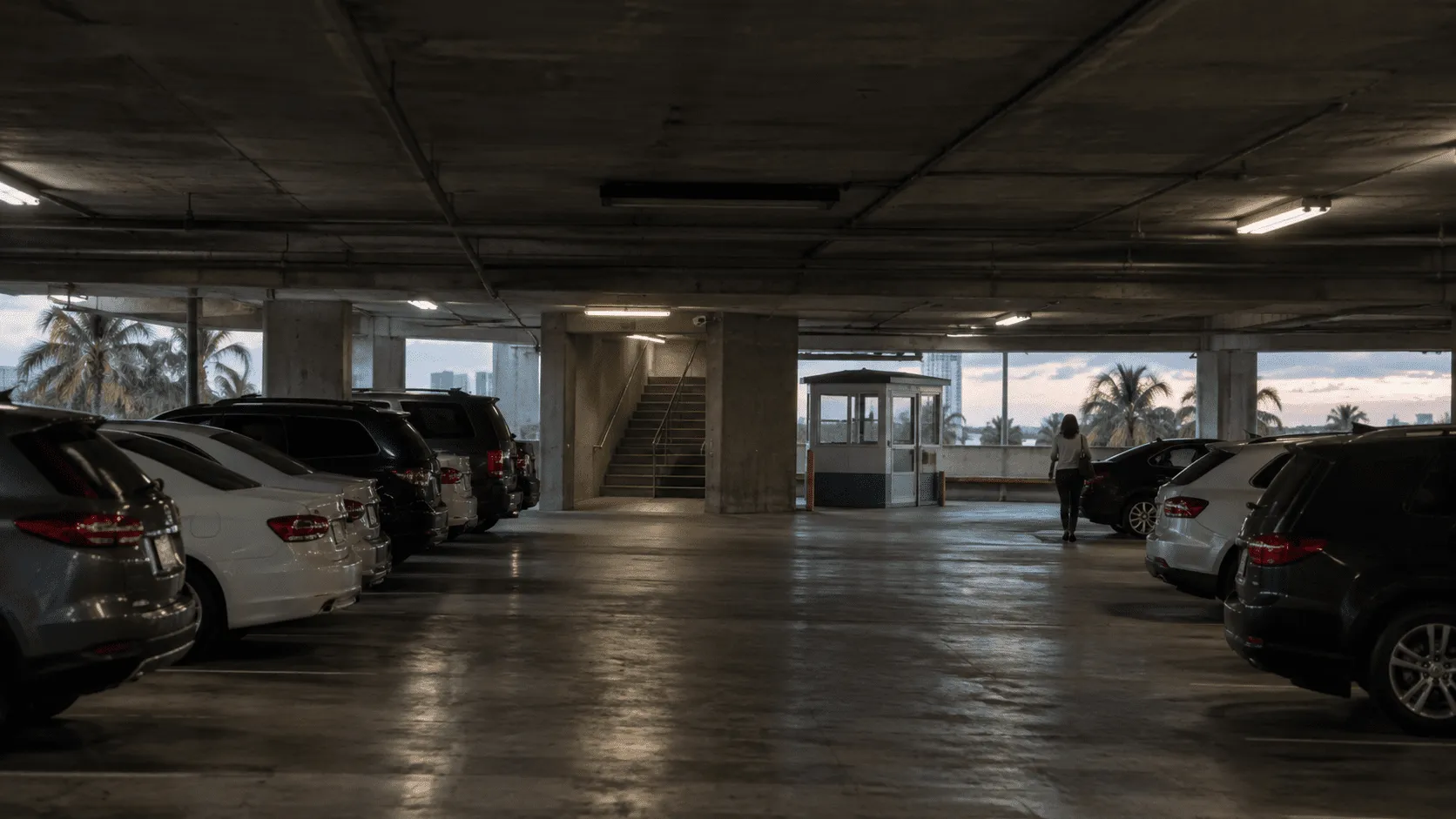
Ask any premises security expert where crime happens on commercial property and you will get the same answer: the parking facility. Not the store, not the lobby, not the pool deck. The lot and the garage, where lighting is thinnest, cameras are oldest, guards are rarest, and every customer walks alone to a predictable destination carrying keys, a phone, and whatever they just bought. National crime data has said it for decades, and our negligent security caseload says it weekly: Parking areas are where robberies, carjackings, and assaults concentrate.
Florida law has an answer for the people hurt there. A business that invites you to park does not get to treat the garage as someone else's problem. The duty of reasonable care that protects you inside the store extends to the parking facility that serves it, and when an attack happens in a lot with burned-out lights, dead cameras, and a security contract cut to the bone, the owner's negligence is part of why you were hurt.
This article explains who is responsible for parking facility attacks, what reasonable security actually looks like in a lot or garage, and how these cases are proven. If you or a family member was attacked in a parking area anywhere in South Florida, the Miami negligent security lawyers at Mausner Group Injury Lawyers offer free, confidential consultations at 305-344-4878.
Why Parking Facilities Are Where Attacks Happen
The geography does the explaining. A parking facility combines everything an attacker wants and everything a victim fears: isolation inside a crowd, sight lines broken by columns and parked cars, multiple escape routes, and a steady supply of distracted people walking to a known point, their own vehicle, often at night. Garages add vertical isolation, by the time you reach level four, the crowd from the elevator lobby is gone.
Miami's versions are everywhere: the municipal garages downtown and in Brickell, mall and shopping plaza lots from Dadeland to Aventura, hospital and airport garages, hotel valet and self-park structures on the Beach, apartment and condo garages, and the surface lots behind every strip plaza in the county. Each has an owner or operator who decided, line item by line item, how much security to provide.
The crime patterns repeat: robberies at or near the victim's car, carjackings at entry and exit points, assaults in stairwells and elevator lobbies, and attacks that begin with a follow from the street or the store. Many involve weapons. The injuries we see in these cases, gunshot and stab wounds, beatings, head injuries from being thrown to the pavement, are among the most serious in our practice, and the trauma does not end when the physical injuries heal.
Who Can Be Held Responsible
More parties than most victims expect, and sorting them out is the first job in every case:
- The property owner, who owes invited visitors reasonable protection from foreseeable crime on the premises, parking areas included
- The parking operator, the management company running the garage under contract, whose name is on the ticket and whose staffing decisions are in the file
- The business the lot serves, when the lot exists for its customers: the mall, the supermarket, the restaurant, the hotel, the hospital
- The security contractor, when guards were hired, but the service failed: posts abandoned, patrols skipped, logs falsified
- A landlord or association, in shared facilities serving multiple tenants, where leases divide responsibility for common areas
These defendants point at each other, the store says the landlord controls the lot, the landlord points to the parking operator, the operator blames the security vendor. The answers live in leases, management agreements, and security contracts, which is why negligent security cases in parking facilities routinely name several defendants and let discovery sort out who owned which failure. We walked through the same control fight for trip and fall injuries in parking facilities, and it is even sharper when the hazard is crime.
What Reasonable Security Looks Like in a Lot or Garage
The duty is reasonable care against foreseeable crime, and what that requires scales with the risk, the prior incidents at the property and around it, the neighborhood's crime grid, the hours, the cash businesses nearby. For parking facilities, the security measures at issue are concrete and measurable:
- Lighting, measured in foot-candles, across the parking surface, at entrances, and in the stairwells and elevator lobbies where attacks cluster. Burned-out fixtures noted in maintenance logs for months are a plaintiff's exhibit waiting to happen
- Cameras that work and are watched, covering entrances, exits, pay stations, and the levels in between. A camera system with dead zones over the exact spot of the attack, or footage nobody preserved, tells its own story
- Patrols and posts, whether a staffed booth, roving guards, or courtesy escorts, matched to the facility's hours and history
- Access control in garages: gates that close, stairwell doors that lock from the outside, elevators that require a ticket or key after hours
- Emergency call stations and signage that let a victim summon help and tell a jury the owner thought about safety, or did not
The gap between what the risk demanded and what the owner provided is the breach, and it is proven the way we described in our guide to proving a negligent security case: police calls-for-service for the address, the property's own incident files, the security contract and staffing schedules, and expert testimony on what a facility with this history should have had.
Florida's HB 837 framework adds a wrinkle for one category: Apartment and condo parking under the statute's multifamily provisions, where owners who implemented the Section 768.0706 checklist, cameras at entrances, lighting standards, locking devices, earn a presumption against liability. For garages serving multifamily buildings, the checklist items an owner skipped become the breach list, written by the Legislature.
What to Do After a Parking Facility Attack
The criminal case and the civil case start in the same place: a police report, the same night, if possible. Then, the steps that protect the civil claim, most of which have short fuses:
- Get medical care immediately, and document everything, injuries, torn clothing, the scene if you can safely photograph it.
- Note the exact location, the level, the row, the nearest column number. Garages are big and the camera question turns on precision.
- Identify the facility's operator, the name on the ticket, the signage, the pay station. That is defendant number one.
- Act fast on the footage. Garage camera systems overwrite in days. A preservation letter from counsel in week one is often the difference between a documented attack and a disputed one.
- Do not give statements to the property's insurer, and do not accept the "there was nothing we could do" framing. That is the causation defense, delivered early, and it is answered with evidence, not accepted at face value.
The civil claim belongs to you whether or not the attacker is ever caught. Most of our negligent security clients never see their attacker arrested. The case targets the property's failures, and those are documented in records that exist regardless of the criminal investigation's outcome, as long as someone moves to preserve them. The two-year statute of limitations governs the deadline, but the evidence sets the real schedule.
Frequently Asked Questions About Parking Lot and Garage Attacks
Can I sue if I was attacked in a parking lot in Florida?
Yes, if the attack was foreseeable and the property's security fell short of reasonable care. Florida businesses owe invited visitors protection from foreseeable crime in their parking areas, and a victim can bring a negligent security claim against the owner, the parking operator, and other responsible parties.
Who is liable for an assault in a parking garage?
Potentially several parties: the property owner, the parking management company, the business the garage serves, and a security contractor that failed to perform. Leases and contracts divide responsibility, so these cases often name multiple defendants and use discovery to establish who controlled what.
What if the attacker was never caught?
The civil case proceeds anyway. A negligent security claim targets the property's failures, inadequate lighting, broken cameras, missing patrols, not the criminal, and most successful cases involve attackers who were never identified or prosecuted.
What counts as inadequate security in a parking facility?
Security that falls short of what the foreseeable risk demanded: insufficient lighting, cameras that were broken or unmonitored, no patrols despite a history of crime, unlocked stairwell doors, and missing access control. Prior incidents at and around the property define what the owner should have anticipated.
Is the store responsible if I was attacked in its parking lot?
Often, yes. When a lot exists to serve a business's customers, that business shares the duty to keep it reasonably safe, even if a landlord or parking operator handles day-to-day management. The lease and management agreements determine how responsibility is divided.
How long do I have to file a negligent security claim in Florida?
Two years from the attack in most cases. The practical deadline is much shorter, because garage camera footage typically overwrites within days and witness memories fade. Early investigation preserves the claim without committing you to a lawsuit.
Attacked Where You Parked? The Property's Choices Are Part of the Story
The attacker made a choice. So did the property that left the lights broken and the cameras dead. Eric J. Mausner spent years as a prosecutor holding criminals accountable; now he holds property owners accountable for the conditions that invite them. Mausner Group Injury Lawyers handles negligent security cases across Miami-Dade and South Florida.
Call 305-344-4878 for a free, confidential consultation, available 24/7, in English or Spanish. You pay nothing unless we win.
This article is for general informational purposes only and does not constitute legal advice. Florida law referenced includes Fla. Stat. 768.0706 and 95.11, as amended by HB 837 (2023), and Florida premises liability case law. Laws change; consult a licensed Florida attorney for advice specific to your situation.
