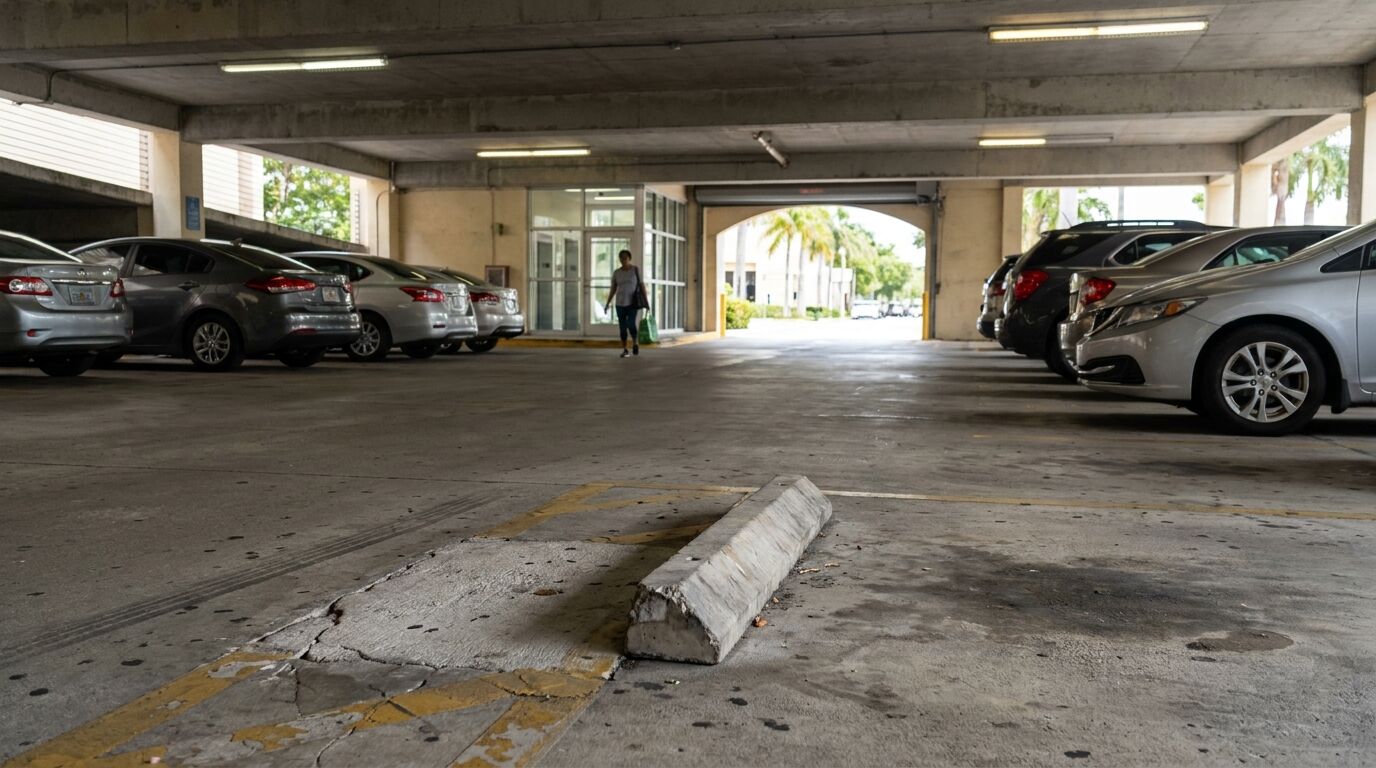
Nobody thinks of a parking lot as dangerous until the ground proves otherwise. Parking facilities produce a steady share of Florida's serious fall injuries for a simple reason: they are the one property type built entirely of hazards, uneven asphalt, wheel stops, oil and fluid slicks, storm-flooded surfaces, dark stairwells, and concrete everywhere a body can land. And unlike a store aisle, nobody is assigned to watch them.
The legal question after a parking facility fall is rarely whether a hazard existed. It is who answers for it, and the answer is less obvious than it looks. The lot behind a Wynwood restaurant may belong to a landlord, be maintained by a contractor, and serve a tenant business, three parties, three insurers, and a lease that divides the duty among them. Downtown and Brickell garages add operators, valet companies, and condo associations to the mix.
This article explains how responsibility for parking lot and garage falls actually gets assigned in Florida, the recurring hazards that produce these cases, and the steps that protect a claim. If you were hurt in a fall at a parking facility anywhere in South Florida, the premises liability lawyers at Mausner Group Injury Lawyers offer free consultations at 305-344-4878.
The Duty: What Parking Facility Owners Owe You
A paying customer, a shopper, a resident's guest, nearly everyone legally in a parking facility is an invitee under Florida law, owed the full premises duty: reasonable inspection for hazards, repair or warning within a reasonable time, and maintenance of a reasonably safe property. That duty covers the surfaces, the lighting, the stairwells and elevators, the drainage, and the design choices that make a facility safe or treacherous.
Two features distinguish parking cases from store falls. First, the transitory substance statute that governs supermarket spills, which we covered in our grocery store guide, matters less here, because parking hazards are mostly permanent or long-developing conditions: the pothole that grew for a year, the stairwell light out for a month, the chronic oil slick in the same corner. Long-standing conditions make the owner's knowledge far easier to prove, since the condition itself testifies to how long it existed. Second, inspection and maintenance are usually contracted out, which multiplies defendants rather than excusing the owner.
The Hazards That Produce These Cases
- Broken and uneven pavement: potholes, alligator cracking, abrupt elevation changes between asphalt and concrete, and the parking bumper or wheel stop placed where no one walking between cars can see it
- Oil, transmission fluid, and grease slicks, which accumulate in the same stalls for months
- Standing water and algae, a South Florida specialty, where poor drainage meets daily storms and shaded concrete grows a slick film
- Stairwells and ramps: worn nosings, missing or loose handrails, and lighting that fails and stays failed
- Lighting generally, which does double duty in these cases, since darkness both hides tripping hazards and defeats the warning value of any paint or signage
- Construction and repair zones left unmarked between work shifts
Garages add their own catalog: low-visibility pedestrian paths that force walkers behind reversing cars, slick painted surfaces, and elevator lobbies where tile meets ramp.
Who Actually Answers: Following the Control
The defendant list in a parking fall case follows control of the facility, and the documents decide it:
- The property owner, who holds the baseline duty and cannot fully contract it away
- The business tenant, where the lease assigns it maintenance of the lot or the lease language makes the lot part of the premises it controls
- The parking operator or management company running a garage day to day
- Maintenance and sweeping contractors whose logs show what was inspected and when, or more often, what was not
- Condo and homeowners associations for residential garages and guest parking
- Valet companies, for the zones they stage and control
We walked through the same owner-versus-tenant question for wet floor cases in our warning sign guide, and it matters even more here: naming only the business whose storefront you parked at, and learning in discovery that the landlord owned the lot, is the classic self-inflicted wound. The lease, the management agreement, and the maintenance contract answer the control question, and your lawyer gets them. You cannot.
One honest boundary: this article covers falls. When the parking facility failure is violence, the robbery in the unlit garage, the assault by the stairwell, that is a negligent security case built on the foreseeability principles we covered in our prior crime article, and it is its own topic we will treat separately.
The Government Garage Wrinkle
A meaningful share of Miami's parking happens in publicly owned facilities: county and municipal garages downtown, Miami Parking Authority lots, airport and seaport parking, and the surface lots at parks and government buildings. Falls there follow the same premises principles with one critical addition: claims against government entities require formal pre-suit notice under Section 768.28, Florida Statutes, with its own deadlines and damage caps, before any lawsuit can be filed.
The notice requirement is unforgiving and the clock is shorter than it looks, which makes early identification of a public owner essential. A garage that looks private is sometimes county-owned and operated by a private contractor, and that structure can mean two defendants under two different sets of rules, the contractor under ordinary negligence law and the public owner under the sovereign immunity framework. Sorting it in month one, not month twenty, protects both claims.
What These Injuries Look Like
Concrete and asphalt are unforgiving. Parking facility falls produce wrist and hip fractures, shoulder injuries requiring surgery, knee damage, and head strikes, and the victims skew older, since parking is where every errand begins and ends. The serious cases become the lifetime-damages claims our catastrophic injury page describes, and Florida's comparative fault rules, with the 51 percent bar we explained in our comparative negligence guide, frame the predictable defense: you should have watched where you were walking. The answer is the same as in every premises case: the law does not require pedestrians to walk staring at the ground, and a hazard the owner let ripen for months is the owner's responsibility, not the walker's.
Protecting the Claim
The evidence in parking cases is unusually durable, the pothole does not clean itself up, but the window still matters:
- Photograph the hazard immediately, with something for scale, plus the lighting conditions if the fall happened after dark
- Report the fall to the business, the operator, or the association, and get the incident documented
- Identify witnesses, including the valet or attendant who has seen the hazard for months
- Get medical care the same day
- Preserve footwear and clothing, and request camera footage fast, since garage surveillance cycles quickly even when the pavement does not change
Florida's two-year deadline, covered in our statute of limitations guide, applies, and the lease-and-contract work that identifies every responsible party takes time worth starting early. Our slip and fall practice page explains how we build these cases across Florida.
Frequently Asked Questions About Parking Lot and Garage Falls
Who is liable if I fall in a parking lot in Florida?
Whoever controlled the condition that caused the fall: the property owner, the tenant business where the lease assigns lot maintenance, the parking operator or management company, or the contractors responsible for maintenance and lighting. Leases and management agreements decide the question, and more than one party often shares responsibility.
Can I sue if I tripped over a wheel stop or parking bumper?
Potentially, yes. Wheel stops placed in walking paths, unpainted, broken, or hidden by darkness have supported many Florida premises claims. The analysis turns on visibility, placement, lighting, and whether the facility followed its own standards and industry practice.
Is the business I was visiting responsible, or the lot's owner?
It depends on the lease. Some tenants control and maintain their parking areas; other lots remain the landlord's responsibility or a shared common area. Injured visitors rarely can tell from the outside, which is why these cases start by obtaining the lease and management contracts and naming every party with control.
What if I fell in a dark parking garage stairwell?
Lighting is part of the premises duty, and a stairwell light that has been out long enough becomes strong evidence of negligent maintenance. Photograph the conditions immediately, because lighting gets fixed fast after an incident report, and the before picture is the case.
Does it matter that my fall happened after a rainstorm?
Not in the way facilities hope. Florida property owners are not liable for rain itself, but chronic drainage failures, algae-slicked concrete, and flooded walkways the facility never addresses are maintenance problems, not weather. South Florida's daily storms make standing water a foreseeable, manageable condition.
How long do I have to file a parking lot injury claim?
Two years under Florida's statute of limitations. The hazard itself may persist, but camera footage, maintenance records, and witness availability fade quickly, and identifying every responsible company through the contracts takes time. Early investigation protects all of it.
Hurt in a Parking Lot or Garage? Find Out Who Answers for It
The pavement did not maintain itself, and the companies responsible for it have insurance for exactly this. Mausner Group Injury Lawyers handles parking facility injury cases across Miami-Dade and South Florida.
Call 305-344-4878 for a free consultation, available 24/7. You pay nothing unless we win.
