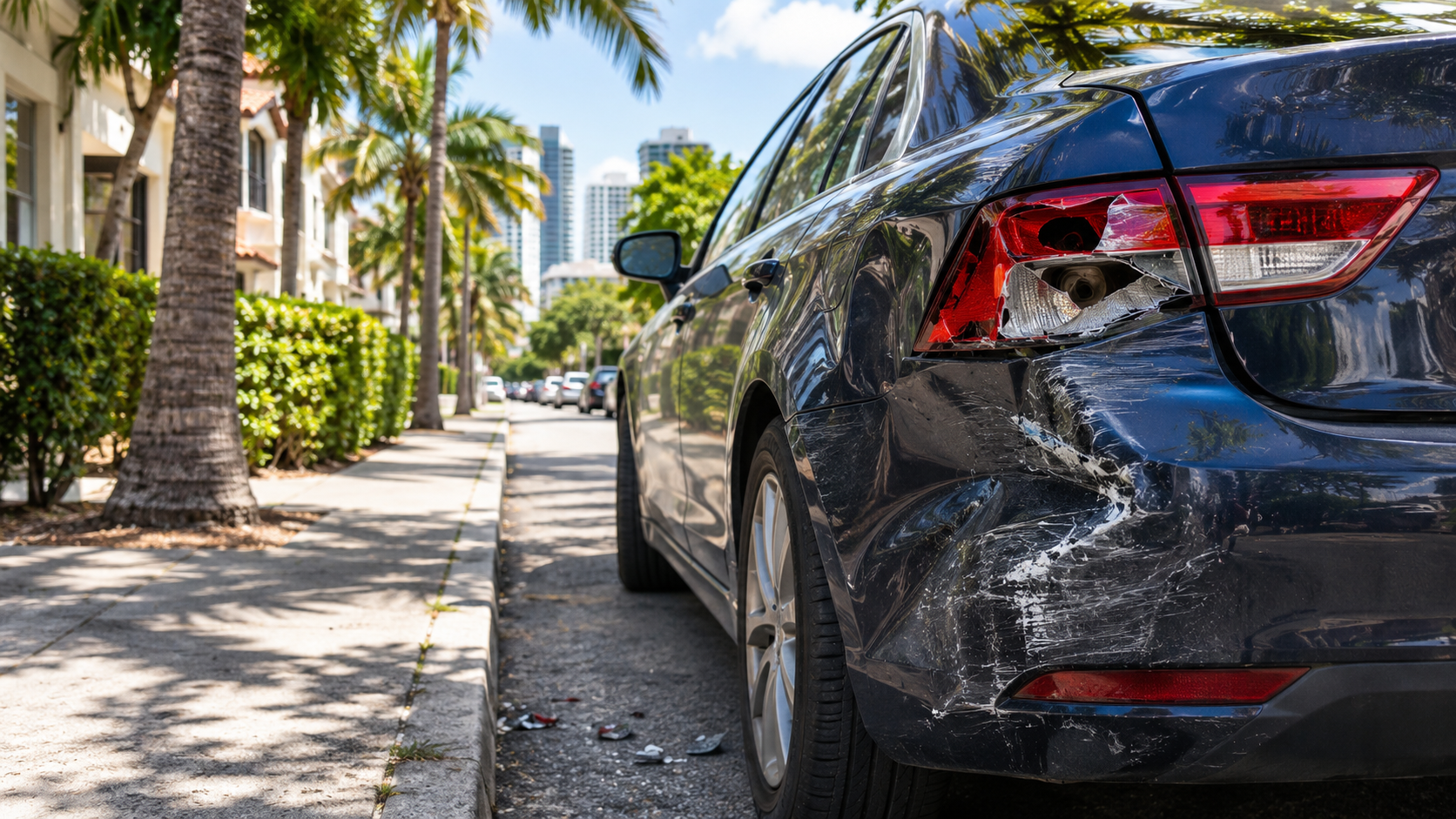
It is the most common hit-and-run there is, and it never makes the news. You walk out in the morning and your car is wrecked: a crushed quarter panel on the street in Little Havana, a sheared mirror in a Brickell garage, a caved-in door in the Publix lot, and no note, no witness, no driver. Just damage, a ruined morning, and a string of questions nobody ever teaches you the answers to.
Florida logs over a hundred thousand leaving-the-scene crashes in a typical year, and Miami-Dade leads the state's counties again and again. A huge share of those are parked-car hits, and the law is blunt about them: leaving the scene after striking an unattended vehicle without making a reasonable effort to notify the owner is a crime in Florida, note or no note. The driver who clipped your car and drove off did not just cost you money. They broke the law.
This guide walks through what to do in the first hour, which insurance actually pays (the answer surprises almost everyone), when a parked-car hit turns into something bigger, and how often these drivers actually get found. If anyone was in or near the car when it was hit, that changes everything, and the injury side is covered in our hit-and-run accident guide. For the questions in between, the Miami car accident lawyers at Mausner Group Injury Lawyers are at 305-344-4878.
The First Hour: Build the File Before You Touch Anything
The instinct is to inspect the damage and start making calls. Resist it for ten minutes and document first, because everything that follows, the police report, the insurance claim, any hope of finding the driver, is built on what you capture now:
- Photograph everything before moving the car: wide shots showing where it is parked, close shots of the damage, the debris field on the pavement, and any paint transfer, the streak of the other car's color is evidence, and body shops and police can work with it
- Look for the pieces they left behind. Fleeing cars shed parts: mirror housings, bumper fragments, trim. Those fragments often carry part numbers that narrow the make and model
- Canvass for cameras immediately. This is the step that actually finds drivers. Miami is blanketed in them: doorbell cameras on residential streets, business security systems, garage and lot cameras, and the dashcams of parked cars nearby, many record while parked. Note every camera with a view, knock on the door or ask the business the same day, and ask them to preserve the footage, most systems overwrite within days
- Ask around. The neighbor who heard the bang at 2 a.m., the valet who saw the truck clip the row, the dog walker who passes every morning. Parked-car hits have more witnesses than people assume
- File a police report the same day. For a parked-car hit this usually means a crash report or an online report, and it matters twice: it is a legal record of when and where the damage happened, and your insurer will effectively require it before treating the claim as a hit-and-run rather than "damage you cannot explain"
Who Actually Pays, and the Answer Most People Get Wrong
Here is the coverage reality, and it is worth reading twice because it is the part everyone misunderstands.
If the driver is never identified, your collision coverage pays, minus your deductible. Not uninsured motorist coverage. Florida UM coverage is bodily injury coverage: it compensates people, not bumpers. A property-only parked-car hit runs through your own collision coverage, with your deductible coming out of your pocket, which feels deeply unfair and is nevertheless how the system works. If you carry no collision coverage, an unidentified parked-car hit is, bluntly, your loss, which is a real argument for carrying it in the county that leads Florida in hit-and-runs.
If the driver is identified, everything changes. Their property damage liability coverage pays for your car with no deductible, plus your rental and related costs. This is why the camera canvass is worth the effort even for "just" property damage: one doorbell clip with a plate converts a deductible-and-rate-worry problem into a claim against the driver's insurer. It also hands the police a leaving-the-scene case, and Florida treats those seriously.
If anyone was in the car, or loading it, it is an injury case, and a different claim entirely. A person struck while sitting in, entering, or loading a parked car has the full hit-and-run injury framework available: PIP for initial medical bills with the 14-day treatment deadline, and uninsured motorist coverage standing in for the fled driver on the serious-injury side. That path, and the mistakes that quietly kill those claims, is exactly what our hit-and-run accident page covers. The one-sentence version: if your body was involved and not just your bumper, call before you talk to any insurer.
A note on rate fear. The question everyone asks: will claiming this raise my rates? Florida law restricts insurers from surcharging you for accidents you did not cause, and a documented parked-car hit-and-run with a police report is the textbook not-at-fault claim. That is one more reason the same-day report matters: it is the paper that marks the claim as someone else's doing.
Where It Happens, and How Drivers Get Caught
The geography is familiar to anyone who parks in this county. Residential streets in the neighborhoods where parking is tight, Little Havana, Shenandoah, the Beach's side streets, collect the overnight hits. Parking garages downtown and in Brickell produce the pillar-and-bumper scrapes and the mysterious door craters. Retail lots, the Publix, the mall, the big-box corridors, produce the daytime hits, where the at-fault driver is often parked thirty feet away deciding whether to leave a note. And apartment and condo garages have a version all their own, where the fleeing driver may literally live in the building, and where the property's own gate and garage cameras, the same systems we scrutinize in our premises security work, can answer the question in an afternoon.
Drivers do get caught, more often than cynics expect. The solves come from exactly the evidence the first-hour checklist preserves: camera footage, paint transfer matched to a make and color, shed parts with part numbers, witness partial plates, and, in garages and lots, entry and exit records. Police prioritize injury hit-and-runs over property ones, realistically, so the more of the file you hand them pre-built, the better the odds. We have seen parked-car cases solved by a single doorbell notification and a neighbor who checked their app.
When to Involve a Lawyer
Honestly: for a pure property-damage parked-car hit with no driver found, most people do not need a lawyer, they need the checklist above, their collision coverage, and a good body shop. Where it changes:
- Anyone was in or near the car, injuries from parked-car strikes are routinely worse than they first feel, and the 14-day PIP clock is running
- The driver was identified and their insurer is slow-walking, lowballing, or disputing obvious liability
- The hit happened in a garage or lot whose operator refuses to preserve or share footage, a preservation letter changes that conversation
- Your own insurer is treating a documented hit-and-run as an at-fault or "unexplained damage" claim
Those calls cost nothing, and the first one is usually five minutes of "here is what to do" either way.
Frequently Asked Questions About Parked-Car Hit-and-Runs
What should I do if someone hit my parked car and left no note?
Photograph everything before moving the car, collect any debris or paint transfer, canvass for cameras the same day, ask potential witnesses, and file a police report immediately. The report is what lets your insurer treat it as a hit-and-run, and the cameras are your best chance of finding the driver.
Is hitting a parked car and leaving illegal in Florida?
Yes. Florida law requires a driver who strikes an unattended vehicle to stop and make a reasonable effort to notify the owner, leaving a note with contact information or reporting it. Driving off is a criminal offense, separate from the civil responsibility for the damage.
Who pays when someone hits your parked car and leaves?
If the driver is never identified, your own collision coverage pays, minus your deductible. Uninsured motorist coverage does not apply to property-only claims in Florida, it covers injuries. If the driver is identified, their property damage liability coverage pays with no deductible to you.
Will a parked-car hit-and-run claim raise my insurance rates?
Florida law restricts insurers from surcharging for crashes you did not cause, and a documented parked-car hit-and-run is a textbook not-at-fault claim. The same-day police report is the key document establishing that.
What if I was sitting in my car when it was hit?
Then it is an injury claim, not a property claim, and far more coverage applies: PIP for initial medical care (within 14 days) and your uninsured motorist coverage standing in for the fled driver. Get medical attention promptly and get advice before giving any insurer a statement.
How often do police find parked-car hit-and-run drivers?
More often than people assume when evidence is preserved: camera footage, paint transfer, shed vehicle parts, and partial plates all produce solves. Property-only cases get less police priority than injury cases, so a well-documented file handed to the officer meaningfully improves the odds.
Hit While Parked? Ten Minutes of Documentation Beats a Month of Arguing
Most parked-car hit-and-runs are won or lost in the first hour, by the photos, the cameras, and the report. If yours involves an injury, an identified driver, or an insurer that will not play straight, we are here. Mausner Group Injury Lawyers handles hit-and-run cases across Miami-Dade and South Florida.
Call 305-344-4878 for a free consultation, available 24/7, in English or Spanish. You pay nothing unless we win.
This article is for general informational purposes only and does not constitute legal advice. Florida law referenced includes Fla. Stat. 316.063, 316.027, 626.9541, 627.727, and 627.736. Laws change; consult a licensed Florida attorney for advice specific to your situation.
