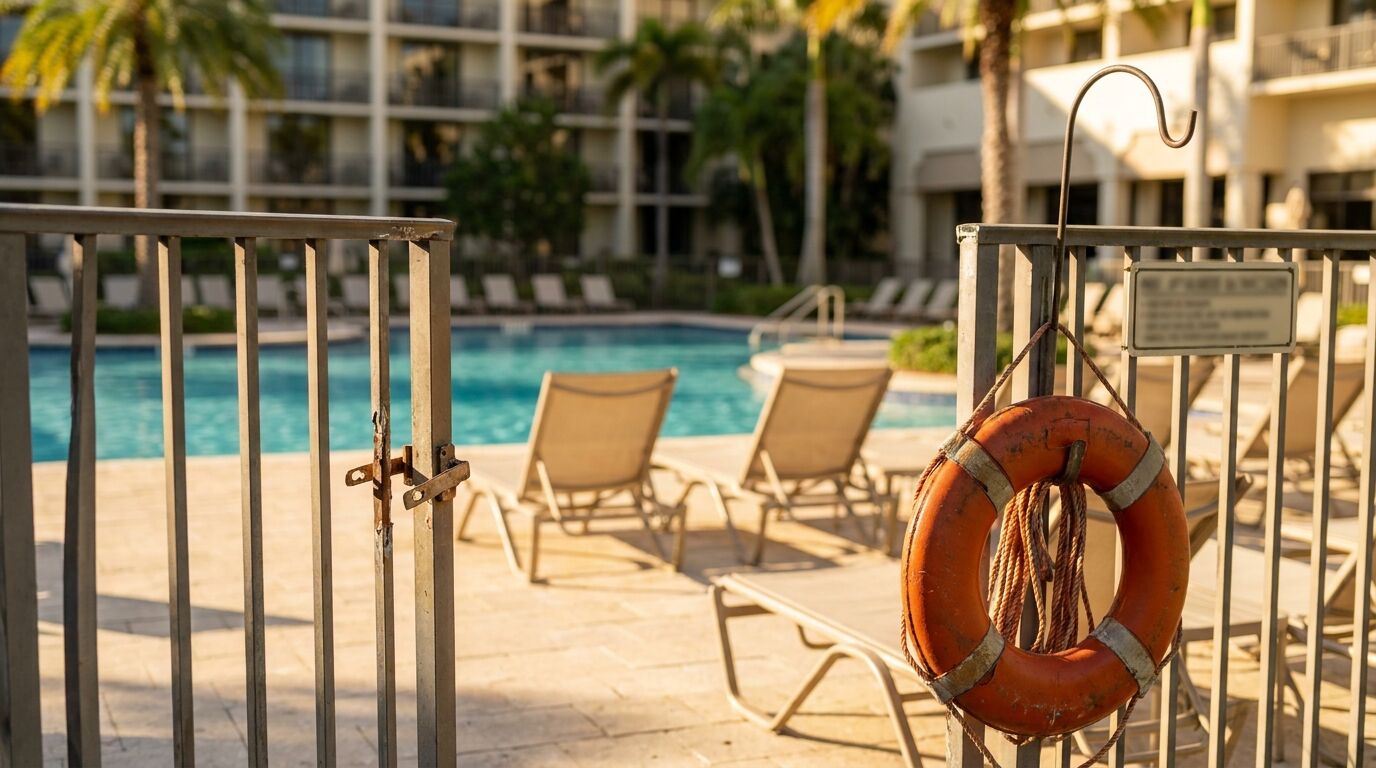
Florida law does not require hotels to post lifeguards at their pools, but that does not make a hotel blameless when a guest drowns. Hotels owe their guests a duty of reasonable care, and when a drowning traces back to a broken gate, cloudy water, missing safety equipment, or an unmaintained drain, the hotel can be held liable for it.
Millions of visitors swim in Miami's hotel pools every year, from the resort towers on Collins Avenue to the rooftop pools of Brickell. Most families assume someone is watching out for their safety. Legally, someone is supposed to be: the hotel itself.
This article explains the rules Florida applies to hotel and resort pools, the difference between an unavoidable tragedy and actionable negligence, and what families, including families visiting from out of state, can do after a drowning or near-drowning. The Miami premises liability lawyers at Mausner Group Injury Lawyers handle these cases throughout South Florida, and consultations are free and confidential at 305-344-4878.
The Rules That Govern Hotel Pools
Hotel and resort pools are not covered by the residential pool law we explained in our guide to Florida's Residential Swimming Pool Safety Act. They are public swimming pools, regulated by the Florida Department of Health under Chapter 514 of the Florida Statutes and the state's public pool rules.
Those rules require operating permits and inspections, and they set standards for water clarity, depth markings, safety equipment such as shepherd's hooks and ring buoys, barriers and self-closing gates, and drain covers. Federal law adds another layer: the Virginia Graeme Baker Pool and Spa Safety Act requires anti-entrapment drain covers in public pools, a response to a series of horrific suction-entrapment deaths involving children.
A hotel that lets its permit lapse, fails inspections, or ignores these standards is not just risking a citation. It is building the evidence file for the next drowning case.
No Lifeguard Required Does Not Mean No Responsibility
Florida generally allows hotels to operate pools without lifeguards as long as they post warning signage. Hotels sometimes treat that sign as a force field against liability. It is not.
The sign addresses one specific risk: No one is on duty to rescue you. It does nothing to excuse the hazards the hotel itself controls:
- Gates and fences that do not self-close or latch, giving unsupervised children a path to the water
- Cloudy or algae-clouded water that hides a struggling swimmer or a body on the bottom
- Missing or broken rescue equipment that turns a survivable incident into a fatal one
- Broken underwater lighting that makes evening swimming blind
- Non-compliant drains with entrapment risk
- Hotel-organized pool activities or kids' programming run without adequate supervision
- Bars serving guests to obvious intoxication feet from the water
When one of these failures contributes to a drowning, the "swim at your own risk" sign does not answer for it.
Children, Tourists, and the Foreseeability Problem
Hotels know exactly who uses their pools: families with young children, travelers who may be weak swimmers, and guests who have been drinking. Florida premises law calibrates a property owner's duty to what it can foresee, and nothing is more foreseeable at a Miami Beach resort than a child near the pool at dusk while parents unpack.
That foreseeability shapes everything. A latch the maintenance log shows broken for three weeks reads very differently when the hotel's own records show hundreds of children checked in during those weeks. Young children cannot be blamed for their own drownings under Florida law, and hotels that market themselves to families are held to what they invited.
What a Hotel Pool Drowning Case Looks Like
These cases are records cases. The investigation typically pulls:
- Department of Health inspection reports for the pool, which are public records and often show a history
- The hotel's internal maintenance logs, incident reports, and prior guest complaints
- Surveillance footage, which hotels overwrite quickly and which must be preserved fast
- Staffing and training records for any pool attendants or activities staff
- Permit history and any past citations
A drowning at a permitted, inspected, well-maintained pool with functioning equipment may be a true accident. A drowning at a pool with a paper trail of violations is something else. The difference lives in documents the hotel controls, which is why an early preservation letter matters as much here as in any trucking case.
Out-of-State Families Can Bring Florida Claims
Many hotel drowning victims are tourists, and grieving families often assume that going home to Ohio or New York ends their options. It does not. The claim arises under Florida law where the drowning happened, a Florida wrongful death claim is filed by the estate's personal representative on behalf of the survivors, and a Florida firm can handle the case while the family remains home. Distance is a logistics problem, not a legal one.
The same two-year wrongful death deadline we covered in our statute of limitations guide applies, and hotel surveillance footage disappears far faster than that.
Where This Fits in the Drowning Series
This article is part of our broader work on South Florida water deaths, alongside our guides to retention pond drownings and the drowning risk faced by children with autism, a risk that follows families to hotels, where unfamiliar layouts and busy check-in windows are exactly when elopement happens. Our premises liability practice page explains how we investigate all of these cases.
Frequently Asked Questions About Hotel Pool Drownings
Are hotels in Florida required to have lifeguards?
Generally no. Florida allows hotels and resorts to operate pools without lifeguards if they post warning signage. The absence of a lifeguard does not eliminate the hotel's duty to maintain safe barriers, clear water, working safety equipment, and compliant drains.
Can I sue a hotel if someone drowned in its pool?
Potentially, yes. A hotel can be liable when a drowning is connected to its negligence, such as broken gates, cloudy water, missing rescue equipment, non-compliant drains, inadequate supervision of hotel-run activities, or code violations documented in inspection records.
Who regulates hotel and resort pools in Florida?
The Florida Department of Health regulates public pools, including hotel pools, under Chapter 514 of the Florida Statutes, covering permits, inspections, water quality, safety equipment, and barriers. Federal law separately requires anti-entrapment drain covers under the Virginia Graeme Baker Act.
What if the drowning victim was a child who got into the pool area alone?
Access is usually the case. Public pool rules require barriers with self-closing, self-latching gates, and a child who reached the water through a broken gate points directly at the hotel's maintenance failures. Florida law does not treat young children as capable of negligence.
We live out of state. Can we still bring a claim for a drowning at a Florida hotel?
Yes. The claim is governed by Florida law because the drowning occurred here, and a Florida attorney can handle the entire case while your family remains home. Wrongful death claims are filed by the estate's personal representative within two years.
What should we do first after a hotel pool drowning or near-drowning?
Get a preservation letter to the hotel quickly. Surveillance footage, maintenance logs, and incident reports are all in the hotel's hands and can be lost or overwritten within days. An attorney can send that demand immediately, before any decisions about a lawsuit are made.
Speak With a Miami Premises Liability Lawyer
A drowning at a place that promised your family a vacation deserves real answers, not a hotel's form-letter condolences. Mausner Group Injury Lawyers investigates pool drownings across Miami-Dade and South Florida with the urgency and care these cases demand.
Call 305-344-4878 for a free, confidential consultation, available 24 hours a day. There is no fee unless we recover for your family.
This article is for general informational purposes only and does not constitute legal advice. Authority cited includes Fla. Stat. Chapter 514, Florida Department of Health public pool rules, and the federal Virginia Graeme Baker Pool and Spa Safety Act. Laws change; consult a licensed Florida attorney for advice specific to your situation.
