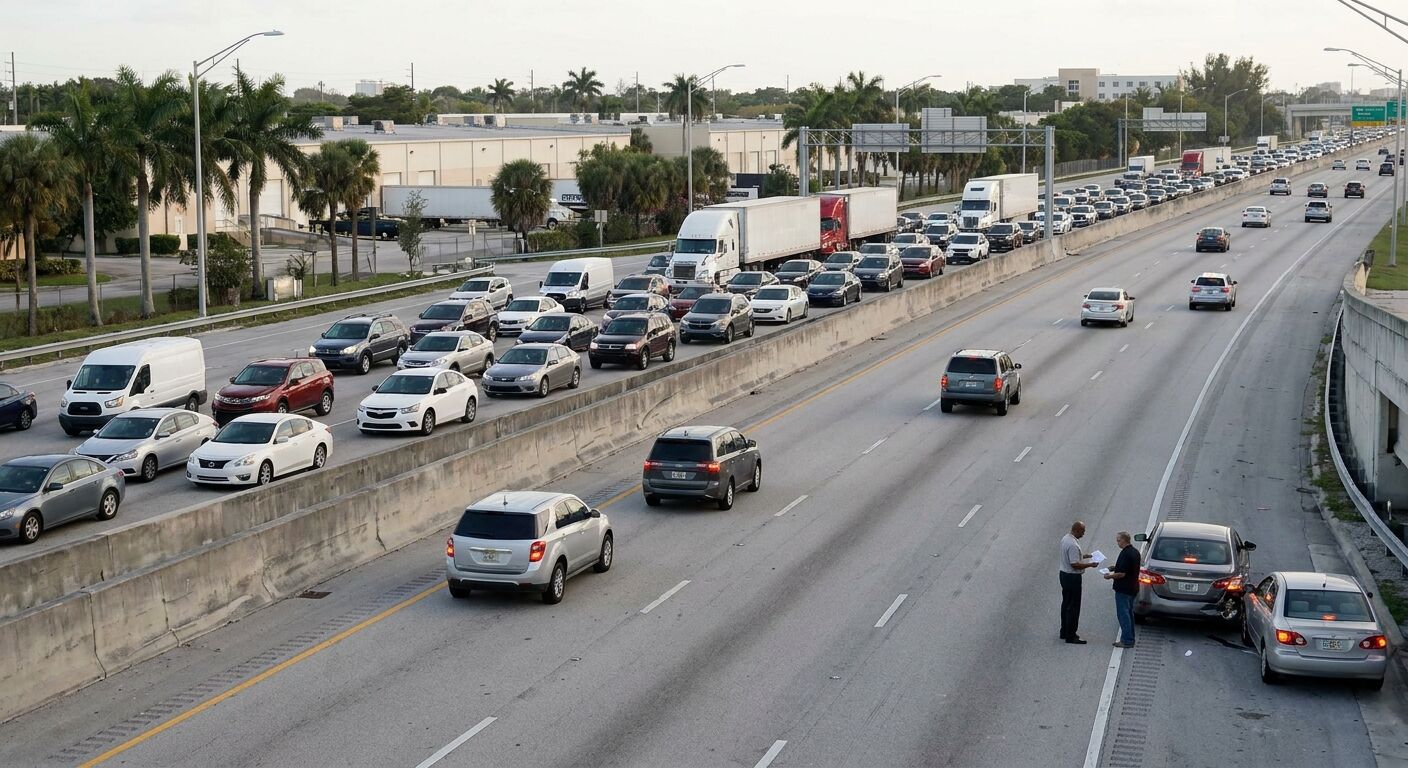
Ask any Miami driver to name the road they dread, and you will hear the same answer: the Palmetto. State Road 826 runs a 30-mile arc around the county, from the Golden Glades interchange down through Medley, Doral, and Westchester to US-1, and at its busiest stretches it carries on the order of a quarter million vehicles a day. It is the road almost everyone in this county has to use and almost no one feels safe on, and the crash data says that instinct is correct.
I have driven the Palmetto my whole career, and my firm has represented clients hurt on nearly every mile of it. The same locations come up again and again: the Dolphin interchange, Bird Road, Flagler Street, NW 103rd Street, the Golden Glades. Crash mapping data from Florida's Signal Four Analytics system tells the same story our case files do, because the Palmetto's dangers are not random. They are built into the road.
This article is my honest tour of SR-826: why it produces so many serious crashes, where they cluster, and what to do if one of them happens to you or your family. If it already has, Mausner Group Injury Lawyers is at 305-344-4878, and the consultation is free.
Why the Palmetto Is Different
Every busy highway has crashes. The Palmetto has a personality, and it comes from four design realities.
It was built for a smaller Miami. The Palmetto opened in stages beginning in the 1960s, sized for a county that no longer exists. Traffic has grown relentlessly while the road's basic geometry, short merges, tight interchange loops, left exits in places drivers do not expect, has stayed stubbornly mid-century, with construction projects perpetually trying to catch up.
It is a truck corridor. SR-826 is the spine connecting Medley and Doral's warehouse districts, the airport cargo belt, and every distribution operation in between. Heavy trucks share short merge lanes with commuters, and the stopping-distance physics I describe on our 18-wheeler accident page play out here daily.
It runs at extremes. The Palmetto alternates between stop-and-go compression and 80 mph weaving, sometimes within the same mile. That speed differential, not speed alone, is what produces the chain-reaction rear-end crashes that close lanes almost every rush hour.
Everyone on it is merging. With interchanges packed close together and express lane entrances added into the mix, a huge share of Palmetto traffic is always entering, exiting, or crossing lanes to do one or the other. Merging is where drivers fail, and the Palmetto is a 30-mile merge.
Where the Crashes Cluster
Our case files and the public crash data point to the same hot spots:
- The Dolphin interchange (SR-836). The junction of Miami's two busiest expressways, where westbound Dolphin traffic meets the Palmetto in a tangle of ramps and last-second lane changes
- Bird Road (SW 40th Street). Dense commercial traffic entering and exiting against heavy through-volume, with short acceleration lanes doing the work of long ones
- Flagler Street. The east-west artery of the county crossing its north-south workhorse, with ramp queues that back onto the mainline at peak hours
- NW 103rd Street and the Medley stretch. Where the truck corridor is at its most concentrated and rear-end crashes involve the heaviest vehicles on the road
- The Golden Glades. The five-highway interchange at the Palmetto's north end, which I would call the most confusing piece of pavement in Florida, and which rewards hesitation and punishes it at the same time
[ERIC: optional insert. If you have a specific stretch you avoid, a case pattern you have seen repeatedly at one of these interchanges, or a personal rule for driving the Palmetto, two or three sentences here make this piece unique and yours.]
The Crash Types the Palmetto Produces
The road's design shows up in the injuries. Chain-reaction rear-end crashes from the speed-to-stopped compression waves. Sideswipes and run-off-the-road crashes from last-second exits, the Palmetto specialty. Truck underride and jackknife crashes in the Medley-Doral stretch, which carry the catastrophic injuries our catastrophic injury practice covers. Motorcycle crashes in the weave, because riders are invisible in exactly the blind spots all that merging exposes, a pattern we covered in our Miami motorcycle accident causes guide. And a relentless share of hit-and-run, because fleeing on a road with a dozen exits a mile is depressingly practical. Those cases turn on the uninsured motorist coverage I hope every reader carries, and which we explained in our UM claims guide.
Fault Fights on a Road Like This
Palmetto crashes produce murkier fault disputes than surface-street collisions, because everyone was moving, merging, and reacting. Under Florida's comparative negligence rules, with the 51 percent bar deciding whether you recover at all, those disputes are now worth real money, and insurers work them hard. Three things decide them:
- Video. FDOT's traffic cameras, express lane systems, and the dashcams of other drivers capture more of the Palmetto than any road in the county. Footage must be requested fast, because retention windows are short.
- Vehicle data. Event data recorders fix speeds and braking in the seconds before impact, on cars and especially on the commercial trucks that dominate this corridor.
- Physical evidence and reconstruction. Lane positions, crush patterns, and debris fields answer the "who merged into whom" question drivers argue about at the scene.
The playbook after a Palmetto crash is the one we detail in our car accident practice: medical care immediately, photographs if you can safely take them, no recorded statements, and get counsel moving on the camera footage within days.
Driving It Anyway
Nobody can avoid the Palmetto, so drive it like the road it is: Leave the following distance the compression waves demand, commit to exits early or take the next one, assume every truck cannot see you until you can see its mirrors, and treat the express lane entrances like the merge hazards they are. None of that is legal advice. It is what thirty miles of case files teach.
If the Palmetto has already put you or someone you love in a hospital, the fault fight has already started on the insurer's side. Start yours. Mausner Group Injury Lawyers handles SR-826 crashes from the Golden Glades to US-1, and I look at every one of these cases personally.
Frequently Asked Questions About Palmetto Expressway Accidents
Is the Palmetto Expressway really Miami's most dangerous road?
It is consistently among the county's worst for crash frequency, a product of extreme traffic volume, dated interchange design, constant merging, and heavy truck traffic. Crash mapping data and our own case files both show serious collisions clustering at the Dolphin interchange, Bird Road, Flagler, NW 103rd, and the Golden Glades.
What should I do after an accident on the Palmetto?
Get to a safe position if your car is drivable, call 911, photograph what you safely can, and get medical care the same day. Then move quickly on evidence: FDOT camera footage and other drivers' dashcam video decide Palmetto fault disputes, and retention windows are measured in days.
Who is at fault in a merging accident on SR-826?
Generally the driver who changed lanes or entered when it was unsafe, but Palmetto merges produce genuine disputes where both drivers were moving. Vehicle data, camera footage, and physical evidence resolve them, and under Florida's comparative fault rules, the percentage assigned to each driver directly changes the recovery.
What if I was hit by a truck on the Palmetto?
The Medley-Doral stretch makes truck crashes a Palmetto signature, and those cases involve federal regulations, electronic evidence on the truck, and trucking company insurance far larger than ordinary auto policies. They are built differently from car cases, and they should be handled by lawyers who build them that way.
What if the driver who hit me fled?
Hit and run is common on SR-826 because exits come every minute. Report the crash to police immediately, preserve any dashcam or witness evidence of the vehicle, and look to the uninsured motorist coverage on your own policy, which treats an unidentified driver as an uninsured one.
How long do I have to file a claim after a Palmetto crash?
Two years under Florida's statute of limitations, but the camera footage, vehicle data, and witness evidence that actually win these cases can be gone within weeks. The effective deadline for protecting a Palmetto case is the first days after the crash.
A Personal Note on This Road
I have spent my career a few exits from the Palmetto, and I have sat with too many families whose lives changed between two of its interchanges. If that is your family, call me. We will find out what the cameras saw, what the data shows, and what your case is actually worth.
Mausner Group Injury Lawyers, 305-344-4878. Free consultations, 24 hours a day, in English or Spanish. You pay nothing unless we win.
This article is for general informational purposes only and does not constitute legal advice. Crash pattern references draw on Florida DOT traffic data and the University of Florida's Signal Four Analytics crash mapping platform, along with the firm's case experience. Florida law referenced includes Fla. Stat. 768.81, 627.727, and 95.11. Laws change; consult a licensed Florida attorney for advice specific to your situation.
