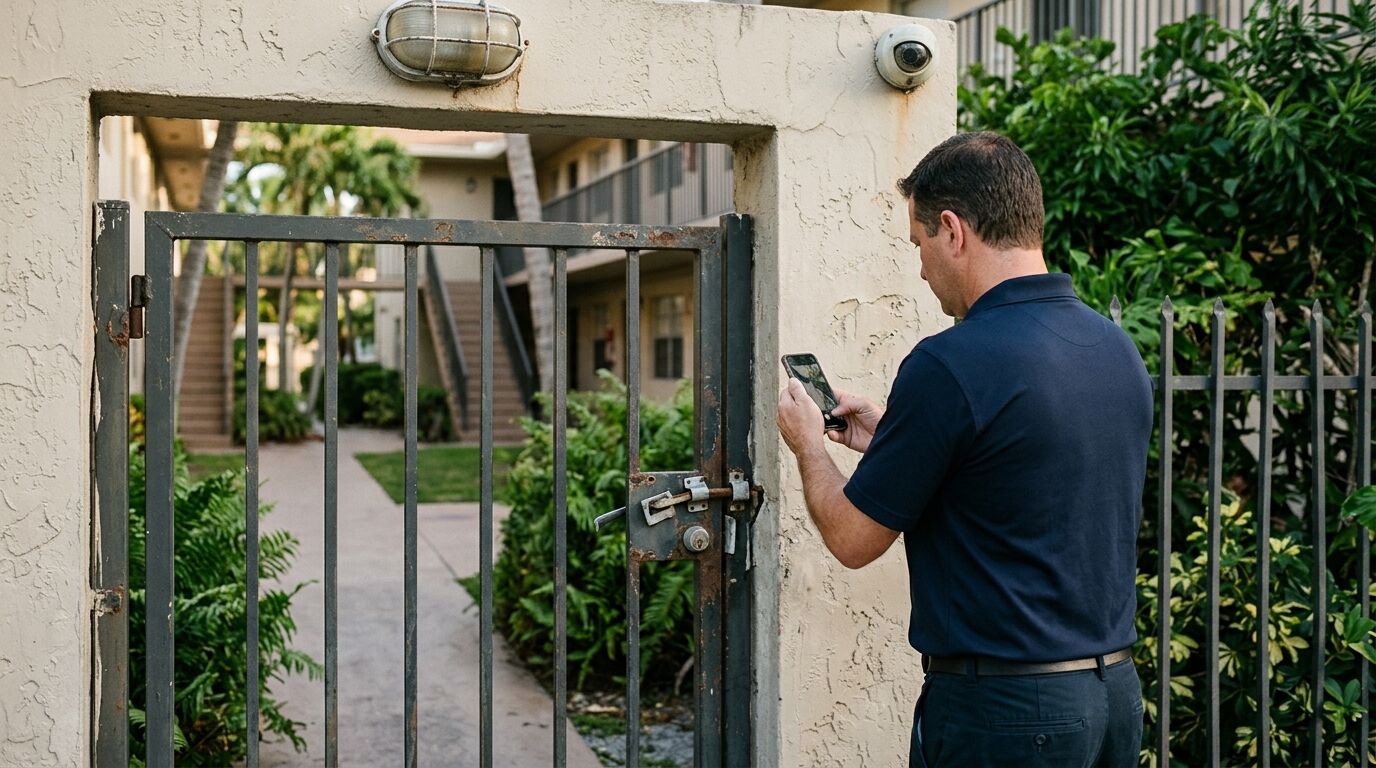
A negligent security case is proven the same way every negligence case is proven, with four elements: the property owner owed you a duty, the crime that hurt you was foreseeable, the owner's security fell below reasonable care, and that failure actually contributed to what happened. What makes these cases different is where the proof lives. Almost all of it sits in records you have never seen: police dispatch logs, the property's incident files, security contracts, staffing schedules, and camera systems the owner controls.
That is why "Can I prove it?" is the wrong first question for a crime victim to agonize over. The honest answer is that nobody can prove a negligent security case on day one. These cases are built, piece by piece, through records requests, subpoenas, and expert analysis, and the victims who win are the ones whose lawyers started building early, before footage cycled and memories faded.
This article walks through each of the four proofs and the specific evidence that establishes it, continuing the framework we laid out in our guide to foreseeability and prior crime. If you or a family member was attacked at a business, apartment complex, hotel, or parking facility anywhere in South Florida, the seguridad negligente Abogados de Miami at Mausner Group Injury Lawyers offer free, confidential consultations.
Proof One: The Property Owed You a Duty
The first element is usually the simplest. Florida businesses and landlords owe invited visitors, customers, tenants, hotel guests, and patrons, reasonable protection from foreseeable harm on their premises. Proving duty means proving your status and the owner's control: You were there legitimately, and the defendant owned, operated, or controlled the place where the attack happened.
Control is where defendants wiggle. The attack happened in the parking lot, and the store says the lot belongs to the landlord; the garage operator points at the security contractor; the bar says the sidewalk line is the city's problem. The answer lives in leases, management agreements, and security contracts, which define who was responsible for what, and these cases routinely name several defendants whose documents point at each other. We covered the same control question for falls in our parking facility article, and it matters doubly when the hazard is crime.
Proof Two: The Crime Was Foreseeable
Foreseeability is the heart of the case, and we devoted a full article to it. In short, Florida courts ask whether prior crime at and around the property, or the totality of circumstances, put the owner on notice that violence was a real risk. The evidence:
- Police calls-for-service records for the address, often hundreds of entries
- Incident-level crime grid data for the surrounding blocks
- The property's own internal incident reports and tenant or guest complaints
- Prior lawsuits and insurance claims against the property
- Security assessments the owner commissioned and shelved
One addition to what we covered before: the burden of assembling this record falls on the victim's side, and it is real work. Calls-for-service requests go to the police agency, crime mapping gets pulled and analyzed, and prior incidents get found through discovery demands the owner will resist. This is the stage where an unrepresented claim quietly dies.
Proof Three: The Security Fell Below Reasonable Care
Duty and foreseeability establish that the owner should have done something. The third proof establishes what, and that they did not do it. This is where security expert testimony carries the case.
A qualified security expert, typically a career professional in premises security or law enforcement, compares what the property had against what the foreseeable risk demanded: staffing levels and post placement, camera coverage and whether anyone monitored it, lighting measured in actual foot-candles, access control at gates and doors, and written security policies versus the practice on the ground the night you were hurt. The gap between the two is the breach.
The owner's own documents make the best exhibits. A security contract cut from five guards to two the year before the attack. A camera system with four dead cameras noted in maintenance logs for months. A lighting survey recommending fixtures that were never installed. Under the HB 837 framework, we explained in the Artículo sobre previsibilidad, apartment owners who implemented the statutory checklist get a presumption against liability, which means the checklist items an owner skipped become a ready-made breach list, written by the Legislature itself.
Proof Four: The Failure Caused the Harm
The defense's favorite argument arrives here: "The crime would have happened anyway." Causation in negligent security means showing that reasonable security would more likely than not have prevented or deterred this attack, and it is proven with specifics, not speculation:
- Time and opportunity. An assault that unfolded over ten minutes in an unpatrolled garage reads differently than a split-second ambush. The longer the incident, the harder "nothing would have helped" is to sustain.
- Entry and access. An attacker who walked through a broken gate, a propped door, or an unstaffed entrance connects the breach to the crime directly.
- Deterrence evidence. Security literature and expert testimony on how visible guards, lighting, and cameras change criminal behavior, paired with the attacker's own conduct, choosing the dark corner, avoiding the staffed lobby.
- The attacker's statements. When the assailant is caught, what they say about why they chose that location can become causation evidence.
Florida juries may also assign a share of fault to the criminal attacker, which the defense always requests. The counter is a causation case built so tightly on the owner's specific failures that the jury sees two wrongdoers, not one, and prices the owner's share accordingly.
What This Looks Like on a Timeline
The first two weeks decide more than the next two years: preservation letters for camera footage (which cycles in days), photographs of the lighting and access points as they existed that night, and witness statements before people scatter. The first two months build the records: calls for service, crime data, leases and contracts, incident files. The expert work follows, and the demand goes out only when all four proofs are documented. Our seguridad negligente Página de prácticas covers how we run these cases, and the two-year deadline from our plazo de prescripción guía runs regardless of how long the criminal case takes, a trap that catches victims who wait for the prosecution to finish before calling a civil lawyer.
The victim's job in all of this is small and important: Get medical care, keep everything (clothing, photos, discharge papers, the police report number), write down what you remember while it is fresh, and do not give statements to the property's insurer. The building of the case is the lawyer's job, which is why consultations cost nothing and the right time for one is now rather than later.
Frequently Asked Questions About Proving Negligent Security
What do I have to prove in a negligent security case?
Four things: The property owner owed you a duty of reasonable protection, the crime was foreseeable based on prior incidents or surrounding circumstances, the security provided fell below what the risk demanded, and that failure contributed to the attack. Each element is built on specific records and expert analysis.
What evidence is used to prove a negligent security claim?
Police calls-for-service logs, area crime data, the property's internal incident reports, leases and security contracts, staffing schedules, camera footage and maintenance records, lighting measurements, and security expert testimony comparing what existed against what the foreseeable risk required.
Do I need the criminal to be caught or convicted to win?
No. The civil case targets the property owner's failures, not the attacker, and proceeds whether or not the assailant is ever identified. Many successful negligent security cases involve attackers who were never caught.
How do lawyers prove the attack could have been prevented?
Through causation evidence: how the attacker got in, how long the incident lasted, where it happened relative to guards, cameras, and lighting, and expert testimony on deterrence. The more the attack exploited a specific security failure, the stronger the causation proof.
What is a security expert witness?
A premises security professional, often with law enforcement or corporate security background, who evaluates the property's measures against industry standards and the foreseeable risk, and testifies to the gap. Expert testimony is effectively required in contested negligent security cases.
How long do I have to file a negligent security lawsuit in Florida?
Two years from the attack in most cases, and the deadline runs even while a criminal prosecution is pending. The practical window is far shorter, because camera footage and witness availability disappear within weeks. Early investigation protects the claim without committing you to anything.
Attacked Somewhere That Should Have Protected You? Find Out What Your Case Needs
The proof of your case is sitting in the property's own files, and every week it sits there is a week it can disappear. Eric J. Mausner spent years as a prosecutor proving crimes; now he proves the security failures that allowed them. Mausner Group Injury Lawyers handles negligent security cases across Miami-Dade and South Florida.
Llamar 305-344-4878 for a free, confidential consultation, available 24/7, in English or Spanish. You pay nothing unless we win.
Este artículo tiene como objetivo proporcionar información general y no constituye asesoramiento jurídico. Los términos legales mencionados incluyen la Florida Stat. 768.0706 y la Florida Stat. 95.11, en su versión enmendada por la HB 837 (2023), así como la responsabilidad del propietario jurisprudencia de Florida. Las leyes pueden cambiar; consulte a un abogado con licencia de Florida para obtener asesoramiento específico para su situación.
